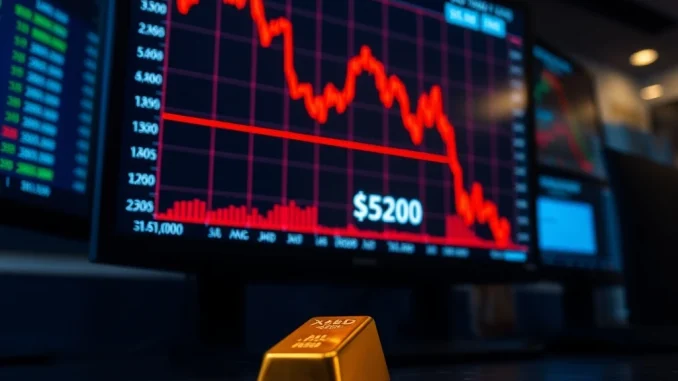
Spot Gold Price Plummets: A Stunning 5.45% Correction to $5,200 Shakes Markets
Global Markets, April 2025: The spot gold price has experienced a stunning correction, falling sharply by 5.45% to trade at the $5,200 per ounce level. This significant single-day move, reported by financial outlets including Cointelegraph, represents one of the most pronounced declines for the precious metal in recent years, sending ripples through global commodity and financial markets. The drop prompts immediate analysis from traders and economists seeking to understand the drivers behind the sudden shift in sentiment toward the traditional safe-haven asset.
Spot Gold Price Plunge: Analyzing the Immediate Data
The reported 5.45% decline in the spot gold price is a substantial move for an asset known for its relative stability compared to equities or cryptocurrencies. A drop of this magnitude erases weeks or even months of incremental gains in a single session. Trading at the $5,200 level places gold significantly below recent psychological and technical support zones that market participants had been monitoring. The spot price, which reflects the current market price for immediate delivery, is the most sensitive benchmark, reacting instantly to global news, currency fluctuations, and changes in investor appetite. This move was characterized by high trading volume, indicating broad participation and a decisive shift in market positioning rather than an isolated event.
Historical Context of Gold Market Corrections
While dramatic, sharp corrections are not unprecedented in the gold market. Historical analysis provides crucial context for understanding the current volatility.
- 2013 Taper Tantrum: Following signals from the U.S. Federal Reserve about reducing quantitative easing, gold fell over 25% in a matter of months, a move driven by rising real interest rate expectations.
- 2020 COVID-19 Liquidity Crisis: In March 2020, gold initially sold off sharply alongside nearly all assets as investors scrambled for U.S. dollar cash liquidity, before embarking on a historic rally.
- 2022-2023 Rate Hike Cycle: Aggressive interest rate hikes by central banks globally created strong headwinds for non-yielding assets like gold, leading to periods of sustained pressure.
The current 5.45% single-day drop is notable for its speed, echoing the pace of moves seen during acute market stress events, even if the broader macroeconomic backdrop may differ.
Potential Catalysts for the Sudden Decline
Market analysts point to a confluence of factors that likely contributed to the aggressive sell-off in spot gold. A primary driver appears to be a sudden and sharp rally in the U.S. Dollar Index (DXY), as gold is priced in dollars and becomes more expensive for holders of other currencies when the dollar strengthens. Concurrently, a spike in U.S. Treasury bond yields, particularly on the long end of the curve, increases the opportunity cost of holding gold, which offers no yield. Furthermore, a wave of better-than-expected economic data from major economies may have reduced immediate fears of a deep recession, temporarily diminishing gold’s appeal as a defensive asset. Technical selling likely accelerated the move once key support levels were breached, triggering automated sell orders.
Implications for Investors and the Broader Financial System
The dramatic move in the spot gold price carries several important implications. For portfolio managers, it serves as a stark reminder of the volatility inherent even in traditional safe havens, challenging the notion of “set-and-forget” asset allocation. The decline may also signal a broader rotation in market sentiment, where capital flows out of perceived stores of value and into riskier, yield-generating assets or back into cash. Central banks, which have been consistent net buyers of gold in recent years to diversify reserves, will scrutinize this move closely, though their long-term strategic purchasing programs are unlikely to be swayed by short-term volatility. The event also impacts related markets, including gold mining equities, which typically exhibit leveraged moves relative to the underlying metal, and gold-backed financial products like ETFs.
| Date | Approximate Move | Primary Catalyst |
|---|---|---|
| March 2020 | -4.5% | Global liquidity scramble |
| June 2021 | -5.7% | Strong USD, Fed policy shift signals |
| November 2022 | -3.5% | Robust U.S. jobs data |
| April 2025 | -5.45% | Strong USD, yield spike, technical breakdown |
The Role of Technical Analysis and Market Psychology
Beyond fundamentals, market psychology and technical levels played a critical role in amplifying the spot gold price decline. The $5,300-$5,400 zone had been identified by many chart analysts as a major support area, representing a convergence of moving averages and previous price reaction points. The breach of this zone likely triggered a cascade of stop-loss orders from leveraged traders and algorithmic systems, creating a self-reinforcing wave of selling pressure. This phenomenon, known as a “liquidation cascade,” can drive prices far beyond levels justified by fundamental news alone in the short term, creating potential dislocations and opportunities for contrarian buyers.
Conclusion
The spot gold price correction of 5.45% to $5,200 is a significant market event that underscores the dynamic and interconnected nature of global finance. While the immediate catalysts point to a strong U.S. dollar and rising yields, the move’s severity was amplified by technical breakdowns and shifts in market sentiment. For long-term investors, such volatility tests conviction but does not necessarily alter the fundamental arguments for holding gold as a portfolio diversifier and hedge against systemic risk. The coming days will be crucial in determining whether this represents a healthy correction within a longer-term uptrend or the beginning of a more profound shift in the precious metals complex. Monitoring central bank commentary, inflation data, and currency markets will be key to understanding the next direction for the spot gold price.
FAQs
Q1: What does “spot gold price” mean?
The spot gold price is the current market price at which gold can be bought or sold for immediate delivery and payment. It is the benchmark price for physical gold and many financial derivatives, fluctuating continuously based on global supply and demand.
Q2: Why does a stronger U.S. dollar typically hurt the gold price?
Gold is globally priced in U.S. dollars. When the dollar strengthens, it takes fewer dollars to buy an ounce of gold, making it cheaper in dollar terms. Conversely, and more relevantly, a stronger dollar makes gold more expensive for buyers using other currencies, which can reduce international demand and put downward pressure on the dollar-denominated price.
Q3: Is a 5.45% drop considered a crash for gold?
While very significant, a single-day drop of this size is generally termed a sharp correction or a plunge. A “crash” is typically reserved for more sustained, multi-day collapses of a much larger magnitude (e.g., 20%+ over a short period). However, it is among the larger single-day percentage declines seen in the past decade.
Q4: How does this affect people who own physical gold coins or bars?
The market value of their holdings has decreased proportionally with the spot price. For those holding physical gold as a long-term store of value or insurance, short-term paper market fluctuations are less relevant than for traders. The intrinsic value of the metal remains, but its immediate resale value is lower.
Q5: Could this price drop present a buying opportunity?
Some investors and analysts view sharp corrections in a long-term bull market as potential buying opportunities, a concept known as “buying the dip.” However, this depends entirely on one’s view of the future direction of interest rates, inflation, and the U.S. dollar. It carries significant risk if the downward trend continues.
Q6: What assets typically move opposite to gold?
There is no perfect inverse correlation, but assets that often move opposite to gold during risk-on periods include major stock market indices (like the S&P 500), the U.S. dollar (USD), and, importantly, U.S. Treasury bond yields (when yields rise, gold often falls).
Related News
- Bitcoin Options Market Reveals Stunning Fear as Delta Skew Spikes to One-Year High
- Strategic Partnership: How ATT Global and Waves AI Are Redefining Web3 Cultural Identity and Advertising
- Kraken Acquisition: Strategic Move Bolsters Crypto Trading Platform Capabilities
Related: Goldman Sachs CEO David Solomon Reveals: I Personally Own Bitcoin
Related: Bitcoin Dominance Weakens: Revealing Early Signals of an Ethereum-Led Market Phase