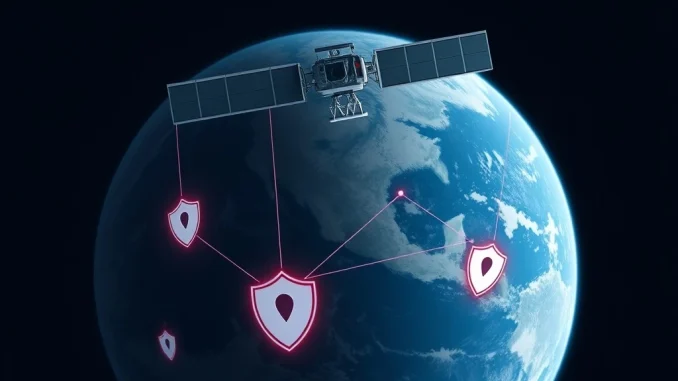
SpaceCoin and Midnight Forge Revolutionary Satellite Privacy Messaging Alliance
Global, March 2025: In a significant development for decentralized infrastructure, SpaceCoin (SPACE) has announced a strategic partnership with Midnight, the privacy-focused blockchain led by Cardano founder Charles Hoskinson. The collaboration aims to conduct a comprehensive joint review for developing privacy messaging technology that leverages satellite infrastructure, marking a potential breakthrough in censorship-resistant communication.
SpaceCoin and Midnight Announce Satellite Privacy Messaging Partnership
The decentralized satellite internet project SpaceCoin revealed its partnership with Midnight this week, initiating what both organizations describe as a “technical deep dive” into satellite-based privacy solutions. According to official statements, the initial priority involves implementing a peer-to-peer messaging application that operates independently of centralized servers. This approach fundamentally differs from traditional messaging platforms that rely on data centers and corporate infrastructure.
SpaceCoin has been developing satellite-based internet connectivity since its inception, focusing on creating decentralized network infrastructure that can operate outside traditional terrestrial systems. The project utilizes a constellation of low-earth orbit satellites to provide internet access, particularly targeting regions with limited connectivity. Midnight, launched by Input Output Global (IOG) and Charles Hoskinson in 2023, specializes in privacy-preserving blockchain technology that enables developers to build data-protective decentralized applications (dApps).
Technical Framework and Zero-Knowledge Proof Integration
The collaboration will explore integrating Midnight’s zero-knowledge proof (ZKP) technology with SpaceCoin’s satellite infrastructure. Zero-knowledge proofs represent a cryptographic method that allows one party to prove to another that a statement is true without revealing any information beyond the validity of the statement itself. In practical terms for messaging, this technology could enable users to verify their authorization to communicate without exposing sensitive metadata such as identity, location, or connection patterns.
Industry experts note several technical advantages to this approach. Satellite-based communication inherently provides broader geographical coverage than terrestrial networks, particularly in remote or politically sensitive regions. When combined with ZKP technology, the system could theoretically enable private communications that are both difficult to intercept and challenging to attribute to specific individuals or locations. The partnership’s technical review will examine implementation challenges including latency considerations, bandwidth limitations of satellite networks, and the computational requirements of zero-knowledge proofs in resource-constrained environments.
- Satellite Infrastructure: SpaceCoin’s decentralized satellite network provides the physical communication layer
- Privacy Protocol: Midnight’s blockchain implements zero-knowledge proofs for authorization and verification
- Decentralized Architecture: Peer-to-peer design eliminates single points of failure and control
- Metadata Protection: ZKP technology minimizes exposure of user identity and location data
Historical Context of Satellite Communication Projects
The concept of satellite-based decentralized communication has historical precedents in both the cryptocurrency and telecommunications sectors. Projects like Blockstream Satellite, launched in 2017, demonstrated the feasibility of broadcasting Bitcoin blockchain data via satellite to provide network access in areas without reliable internet connectivity. Similarly, initiatives such as the Outernet project (now known as Othernet) have explored satellite-based content delivery for educational and informational purposes in underserved regions.
What distinguishes the SpaceCoin-Midnight collaboration is its specific focus on privacy-preserving messaging rather than general data broadcasting. The partnership emerges during a period of increasing global concern about digital surveillance, data privacy regulations, and internet fragmentation. Recent years have seen growing interest in decentralized communication protocols, with projects like Matrix, Session, and Briar gaining attention for their serverless or federated architectures. However, none have yet successfully integrated satellite infrastructure with advanced zero-knowledge cryptography at scale.
Industry Implications and Regulatory Considerations
The announcement has generated discussion within both the blockchain and telecommunications sectors regarding potential applications and challenges. Satellite-based privacy messaging could theoretically serve several use cases including humanitarian communications in conflict zones, secure messaging for journalists and activists operating under repressive regimes, and backup communication channels during natural disasters that disrupt terrestrial networks.
Regulatory considerations present significant questions for such technology. Satellite communications typically fall under both national telecommunications regulations and international agreements through organizations like the International Telecommunication Union (ITU). Privacy-focused messaging systems using cryptographic protections have historically faced scrutiny from governments concerned about law enforcement access and national security implications. The decentralized nature of both SpaceCoin’s satellite network and Midnight’s blockchain architecture may complicate traditional regulatory approaches that typically focus on centralized service providers.
Technical analysts point to several implementation challenges the partnership must address. Satellite communication inherently involves higher latency than terrestrial fiber optic networks, which could impact real-time messaging applications. Bandwidth limitations may constrain the volume of messages or require efficient data compression techniques. Additionally, the energy requirements for both satellite operation and zero-knowledge proof computation present sustainability considerations that the technical review will likely examine.
Expert Perspectives on the Technical Feasibility
Cryptography specialists familiar with zero-knowledge proof implementations note that recent advancements have significantly improved the efficiency of these systems. “ZK-SNARKs and related technologies have seen remarkable optimization in recent years,” explains Dr. Anya Petrova, a cryptography researcher at the University of Cambridge. “What was once computationally prohibitive for consumer applications is now becoming feasible, though satellite environments present unique constraints regarding power and processing capabilities.”
Satellite communication engineers highlight additional considerations. “Low-earth orbit satellite constellations like those proposed by SpaceCoin typically offer lower latency than geostationary systems, but they still face challenges with intermittent connectivity as satellites pass overhead,” notes Marcus Chen, a satellite systems engineer with fifteen years of industry experience. “For messaging applications, this might require sophisticated store-and-forward mechanisms or mesh networking approaches between satellites.”
Development Timeline and Project Roadmap
According to statements from both organizations, the partnership will proceed through several phases beginning with the current joint technical review. This initial phase, expected to last three to six months, will involve feasibility studies, protocol design, and preliminary testing. Following this review, the teams plan to develop a prototype implementation for laboratory testing, then progress to limited field trials using SpaceCoin’s existing satellite infrastructure.
The development approach appears methodical rather than rushed, with both organizations emphasizing thorough technical evaluation before committing to specific implementation paths. This cautious methodology reflects lessons learned from earlier blockchain projects that sometimes prioritized rapid deployment over robust engineering. Industry observers note that Charles Hoskinson’s involvement through Midnight suggests a focus on academic rigor and peer-reviewed approaches, consistent with his previous work on Cardano and its research-driven development philosophy.
Potential milestones for the project include:
| Phase | Timeframe | Key Objectives |
|---|---|---|
| Technical Review | Q2-Q3 2025 | Feasibility analysis, protocol design, resource assessment |
| Prototype Development | Q4 2025-Q1 2026 | Laboratory implementation, basic functionality testing |
| Limited Field Trials | Q2-Q3 2026 | Satellite integration testing, performance evaluation |
| Public Test Network | Q4 2026 onward | Expanded testing, security audits, community feedback |
Conclusion
The partnership between SpaceCoin and Midnight represents a convergence of two significant technological trends: decentralized satellite infrastructure and privacy-preserving cryptography. While the project faces substantial technical and regulatory challenges, its potential implications for secure, censorship-resistant communication warrant serious attention. The collaboration’s focus on thorough technical review before implementation suggests a responsible approach to innovation in a sensitive domain. As the joint evaluation progresses throughout 2025, the blockchain and telecommunications communities will monitor developments closely, recognizing that successful satellite privacy messaging could establish new paradigms for digital communication in an increasingly fragmented and surveilled internet landscape.
FAQs
Q1: What is the main goal of the SpaceCoin and Midnight partnership?
The primary objective is to develop and implement a satellite-based privacy messaging system that uses zero-knowledge proofs to protect user identity and location data while operating without centralized servers.
Q2: How does zero-knowledge proof technology work in messaging applications?
Zero-knowledge proofs allow users to cryptographically prove they are authorized to communicate without revealing who they are, where they are located, or other identifying metadata, thereby enhancing privacy beyond traditional encryption.
Q3: What advantages does satellite infrastructure offer for private messaging?
Satellite networks can provide communication coverage in areas without reliable terrestrial internet, are less vulnerable to localized network shutdowns, and can implement decentralized architectures that lack single points of control or failure.
Q4: Who is leading the Midnight blockchain project?
Midnight is led by Charles Hoskinson, who co-founded Ethereum and founded Cardano (ADA). The project operates under Input Output Global (IOG), the company behind Cardano’s development.
Q5: What are the main technical challenges for satellite-based privacy messaging?
Key challenges include managing higher latency in satellite communications, working within bandwidth constraints, ensuring efficient computation of zero-knowledge proofs with limited resources, and maintaining connectivity with moving low-earth orbit satellites.
Q6: When might this technology become publicly available?
Based on the announced roadmap, limited field trials might begin in 2026, with broader availability dependent on the results of technical reviews and testing phases currently underway.
Related News
- Liquid Mercury and dVIN Labs Partner to Launch Investment-Grade Wine Trading Platform
- Innovation Meets Opportunity At The Villa’s Elevator Pitch Battle
- Caroline Ellison's Stunning Prison Release: Former Alameda CEO Freed 30 Days Early After 440-Day Sentence
Related: CELO Price Drops 7.06%: Analyzing the Bearish Outlook Amid Weakening Network Activity
Related: Arthur Hayes HYPE Accumulation: Decoding the $1 Million On-Chain Transaction
Related: Crypto Presale Analysis: Five Projects Attracting Early Interest Amid Stalled Market Caps