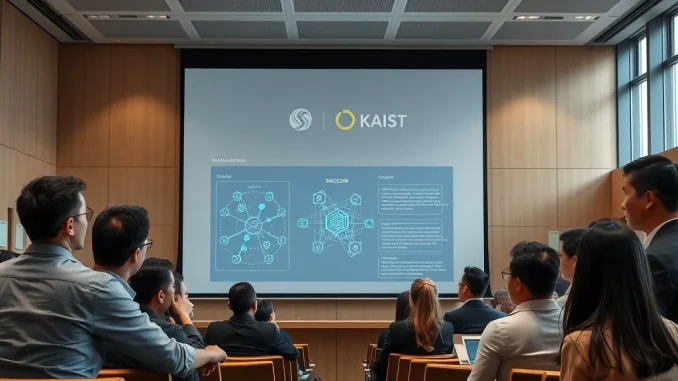
Daejeon, South Korea, April 2025: In a significant move bridging academic research and cutting-edge blockchain infrastructure, the decentralized satellite internet project Spacecoin (SPACE) recently convened a high-level technology seminar with the prestigious School of Electrical Engineering at the Korea Advanced Institute of Science and Technology (KAIST). The event, held on KAIST’s main campus, marks a pivotal step for the ambitious SpaceNetwork initiative, bringing together project leadership and top-tier academic minds to scrutinize its technical vision and implementation roadmap. This collaboration underscores a growing trend where foundational cryptocurrency projects seek rigorous academic validation and engineering expertise to solve complex real-world problems.
Spacecoin and KAIST Forge a Strategic Technical Alliance
The seminar represented more than a standard presentation. It functioned as a deep-dive technical review and collaborative workshop. Attendees included Spacecoin founder Taelim Oh and an advisory group comprising former senior engineers from Samsung Electronics, a detail that highlights the project’s focus on hardware and systems-level engineering. On the academic side, members from research labs led by five distinguished KAIST professors participated, including the noted Professor Jun-hyuk Kang. This composition created a forum where theoretical computer science, electrical engineering, and practical systems deployment intersected. The primary agenda centered on the architectural plans for SpaceNetwork, a proposed constellation of low-earth orbit (LEO) satellites designed to provide internet access, with the Spacecoin blockchain acting as a decentralized governance and incentive layer for network operation and data routing.
The Technical Vision Behind Spacecoin’s Decentralized Network
Spacecoin’s core proposition involves decentralizing a traditionally centralized and capital-intensive sector: global satellite communications. The project’s whitepaper and technical documents outline a system where:
- Satellite Nodes: Entities can operate satellite ground stations or potentially host payloads on satellites, earning SPACE tokens for relaying data and providing bandwidth.
- Blockchain Governance: The Spacecoin blockchain records transactions, manages access rights, and facilitates micropayments for network usage through smart contracts, removing single corporate control.
- Network Resilience: A decentralized node network aims to be more resistant to censorship, single points of failure, and targeted infrastructure attacks compared to traditional models like those operated by Starlink or OneWeb.
The seminar at KAIST likely involved detailed discussions on the immense technical hurdles, including signal processing for satellite-to-ground communication, the cryptographic protocols for secure and private data transit over a public blockchain ledger, and the economic tokenomics required to incentivize a globally distributed physical infrastructure. Engaging with KAIST’s experts in fields like network theory, signal processing, and embedded systems is a logical step for a project transitioning from concept to viable engineering challenge.
Context: The Convergence of Academia and Cryptocurrency Development
This event is part of a broader, industry-wide maturation. Early cryptocurrency projects often operated in relative isolation from established academic institutions. However, as the space evolves to tackle problems in supply chain, identity, and—as with Spacecoin—physical infrastructure, formal research partnerships have become increasingly common. Universities like MIT, Stanford, and now KAIST are becoming critical testing grounds for the cryptographic and systems engineering claims of blockchain projects. For KAIST, a leader in robotics, engineering, and technology in Asia, partnering with an ambitious project like Spacecoin offers students and faculty direct exposure to frontier applications of blockchain technology beyond finance. It provides real-world problems for research labs to model and analyze, creating a symbiotic relationship between theoretical advancement and practical implementation.
Implications for the Blockchain and Telecommunications Landscape
The serious academic engagement signaled by this seminar carries several implications. First, it suggests that Spacecoin is pursuing a path of technical substantiation, seeking critique and input from experts unaffiliated with the project. This can enhance the project’s credibility and identify potential flaws early in the development cycle. Second, it highlights the expanding definition of “blockchain utility.” Moving from decentralized finance (DeFi) and digital art to governing global telecommunications infrastructure represents a quantum leap in ambition and complexity. Success in this domain would demonstrate blockchain’s capacity to coordinate physical-world assets at a massive scale. Conversely, the challenges are formidable, involving not just software but aerospace engineering, international regulation, and spectrum licensing.
The involvement of former Samsung Electronics engineers is another critical data point. Samsung’s expertise in mass-producing reliable, cost-effective hardware for global markets is unparalleled. If Spacecoin’s network requires specialized consumer or industrial hardware for ground stations, tapping into this pool of experience is a strategic necessity. It bridges the gap between a software protocol and the physical devices needed to interact with it.
Conclusion
The technology seminar between Spacecoin and KAIST’s School of Electrical Engineering is a noteworthy development in the blockchain sector. It transcends promotional announcement and enters the realm of technical due diligence and collaborative research. By subjecting its SpaceNetwork plans to scrutiny by one of Asia’s premier engineering institutions, Spacecoin is adopting a methodology more common in deep-tech startups than in cryptocurrency. This partnership does not guarantee the project’s success—the technical and logistical hurdles for a decentralized satellite internet remain immense. However, it does indicate a serious, research-oriented approach to solving those problems. The outcome of such academic-industry collaborations will be a key factor in determining whether blockchain technology can truly underpin the next generation of global communications infrastructure.
FAQs
Q1: What is the primary goal of Spacecoin’s SpaceNetwork?
A1: The primary goal is to create a decentralized satellite internet network. It aims to use a constellation of satellites and a blockchain-based governance system to provide global internet access, potentially increasing resilience and reducing reliance on centralized corporate or government-controlled infrastructure.
Q2: Why is KAIST’s involvement significant for this project?
A2: KAIST is one of South Korea’s and Asia’s leading research universities in science and technology. Its involvement provides Spacecoin with access to top-tier engineering expertise, rigorous academic validation, and research capabilities critical for tackling the complex signal processing, networking, and systems integration challenges inherent in building a satellite network.
Q3: How does blockchain technology integrate with a satellite internet system?
A3: The blockchain is intended to act as the network’s coordination layer. It would manage identities, record service provision (like data relayed by a ground station), facilitate micropayments between users and service providers using SPACE tokens, and enable decentralized governance decisions about network upgrades and parameters through smart contracts.
Q4: What are the major challenges facing a decentralized satellite internet project?
A4: Major challenges include the enormous cost and complexity of launching and maintaining satellites, securing necessary radio spectrum licenses internationally, developing energy-efficient and reliable ground station hardware, ensuring low-latency data routing via a decentralized system, and creating a sustainable economic model that incentivizes all participants to build and maintain the physical network.
Q5: How does this collaboration reflect broader trends in the cryptocurrency industry?
A5: It reflects a trend of maturation, where projects building complex systems are increasingly seeking partnerships with established academic and research institutions. This shift moves beyond pure software development towards integrating with real-world engineering disciplines, aiming for greater credibility, innovation, and practical problem-solving.