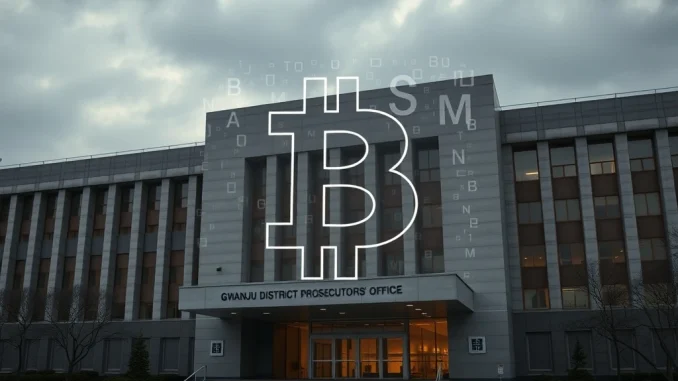
In a stunning development that exposes critical vulnerabilities in law enforcement’s handling of digital evidence, South Korean prosecutors have lost a massive quantity of seized Bitcoin, with its value estimated in the tens of billions of won. The Gwangju District Prosecutors’ Office confirmed the catastrophic custody failure on January 22, 2025, following an exclusive report by OhmyNews, triggering an urgent internal investigation and sending shockwaves through the nation’s legal and cryptocurrency communities. This incident represents one of the most significant losses of seized digital assets by a government agency globally, raising profound questions about protocol, security, and accountability.
Anatomy of a Digital Asset Custody Failure
The Gwangju District Prosecutors’ Office has not disclosed the precise quantity of lost Bitcoin. However, the confirmed valuation in the “tens of billions of won” places the loss at a minimum of approximately 10 billion KRW, equivalent to roughly $7.5 million USD, and potentially far higher. Authorities seized the cryptocurrency during a prior, unspecified criminal investigation. Consequently, the assets fell under the legal responsibility of the prosecution service for secure holding as evidence or for eventual forfeiture to the state.
An internal investigation is now actively underway to determine the cause. Potential scenarios under examination include:
- Technical Failure: Loss of private keys required to access the Bitcoin wallets.
- Security Breach: External hacking of the storage system.
- Procedural Error: Mishandling during transfer or mismanagement of access credentials.
- Internal Malfeasance: The possibility of insider involvement.
This event starkly highlights the complex challenge governments face. Unlike physical cash or gold, cryptocurrency exists as entries on a blockchain, accessible only through cryptographic keys. Therefore, losing these keys equates to permanently losing the asset, with little hope of recovery.
South Korea’s Evolving Cryptocurrency Landscape
This loss occurs against a backdrop of South Korea’s rigorous and evolving approach to digital asset regulation. The nation is a global cryptocurrency hub, with high retail adoption and a developed exchange ecosystem. In response, regulators have implemented strict know-your-customer (KYC) and anti-money laundering (AML) frameworks. The Travel Rule mandates that virtual asset service providers (VASPs) share sender and receiver information for transactions above 1 million KRW.
Moreover, the government has actively pursued the seizure and forfeiture of crypto assets linked to crime. For instance, prosecutors previously confiscated billions of won in cryptocurrency from tax evaders and fraudsters. This established practice makes the Gwangju loss particularly embarrassing and damaging. It undermines public trust in the state’s ability to manage the very assets it seeks to control and regulate.
| Year | Case | Estimated Value (KRW) | Asset Type |
|---|---|---|---|
| 2023 | Tax Evasion Crackdown | ~180 Billion | Various Cryptocurrencies |
| 2022 | Fraud & Pyramid Scheme | ~50 Billion | Bitcoin, Altcoins |
| 2021 | Drug Trafficking Proceeds | ~10 Billion | Privacy Coins, Bitcoin |
Expert Analysis on Institutional Crypto Custody
Cybersecurity and blockchain forensic experts point to a common institutional blind spot. “Many public agencies treat cryptocurrency custody as an IT problem rather than a core treasury or evidence management function,” explains Dr. Mina Choi, a digital forensics professor at KAIST. “They often lack the dedicated, air-gapped cold storage solutions, multi-signature protocols, and audited procedural chains of custody that characterize professional digital asset custodians.”
This incident mirrors global challenges. For example, the United States Department of Justice maintains detailed guidelines for seizing and managing cryptocurrency, often relying on certified contractors. The South Korean loss suggests a potential gap between seizure authority and secure, long-term storage capability at the regional prosecutor level. The financial impact is direct—lost state revenue—but the legal ramifications are severe. Lost evidence can compromise prosecutions, potentially allowing criminals to avoid conviction or asset forfeiture.
Legal and Systemic Implications of the Loss
The immediate consequence is a damaged case and lost public funds. However, the broader implications are systemic. This failure will likely trigger nationwide audits of seized digital assets held by other prosecutors’ offices and police agencies. Furthermore, it will intensify calls for standardized, centralized custody solutions operated by a specialized national agency, such as the Supreme Prosecutors’ Office or the Financial Services Commission.
Legislators may also push for new laws governing the handling of digital evidence. These laws could mandate specific security standards, mandatory insurance for held assets, and regular third-party audits. The incident serves as a costly lesson. It demonstrates that the operational risks of cryptocurrency—key loss, hacking, procedural failure—apply equally to governments as they do to individuals and exchanges.
Public reaction has been swift, with criticism focusing on accountability. Citizens are demanding to know who will bear responsibility for the massive financial loss. Additionally, there are questions about whether victims of the original crime, if any, could have had claims to the seized assets. The prosecutors’ office now faces the dual task of investigating itself while managing a significant reputational crisis.
Conclusion
The loss of tens of billions of won in seized Bitcoin by South Korean prosecutors is a landmark event with far-reaching consequences. It exposes a critical vulnerability in the state’s ability to secure digital evidence and assets. This failure will undoubtedly accelerate reforms in how South Korea, and potentially other nations, manage seized cryptocurrency. The incident underscores a universal truth in the digital age: controlling an asset requires mastering its unique technological custody requirements. The Gwangju District Prosecutors’ Office’s internal investigation must not only find the cause but also catalyze a systemic upgrade to prevent a repeat of this shocking and costly Bitcoin custody failure.
FAQs
Q1: How much Bitcoin did the South Korean prosecutors actually lose?
A1: The exact quantity of Bitcoin has not been disclosed. Officials have only confirmed that its value is in the “tens of billions of South Korean won,” which translates to a minimum of roughly $7.5 million USD and potentially much more.
Q2: How can a government agency simply “lose” Bitcoin?
A2: Bitcoin is accessed via cryptographic private keys. Loss can occur through deletion or misplacement of these keys, a security hack that steals them, corruption of the digital wallet file, or a catastrophic procedural error during a transfer. Unlike a bank account, there is no customer service to recover lost keys.
Q3: What happens to the criminal case from which the Bitcoin was seized?
A3: The loss could seriously compromise the related prosecution. The Bitcoin was likely held as evidence or for forfeiture. Its disappearance may weaken the state’s case for asset confiscation and could raise legal challenges regarding evidence integrity.
Q4: Has this happened before in other countries?
A4: While rare, there are precedents. U.S. law enforcement has occasionally faced challenges with accessing seized crypto. However, a loss of this confirmed scale and value from a major agency’s direct custody is among the most significant publicly reported incidents globally.
Q5: What will be the likely outcome of the internal investigation?
A5: The investigation will aim to determine the cause (technical, security, or human error). Outcomes may include disciplinary action, overhaul of internal protocols, and potential recommendations for new national standards for digital asset custody by law enforcement agencies.
Updated insights and analysis added for better clarity.
This article was produced with AI assistance and reviewed by our editorial team for accuracy and quality.