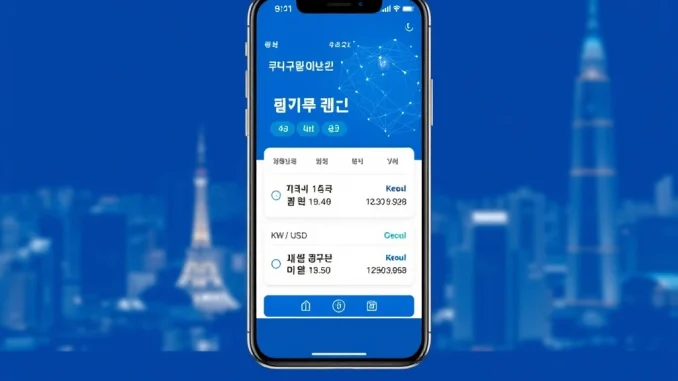
Seoul, South Korea – October 2025: South Korea has taken a significant step toward integrating traditional foreign exchange markets with blockchain technology through the launch of the Bidan Jumeoni wallet application. This innovative platform, developed through a strategic partnership between Hashed, Naver Financial, and the Busan Digital Asset Exchange, represents a pioneering approach to currency exchange by enabling direct conversion of foreign currencies into KRW-pegged stablecoins. The development marks a crucial milestone in South Korea’s broader strategy to establish comprehensive digital asset infrastructure while maintaining regulatory compliance and financial stability.
Bidan Jumeoni Wallet Enables Revolutionary Forex-to-KRW Stablecoin Exchange
The Bidan Jumeoni wallet application, currently in its pre-launch phase, showcases functionality that could transform how individuals and businesses handle international currency transactions in South Korea. Unlike traditional cryptocurrency wallets that primarily facilitate transfers between digital assets, this platform introduces a novel mechanism for converting foreign currencies directly into ‘Dongbaekjeon’ – Busan’s local currency issued as a KRW-pegged stablecoin. This approach bridges the gap between conventional banking systems and blockchain-based financial instruments, potentially reducing transaction costs and processing times for cross-border payments.
Industry analysts note that the timing of this development coincides with South Korea’s increasing acceptance of regulated digital assets. The country has been methodically building its digital finance ecosystem since passing the Virtual Asset User Protection Act in 2023, which established clearer guidelines for cryptocurrency exchanges and service providers. The Bidan Jumeoni project represents a natural progression in this regulatory evolution, focusing specifically on stablecoins – digital assets designed to maintain consistent value by pegging to traditional currencies or commodities.
South Korea’s Strategic Digital Asset Infrastructure Development
South Korea’s approach to digital asset infrastructure follows a carefully planned trajectory that balances innovation with regulatory oversight. The tripartite memorandum of understanding signed in May 2025 between Hashed (a leading blockchain venture studio), Naver Financial (the financial arm of South Korea’s internet giant), and the Busan Digital Asset Exchange created a powerful consortium with complementary expertise. This partnership combines blockchain technology development, mainstream financial integration, and regulated exchange operations – three essential components for successful digital asset implementation.
The infrastructure development follows several key phases:
- Regulatory Framework Establishment (2023-2024): Implementation of comprehensive digital asset legislation providing legal clarity for service providers
- Pilot Program Development (2024): Testing of limited-scale digital currency applications in controlled environments
- Partnership Formation (Early 2025): Strategic alliances between technology, finance, and regulatory entities
- Application Development (Mid-2025): Creation of user-friendly interfaces and backend systems
- Pre-Launch Testing (Late 2025): Feature demonstration and system validation before full public release
This methodical approach contrasts with more rapid implementations in other jurisdictions and reflects South Korea’s preference for stability and security in financial innovations.
The Technical Architecture Behind KRW-Pegged Stablecoins
The Dongbaekjeon stablecoin operates on a technical architecture designed specifically for the South Korean market. Unlike algorithmic stablecoins that maintain their peg through automated mechanisms, Dongbaekjeon follows a fully-backed model where each digital token corresponds to an equivalent amount of Korean won held in reserve. This approach minimizes volatility risks while ensuring regulatory compliance with South Korea’s financial regulations.
The technical implementation involves several key components:
- Reserve Management: Regular auditing of KRW reserves by licensed financial institutions
- Blockchain Protocol: Utilization of an enterprise-grade blockchain optimized for high transaction throughput
- Conversion Mechanism: Real-time foreign exchange rate integration with traditional banking systems
- Compliance Layer: Built-in Know Your Customer (KYC) and Anti-Money Laundering (AML) protocols
- Interoperability Features: Compatibility with existing financial infrastructure and other blockchain networks
This architecture enables the Bidan Jumeoni wallet to function as both a digital asset storage solution and a foreign exchange platform, creating a seamless bridge between traditional and digital finance.
Implications for South Korea’s Financial Ecosystem and Global Position
The introduction of forex-to-KRW stablecoin exchange capabilities carries significant implications for South Korea’s domestic financial system and its position in global digital finance. Domestically, this development could accelerate the adoption of digital payment methods while providing businesses with more efficient tools for international trade. The reduced friction in cross-border transactions may particularly benefit small and medium enterprises that previously faced substantial costs and delays when dealing with foreign currencies.
Globally, South Korea’s approach establishes a potential model for other nations considering similar integrations between traditional banking and blockchain technology. The country’s emphasis on regulatory compliance, partnership between established financial institutions and technology innovators, and focus on user-friendly implementation provides a template that balances innovation with stability. As more countries explore central bank digital currencies (CBDCs) and regulated stablecoins, South Korea’s experience with the Bidan Jumeoni wallet may inform international best practices.
The development also positions Busan as a potential hub for digital asset innovation within East Asia. By piloting the Dongbaekjeon stablecoin as a local currency before potential national expansion, the city can refine the technology and regulatory approach in a controlled environment. This strategy mirrors historical financial innovations that often begin in specific regions before broader implementation.
Comparative Analysis with International Stablecoin Developments
South Korea’s stablecoin initiative enters a global landscape where various approaches to digital currency implementation are emerging. The table below illustrates how the Bidan Jumeoni/Dongbaekjeon model compares with other major stablecoin developments worldwide:
| Country/Region | Stablecoin Model | Primary Use Case | Regulatory Status |
|---|---|---|---|
| South Korea (Busan) | Regionally-issued, fully-backed KRW stablecoin | Local commerce and forex exchange | Pilot program under existing digital asset regulations |
| United States | Privately-issued USD stablecoins (USDC, USDT) | Cryptocurrency trading and transfers | State-level money transmitter licenses, federal legislation pending |
| European Union | MiCA-regulated stablecoins (implementation 2024-2025) | Cross-border payments within EU | Comprehensive framework under Markets in Crypto-Assets Regulation |
| Singapore | Wholesale CBDC and regulated stablecoins | Institutional settlements and retail payments | Licensing under Payment Services Act |
| Japan | Bank-issued stablecoins under revised Payment Services Act | Corporate payments and remittances | Legal framework established, implementation in progress |
This comparative analysis reveals South Korea’s distinctive approach of integrating stablecoins with foreign exchange functionality – a feature less emphasized in other jurisdictions where stablecoins primarily facilitate cryptocurrency trading or domestic payments.
Future Development Timeline and Expansion Possibilities
The current pre-launch phase of the Bidan Jumeoni wallet represents just the beginning of South Korea’s stablecoin integration roadmap. Based on official statements and industry analysis, several development phases are anticipated in the coming years. The initial release will likely focus on limited user testing and refinement of the forex-to-KRW exchange mechanism, followed by gradual expansion of functionality and user base.
Potential future developments include:
- Integration with Traditional Banking: Direct connections between the wallet and conventional bank accounts for seamless fund transfers
- Expanded Currency Support: Addition of more foreign currencies beyond initial pilot offerings
- Business-to-Business Applications: Specialized features for corporate foreign exchange needs
- Cross-Border Implementation: Partnerships with international financial institutions for global stablecoin transfers
- Smart Contract Functionality: Programmable features enabling automated international payments and settlements
The success of these developments will depend on multiple factors including user adoption rates, regulatory evolution, technological stability, and integration with South Korea’s broader digital transformation initiatives. Industry observers will particularly monitor how the platform balances innovation with the financial stability priorities that have characterized South Korea’s approach to digital assets.
Conclusion
The launch of the Bidan Jumeoni wallet application marks a significant advancement in South Korea’s digital asset infrastructure, specifically enabling forex-to-KRW stablecoin exchange through an innovative platform developed by leading technology and financial institutions. This development represents more than just another cryptocurrency wallet – it signifies a strategic integration of blockchain technology with traditional foreign exchange mechanisms, potentially transforming how individuals and businesses handle international currency transactions. As the platform moves from pre-launch demonstration to full implementation, it will provide valuable insights into the practical challenges and opportunities of bridging conventional finance with digital asset innovation. The success of this initiative could influence not only South Korea’s financial ecosystem but also global approaches to regulated stablecoin implementation and cross-border payment modernization.
FAQs
Q1: What exactly is the Bidan Jumeoni wallet?
The Bidan Jumeoni wallet is a digital asset application developed through a partnership between Hashed, Naver Financial, and the Busan Digital Asset Exchange. Its primary function enables users to exchange foreign currencies for Dongbaekjeon, a KRW-pegged stablecoin representing Busan’s local currency.
Q2: How does the forex-to-KRW stablecoin exchange work technically?
The platform integrates real-time foreign exchange rates with blockchain technology, allowing users to convert supported foreign currencies into Dongbaekjeon stablecoins. Each stablecoin is fully backed by equivalent Korean won reserves held in regulated financial institutions, ensuring price stability and regulatory compliance.
Q3: When will the Bidan Jumeoni wallet be fully available to the public?
The application is currently in a pre-launch phase showcasing its main features. While no official public release date has been announced, industry analysts anticipate a gradual rollout beginning with limited user testing before broader availability, following South Korea’s methodical approach to financial technology implementation.
Q4: What makes South Korea’s approach to stablecoins different from other countries?
South Korea’s model uniquely integrates stablecoins with foreign exchange functionality rather than focusing primarily on cryptocurrency trading or domestic payments. The approach emphasizes partnerships between established financial institutions and technology companies, regulatory compliance from inception, and regional piloting before potential national expansion.
Q5: What are the potential benefits of using stablecoins for foreign exchange?
Stablecoin-based foreign exchange can potentially reduce transaction costs, decrease processing times for cross-border payments, increase accessibility for smaller transactions, and provide greater transparency through blockchain-recorded transactions. However, these benefits depend on successful implementation, user adoption, and regulatory acceptance.