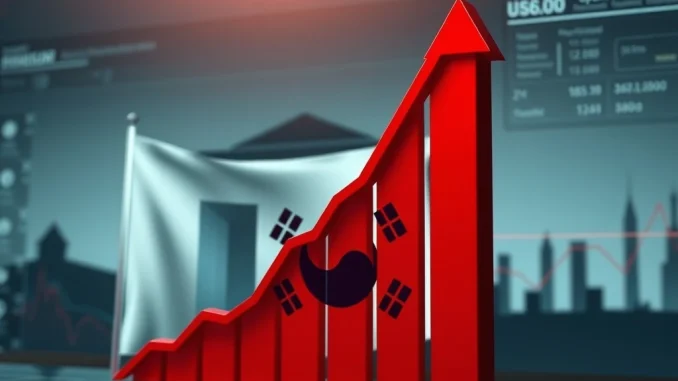
Seoul, South Korea: The South Korean cryptocurrency market witnessed a dramatic and volatile event this week as the digital asset ZK experienced a price explosion of nearly 1,000% on the major exchange Upbit. The surge, which saw ZK’s price rocket from approximately 33 Korean Won (KRW) to around 350 KRW within a mere three-hour window, has prompted immediate regulatory attention. South Korea’s Financial Supervisory Service (FSS) has officially initiated monitoring of ZK trading activity, marking a significant regulatory response to extreme market volatility.
ZK Cryptocurrency Price Surge and Immediate Regulatory Flag
The event began during active Asian trading hours. Market data from Upbit, one of South Korea’s largest and most influential cryptocurrency exchanges, shows a vertical price climb for ZK that defied typical market patterns. This kind of parabolic move, while not unheard of in crypto markets, immediately raises red flags for market integrity units within financial watchdogs. The FSS, acting on its mandate to ensure orderly markets and protect investors, swiftly moved to scrutinize the trading activity. A formal review process is now underway, with Upbit confirming its full cooperation by providing comprehensive trade data to regulators. This sequence—a sharp price spike followed by regulatory inquiry—is a established protocol in South Korea’s closely monitored digital asset ecosystem.
South Korea’s Financial Supervisory Service and Crypto Oversight
South Korea maintains one of the world’s most active and regulated cryptocurrency environments. The Financial Supervisory Service plays a central role in this framework. Its mandate extends beyond traditional finance to include monitoring virtual asset service providers (VASPs) like Upbit for signs of market manipulation, fraud, or abnormal volatility that could harm retail investors. The FSS does not directly set crypto policy—that falls to the Financial Services Commission (FSC)—but it is the primary investigative and supervisory arm. Its decision to publicly announce monitoring of a specific token like ZK is a deliberate action meant to signal oversight and caution to the market. This action aligns with South Korea’s stringent approach following past exchange failures and market scandals, which led to the implementation of strict real-name account trading and anti-money laundering rules.
Historical Context of Korean Market Interventions
This is not the first time South Korean authorities have stepped in during periods of crypto market frenzy. The regulatory playbook has evolved since the 2017-2018 boom, when similar meteoric rises in assets like Bitcoin and altcoins prompted government warnings and eventually a crackdown on initial coin offerings (ICOs). More recently, the FSS has increased surveillance of transaction patterns to detect pump-and-dump schemes and wash trading. The monitoring of ZK fits this pattern of proactive, if sometimes reactive, oversight designed to maintain systemic stability and investor confidence in a market where a significant portion of the population has exposure to digital assets.
Analyzing the Causes and Consequences of the Volatility
While the specific catalyst for ZK’s surge remains under official investigation, market analysts point to several common factors that can trigger such events in the cryptocurrency space. These can range from coordinated social media hype and influencer endorsements to the exploitation of low liquidity on a specific trading pair. The KRW trading pair on Upbit can sometimes act as an isolated market, making assets more susceptible to sharp moves based on localized demand. The consequences are multifaceted:
- Investor Impact: Early buyers during the rise reaped enormous paper gains, while those who bought near the peak faced immediate and steep losses when the price reversed.
- Market Confidence: Such events test the resilience of market infrastructure and can undermine trust among casual investors.
- Regulatory Repercussions: The FSS review could lead to sanctions if misconduct is found, or it may result in tighter surveillance guidelines for all exchanges.
- Exchange Responsibility: Upbit’s role is under the microscope, focusing on its risk management systems and its adherence to market surveillance obligations.
The Role of Major Exchanges Like Upbit in Market Stability
As the platform where the event occurred, Upbit’s actions are critical. The exchange, operated by Dunamu Inc., is a licensed VASP in South Korea and is therefore bound by strict operational rules. Its prompt cooperation with the FSS is a regulatory requirement. Exchanges have tools at their disposal to manage extreme volatility, including temporary trading halts, margin call adjustments, and enhanced monitoring of suspicious accounts. The effectiveness of these tools during the ZK event will likely be part of the FSS’s review. The incident highlights the ongoing challenge for global exchanges: balancing open market access with the need to prevent manipulative or abusive practices that can occur in 24/7, globally-traded, and often thinly-traded asset classes.
Global Implications for Cryptocurrency Regulation
The South Korean response to the ZK surge is being watched by regulators worldwide. Many jurisdictions, from the United States to the European Union, are grappling with how to apply traditional market conduct rules to the crypto sphere. South Korea’s model of direct exchange oversight and real-time data sharing offers one approach. A decisive regulatory move following a volatile event can set a precedent, influencing how other nations respond to similar situations. It reinforces a growing global consensus that cryptocurrency markets, for all their novelty, are not immune to established principles of market fairness and investor protection.
Conclusion
The stunning 1,000% surge of the ZK cryptocurrency on Upbit and the subsequent monitoring by South Korea’s Financial Supervisory Service underscore a pivotal moment in the maturation of digital asset markets. It demonstrates that in regulated jurisdictions, extreme volatility will not go unnoticed by authorities. The event serves as a stark reminder of the inherent risks in cryptocurrency trading, especially around lesser-known assets. For the broader industry, the outcome of the FSS review will be closely monitored, as it may influence future regulatory tactics both in South Korea and abroad. The central takeaway is clear: as cryptocurrency integrates further into the global financial system, it simultaneously integrates further into the global regulatory framework.
FAQs
Q1: What is ZK and why did its price surge on Upbit?
ZK is a digital asset or cryptocurrency. The exact reason for its near-1,000% price surge on the South Korean exchange Upbit is under investigation by regulators. Such spikes can sometimes be caused by coordinated buying, social media hype, or low market liquidity for a specific trading pair.
Q2: What is the Financial Supervisory Service (FSS) of South Korea?
The FSS is South Korea’s primary financial regulatory and supervisory agency. It monitors the activities of financial institutions, including licensed cryptocurrency exchanges like Upbit, to ensure market stability, prevent fraud, and protect investors.
Q3: What does it mean that the FSS is “monitoring” ZK trading?
It means the FSS has formally initiated a review of the trading activity surrounding ZK on Upbit. This involves analyzing trade data, order books, and account activity to determine if the price movement was organic or the result of market manipulation or other misconduct.
Q4: What could happen to Upbit or traders after this monitoring?
If the FSS investigation uncovers evidence of market manipulation or rule violations, it could impose fines or sanctions on Upbit for inadequate surveillance. Individual traders found to have engaged in manipulative practices could face legal penalties, including fines or prosecution.
Q5: How does this event affect the average cryptocurrency investor in South Korea?
It highlights the high volatility and risk associated with trading cryptocurrencies, particularly smaller-cap assets. It also demonstrates the active role of regulators. Investors should be aware that extreme gains can attract regulatory scrutiny and that they are trading in a monitored environment designed, in part, for their protection.
Updated insights and analysis added for better clarity.
This article was produced with AI assistance and reviewed by our editorial team for accuracy and quality.