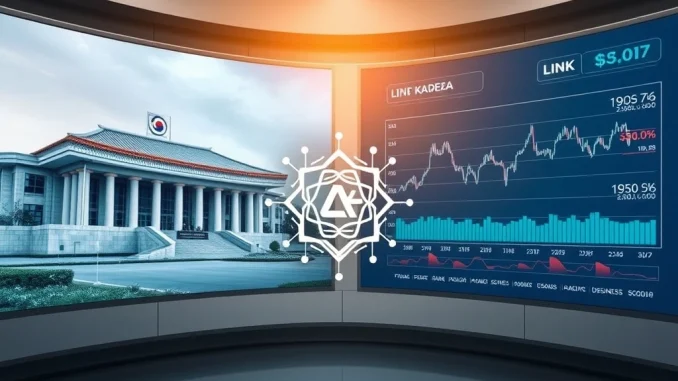
Seoul, South Korea – February 2025: The global cryptocurrency landscape enters a new phase of institutional maturity as regulatory bodies adopt advanced technological tools. South Korea’s Financial Services Commission (FSC) confirmed the operational deployment of an artificial intelligence monitoring system this week. This development coincides with notable price corrections for major altcoins Chainlink (LINK) and Sui (SUI), while the broader market evaluates projects emphasizing tangible utility over speculative narratives. The integration of AI into regulatory frameworks represents a significant shift in how nations oversee digital asset markets.
South Korea’s AI-Powered Regulatory Framework
The Financial Services Commission initiated its AI surveillance platform to enhance market oversight and investor protection. This system analyzes blockchain transactions, social sentiment, and trading patterns across domestic exchanges. Officials designed the platform to identify potential market manipulation, fraudulent schemes, and compliance violations in real-time. The move follows a 2024 pilot program and extensive consultation with technology firms and legal experts.
South Korea maintains one of the world’s most active retail cryptocurrency markets. The government implemented strict regulations following the Terra-LUNA collapse of 2022. The new AI system represents the next evolution in this regulatory approach. It processes vast amounts of public blockchain data alongside traditional financial information. Analysts view this as a model other jurisdictions may study, balancing innovation with consumer safeguards.
Chainlink (LINK) and Sui (SUI) Face Market Pressure
Concurrent with the regulatory news, two prominent cryptocurrency assets experienced downward price momentum. Chainlink (LINK), the leading decentralized oracle network, saw a 7% decline over the weekly chart. Market data indicates this movement aligns with a broader consolidation phase for DeFi-related tokens. Chainlink’s core utility involves supplying real-world data to smart contracts on various blockchains. Its network activity metrics, however, show consistent use, with the number of oracle requests remaining stable.
Sui (SUI), the layer-1 blockchain developed by former Meta engineers, faced an 11% decrease in its token value. The Sui network has focused on scalable smart contract execution and has gained developer traction. Analysts attribute the price slide to profit-taking following a strong performance in late 2024 and a temporary reduction in network growth metrics. Both assets reflect a market environment where short-term price action often diverges from long-term fundamental development.
Understanding the Current Market Context
The cryptocurrency market in early 2025 operates within a complex macro environment. Interest rate policies from major central banks continue to influence investor risk appetite. Furthermore, the final implementation phases of comprehensive regulatory frameworks, like the EU’s Markets in Crypto-Assets (MiCA) regulation, create both certainty and operational challenges for projects. This context is crucial for interpreting individual asset price movements. They rarely occur in isolation from these larger financial and regulatory tides.
The Rise of Utility-Focused AI Cryptocurrency Projects
A distinct trend emerging in the sector is the emphasis on projects demonstrating clear, operational utility. This contrasts with earlier cycles dominated by speculative promises. The category includes blockchain projects leveraging AI for specific functions like data validation, computation, or network optimization. DeepSnitch AI, mentioned in market discussions, exemplifies this trend by focusing on smart contract security auditing—a persistent industry need.
Evaluating such projects requires scrutiny of their actual product development, client adoption, and revenue generation, not just technical whitepapers. The market increasingly rewards tokens with measurable use cases and sustainable economic models. This shift indicates a maturation of the cryptocurrency industry as it moves beyond pure monetary experiments to functional technology platforms.
Expert Analysis on Regulatory Technology
Dr. Elena Vargas, a fintech policy researcher at the Singapore Institute of Technology, provided context. “South Korea’s use of AI for regulation is a natural progression,” she explained. “Regulators globally are overwhelmed by the scale and speed of crypto markets. Automated systems can flag anomalies for human review, making oversight more efficient and comprehensive. The key challenge remains ensuring these systems are transparent and their decision-making logic is auditable to prevent overreach.” This perspective highlights the dual-edged nature of technological adoption by authorities.
Historical Precedents and Market Cycles
The current market phase shares characteristics with past cycles where regulatory clarity prompted short-term volatility but long-term stability. The 2017-2018 period saw initial coin offerings (ICOs) boom and bust, leading to regulatory crackdowns. The 2020-2021 DeFi and NFT boom similarly attracted regulatory attention. Each wave resulted in more defined rules. The integration of sophisticated tools like AI by regulators suggests a move from reactive enforcement to proactive monitoring, potentially reducing systemic shocks from sudden policy announcements.
Conclusion
The crypto market news in February 2025 underscores a sector in transition. South Korea’s deployment of AI regulators signals a new era of technologically-enabled oversight. The price adjustments for Chainlink and Sui reflect normal market cycles and profit-taking, not necessarily diminished fundamentals. Simultaneously, the investor focus is sharpening on projects that deliver verifiable utility, particularly at the intersection of AI and blockchain. These developments collectively point toward a more mature, institutional, and utility-driven future for digital assets, where regulation and innovation continually adapt to one another.
FAQs
Q1: What is the main goal of South Korea’s new AI regulatory system?
The primary goal is to enhance market surveillance and investor protection by using artificial intelligence to monitor trading activity, detect potential manipulation, and ensure exchange compliance in real-time, making oversight more scalable and efficient.
Q2: Why did Chainlink (LINK) and Sui (SUI) prices decline?
The declines appear driven by broader market consolidation and profit-taking after previous gains. For Chainlink, it’s part of a DeFi sector cooldown, while Sui’s drop correlates with a temporary slowdown in network growth metrics, not a failure of its core technology.
Q3: What does “utility-fueled” mean in the context of AI crypto projects?
It refers to projects whose tokens derive value from being essential to a functioning product or service, such as paying for AI-powered security audits or data feeds, rather than from pure speculative trading or governance rights alone.
Q4: How could AI regulation affect ordinary cryptocurrency investors?
It could lead to safer trading environments with less fraud and manipulation, potentially increasing mainstream trust. However, it may also introduce more stringent identity checks and transaction reporting requirements on exchanges.
Q5: Is the focus on utility a new trend for cryptocurrency?
While utility has always been a stated goal, market cycles have often prioritized speculation. The current emphasis is stronger due to institutional involvement, regulatory pressure for substance, and lessons learned from the collapse of projects with no viable product.
Updated insights and analysis added for better clarity.
This article was produced with AI assistance and reviewed by our editorial team for accuracy and quality.