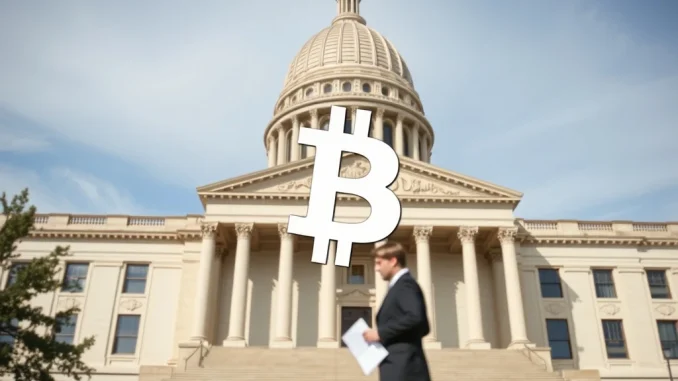
Pierre, South Dakota – February 2025: A renewed and bold legislative effort is underway in South Dakota that could see the state become one of the first in the nation to directly invest a portion of its public treasury in Bitcoin. Representative Logan Manhart has reintroduced a bill, HB 1155, which would authorize the state’s Investment Council to allocate up to 10% of certain public funds into the world’s leading cryptocurrency. This move reignites a complex debate at the intersection of public finance, emerging technology, and fiduciary responsibility.
South Dakota Bitcoin Bill HB 1155: The Specifics and Scope
The proposed legislation, House Bill 1155, seeks a specific amendment to South Dakota Codified Law. The bill’s text aims to empower the South Dakota Investment Council (SDIC) with the legal authority to invest in “virtual currency, including but not limited to Bitcoin.” The proposed cap is set at 10% of the funds under the council’s management. It is critical to understand that this does not propose investing 10% of the entire state budget. Instead, it applies to the assets managed by the SDIC, which oversees the state’s retirement systems and other investment pools. The bill provides a framework but leaves specific investment timing, amounts, and custody solutions to the discretion and due diligence of the council’s professional managers.
Legislative History and the Path to Reintroduction
This is not Representative Manhart’s first attempt to pass such a measure. In January of the previous year, he introduced a nearly identical proposal. That initial bill faced significant scrutiny and was ultimately rejected by the state legislature. The reintroduction signals a persistent belief in the strategy’s potential merits. Analysts note that between the two bills, the national conversation around institutional cryptocurrency adoption has evolved. Several major corporations have added Bitcoin to their balance sheets, and financial giants like BlackRock and Fidelity now offer spot Bitcoin ETFs, providing a more regulated and familiar vehicle for large-scale investment. This changing landscape may influence the bill’s reception during the current legislative session.
Understanding the South Dakota Investment Council’s Role
The South Dakota Investment Council is a constitutionally established body responsible for managing state investment funds. Its primary mandate is to manage assets “prudently” to meet the long-term obligations of the state’s retirement systems. The council employs a professional staff and operates with a long-term, diversified investment philosophy. HB 1155 would essentially add a new, highly volatile asset class to the toolkit available to these managers. Proponents argue it offers a potential hedge against inflation and currency devaluation, while opponents question its alignment with the core principle of prudent risk management for public pensions.
National Context: A State-by-State Approach to Crypto Assets
South Dakota’s proposal exists within a patchwork of state-level approaches to cryptocurrency. No state currently holds Bitcoin directly in its treasury, making this a potential first.
- Pro-Bitcoin States: Texas and Florida have passed supportive legislation clarifying cryptocurrency regulations and encouraging blockchain business development, but have not authorized direct treasury investment.
- Cautious or Restrictive States: New York operates under the stringent BitLicense regime, while others have issued consumer warnings about crypto risks.
- The Wyoming Model: Often cited as a leader, Wyoming has created a comprehensive legal framework for digital assets, treating them as property and establishing special purpose depository institutions (SPDIs) for custody. This provides a regulatory blueprint others may follow.
South Dakota’s bill is distinct because it focuses squarely on state investment rather than general commercial regulation.
Potential Implications and Expert Analysis
The passage of HB 1155 would carry significant implications. Financially, it exposes a slice of public capital to Bitcoin’s notorious price volatility, which saw drawdowns exceeding 75% in previous cycles. Proponents frame this as a calculated, long-term risk for a non-correlated asset. From a governance perspective, it would require the SDIC to develop entirely new protocols for security, custody, accounting, and auditing of digital assets—a complex and costly undertaking. Politically, it could position South Dakota as a pioneer in state-level digital asset adoption, potentially attracting related businesses, or as a cautionary tale if the investment underperforms. Fiduciary duty remains the central question: can investing in a speculative digital asset ever be considered “prudent” management of public worker retirement funds?
The Critical Debate: Prudent Diversification or Speculative Gamble?
The core debate hinges on the definition of a prudent investment. Traditional public fund portfolios consist of stocks, bonds, real estate, and cash. Bitcoin does not generate cash flow like a bond or represent ownership in a productive enterprise like a stock. Its value is derived purely from market sentiment, adoption, and scarcity. Supporters argue its fixed supply makes it a digital analogue to gold—a store of value. Detractors see it as a purely speculative instrument with no intrinsic value, making it unsuitable for safeguarding public pensions. This philosophical divide will likely dominate committee hearings and floor debates on HB 1155.
Conclusion
The reintroduction of the South Dakota Bitcoin bill represents a fascinating test case for the maturation of cryptocurrency within traditional public finance. While the previous iteration failed, the evolving institutional landscape provides a new context for the debate. The ultimate decision on HB 1155 will signal whether a state legislature views Bitcoin as a legitimate, diversifying asset for the long term or an imprudent speculation unfit for public funds. The outcome will be closely watched by lawmakers, public pension administrators, and the cryptocurrency industry nationwide, as it could set a powerful precedent for other states considering similar paths.
FAQs
Q1: What exactly does the South Dakota Bitcoin bill propose?
The bill, HB 1155, proposes to amend state law to allow the South Dakota Investment Council to invest up to 10% of the funds it manages into virtual currencies like Bitcoin.
Q2: Has this been tried before in South Dakota?
Yes. Representative Logan Manhart introduced a nearly identical bill in January of the previous year, but it was rejected by the state legislature.
Q3: Would this use the state’s general tax revenue?
Not directly. It applies to investment pools managed by the South Dakota Investment Council, which include state retirement system assets, not the general operating budget.
Q4: Are any other states investing public money in Bitcoin?
As of early 2025, no U.S. state holds Bitcoin directly in its treasury. Some states, like Wyoming, have created supportive regulatory frameworks, but none have authorized direct investment of public funds.
Q5: What are the biggest arguments against this bill?
The primary arguments center on Bitcoin’s extreme price volatility, the lack of intrinsic value or cash flow, and the fiduciary duty to manage public pension funds with prudence and minimal undue risk.