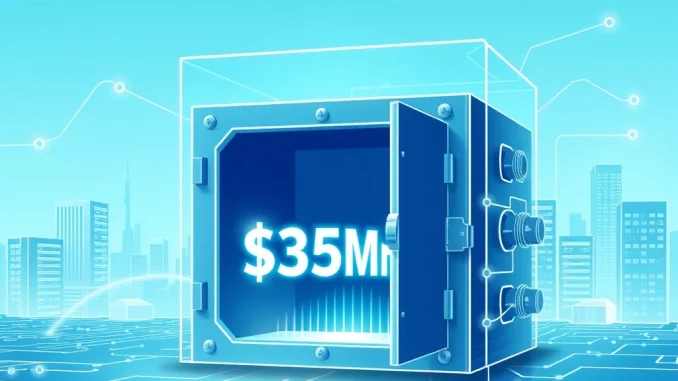
In a significant move for blockchain infrastructure development, the Layer 1 protocol Solayer has officially launched a substantial $35 million ecosystem fund. This strategic initiative, first reported by Unfolded, aims to directly accelerate the creation and scaling of innovative on-chain applications. The fund represents a major commitment to developer growth and signals Solayer’s ambition to expand its technological footprint within the competitive blockchain landscape of 2025.
Solayer’s $35 Million Ecosystem Fund: A Strategic Deep Dive
The announcement of Solayer’s $35 million ecosystem fund marks a pivotal moment for the protocol. This capital injection is specifically earmarked for grants, investments, and technical support aimed at developers building decentralized applications (dApps) on the Solayer network. Consequently, the fund seeks to address a critical need in the blockchain space: reducing the financial and resource barriers for talented developers. By providing this support, Solayer aims to cultivate a more robust and diverse application layer, which is essential for any Layer 1 blockchain seeking long-term adoption and utility.
Industry analysts often compare such funds to the successful ecosystem development strategies employed by other major Layer 1 networks. For instance, similar early-stage funds have historically catalyzed the growth of now-dominant DeFi and NFT ecosystems. Therefore, Solayer’s move is not merely a financial announcement but a foundational step in its roadmap. The protocol is positioning itself to compete more effectively by ensuring a rich library of use cases and services is available directly on its chain, thereby increasing its value proposition to both developers and end-users.
The Broader Context of Layer 1 Protocol Competition
The blockchain sector in 2025 remains intensely competitive, with numerous Layer 1 and Layer 2 solutions vying for developer mindshare and user activity. A protocol’s success increasingly depends on its ability to foster a vibrant ecosystem. Solayer’s $35 million fund directly responds to this market dynamic. It provides a tangible incentive for development teams to choose Solayer’s infrastructure over alternatives. Furthermore, this initiative highlights a trend where blockchain foundations are taking a more active, venture-like role in curating and financing their technological ecosystems.
This fund also arrives at a time when the industry is emphasizing real-world utility and scalable solutions. The capital will likely target projects in several high-growth verticals, including but not limited to:
- Decentralized Finance (DeFi): Lending protocols, decentralized exchanges, and asset management tools.
- Real-World Assets (RWA): Platforms for tokenizing physical assets like real estate or commodities.
- Gaming and Metaverse: Infrastructure for Web3 games and immersive digital worlds.
- Decentralized Social Media: Censorship-resistant communication and content platforms.
By strategically allocating funds across these areas, Solayer can build a more resilient and interconnected application suite.
Expert Analysis on Fund Deployment and Impact
From a technical and economic perspective, the structure of the fund’s deployment will be critical. Typically, ecosystem funds utilize a milestone-based grant system. This means developers receive funding in tranches as they achieve predefined technical and adoption goals. This model ensures accountability and aligns developer success with the health of the overall network. Moreover, a portion of the fund is often reserved for liquidity incentives. These incentives bootstrap initial user activity for new dApps by offering token rewards, a proven method for overcoming the classic “cold start” problem in decentralized networks.
The long-term impact of such a fund extends beyond immediate project funding. It creates a positive feedback loop: more applications attract more users, which in turn attracts more developers, leading to further innovation. This network effect is the primary driver of value for any Layer 1 protocol. Therefore, the $35 million should be viewed as an investment in Solayer’s core infrastructure and long-term valuation, not merely as an expense.
Operational Framework and Expected Outcomes
To ensure transparency and effectiveness, Solayer will need a clear operational framework for its ecosystem fund. This likely involves a dedicated committee or foundation tasked with evaluating proposals, disbursing funds, and providing ongoing technical mentorship. The selection criteria will probably emphasize several key factors:
| Evaluation Criteria | Description |
|---|---|
| Technical Innovation | Does the project introduce novel technology or solve a unique problem? |
| Team Experience | Does the development team have a proven track record in blockchain or software? |
| Roadmap Feasibility | Are the project’s milestones realistic and clearly defined? |
| Ecosystem Fit | Does the application complement and enhance the existing Solayer ecosystem? |
| Tokenomics & Sustainability | Does the project have a sustainable economic model for long-term operation? |
Successful deployment of the fund is expected to yield measurable outcomes within 12-18 months. These outcomes include a quantifiable increase in the number of active developers on the Solayer platform, a growth in total value locked (TVL) within its DeFi applications, and a rise in daily active addresses. Monitoring these metrics will provide clear evidence of the fund’s return on investment for the Solayer community and its stakeholders.
Conclusion
The launch of Solayer’s $35 million ecosystem fund is a decisive and strategic action that underscores the protocol’s commitment to sustainable growth. By directly funding and supporting the development of on-chain applications, Solayer is investing in the most critical component of its future: a usable, valuable, and diverse ecosystem. This move positions Solayer to more effectively compete in the crowded Layer 1 landscape of 2025, offering developers a compelling package of financial support and technological infrastructure. The success of this fund will ultimately be measured by the quality and adoption of the applications it helps bring to life on the Solayer blockchain.
FAQs
Q1: What is the primary goal of Solayer’s $35 million ecosystem fund?
The primary goal is to accelerate the development and deployment of decentralized applications (dApps) on the Solayer blockchain by providing financial grants, technical resources, and strategic support to developer teams.
Q2: How can developers apply for funding from the Solayer ecosystem fund?
While specific application details will be released by the Solayer Foundation, developers should expect a formal proposal process outlined on Solayer’s official website, typically involving project details, team background, technical roadmap, and requested funding amount.
Q3: Does this fund make Solayer a competitor to other Layer 1 ecosystems like Ethereum or Solana?
Yes, directly. Ecosystem funds are a standard competitive tool for Layer 1 protocols to attract developer talent and build network effects. Solayer’s fund is a clear move to capture market share in the multi-chain landscape.
Q4: What types of blockchain projects is the Solayer fund most likely to support?
The fund will likely prioritize projects in high-impact sectors such as Decentralized Finance (DeFi), Real-World Asset (RWA) tokenization, Web3 gaming, and decentralized social media, provided they demonstrate strong technical merit and a clear need for the Solayer network.
Q5: How will the success of this $35 million ecosystem fund be measured?
Success will be measured through key performance indicators (KPIs) like the number of new dApps launched, growth in developer activity, increase in Total Value Locked (TVL), and a rise in daily active users on the Solayer network.
Updated insights and analysis added for better clarity.
This article was produced with AI assistance and reviewed by our editorial team for accuracy and quality.