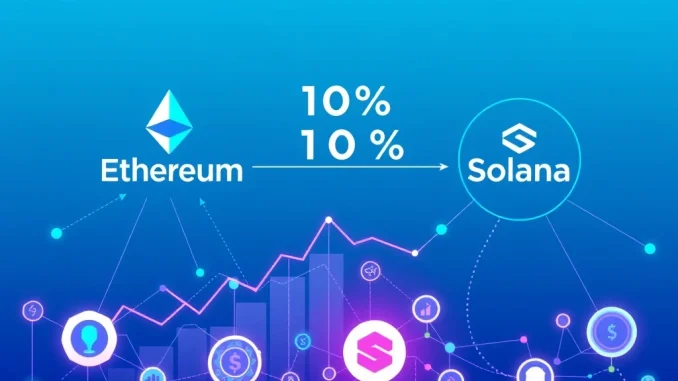
Global, April 2025: The landscape of tokenized equities is undergoing a significant shift. While Ethereum continues to hold a dominant position, Solana is steadily expanding its market share, driven primarily by the growing integration of xStocks across several top-tier decentralized lending protocols. This movement signals a pivotal moment in the convergence of traditional finance and blockchain technology, where speed, cost, and user experience are becoming critical competitive factors.
Solana’s Strategic Advance in Tokenized Equities
The tokenization of real-world assets (RWAs), particularly equities, represents one of the most substantial growth vectors in the blockchain sector. For years, Ethereum has been the default platform for these financial instruments, leveraging its first-mover advantage, robust security, and extensive developer ecosystem. Recent data, however, indicates a change in momentum. Analysts tracking on-chain activity report that Ethereum’s share of the tokenized equity market, while still commanding approximately 40%, is facing increased competition. Solana’s architecture, known for its high throughput and low transaction costs, is proving attractive for financial applications that require efficiency and scalability.
This shift is not merely theoretical. Protocol activity shows a measurable increase in the volume of tokenized stock trading and collateralization on Solana-based platforms. The growth correlates directly with technical upgrades to the Solana network that have improved its stability and the strategic decisions by major financial infrastructure projects to build multi-chain support, with Solana as a key pillar. The narrative is evolving from a single-chain dominance to a multi-chain future for institutional-grade DeFi.
The xStocks Catalyst on Lending Protocols
The primary engine behind Solana’s recent gains is the adoption and integration of xStocks. xStokens are synthetic, blockchain-based representations of traditional stocks that track the price of the underlying equity. They provide global, 24/7 access to equity markets without requiring users to hold the actual security, navigating complex regulatory custody issues through a derivative model. Their integration into decentralized finance (DeFi) is transformative.
Leading lending and borrowing protocols on Solana have begun listing major xStokens—representing companies like Apple, Tesla, and Amazon—as eligible collateral. This allows users to deposit tokenized Tesla stock, for example, and borrow stablecoins or other cryptocurrencies against it. The mechanics offer several compelling advantages:
- Capital Efficiency: Investors can access liquidity from their equity holdings without selling, a concept familiar in traditional finance but now operational on-chain.
- Programmability: These tokenized assets can interact seamlessly with smart contracts, enabling automated strategies, cross-margin accounts, and complex financial products.
- Lower Barrier to Entry: Fractional ownership through xStokens allows for smaller investment sizes, democratizing access to premium equities.
The move by protocols like Solend, Marginfi, and Kamino to aggressively support xStocks has created a powerful flywheel. Increased utility drives demand for the tokens, which in turn attracts more liquidity and developers to the Solana ecosystem to build new products around them.
Ethereum’s Established Dominance and the Multi-Chain Reality
It is crucial to contextualize Solana’s growth within the broader market. Ethereum’s 40% share is a testament to its deep liquidity, the maturity of its Layer 2 scaling solutions, and the sheer volume of institutional activity already settled on its network. Major tokenization platforms like Ondo Finance and Matrixport have established significant operations on Ethereum. Its security model and decentralization are often preferred for high-value, long-term asset custody.
The emerging story, therefore, is not of a winner-takes-all battle but of specialization and choice. Ethereum often serves as the settlement and security layer for large-scale, institutional tokenization deals. Solana, with its sub-second finality and low fees, is carving out a niche as the preferred chain for active trading, leveraged strategies, and applications where user experience is paramount. This multi-chain approach allows the tokenized equity market to grow overall, tapping into different user bases and use cases.
Implications for Investors and the Financial Ecosystem
The expansion of tokenized equities onto chains like Solana carries profound implications. For investors, it increases choice and potentially reduces costs associated with transactions and interactions. The ability to use equities as productive collateral in a decentralized manner opens new avenues for portfolio management and yield generation.
For the traditional financial system, this growth underscores the irreversible trend toward asset tokenization. It pressures incumbent institutions to explore blockchain integration or risk disintermediation. Regulatory bodies worldwide are closely monitoring these developments, with frameworks evolving to address the unique aspects of synthetic assets and cross-chain DeFi. The growth of compliant, transparent platforms for tokenized securities is a key step toward broader institutional adoption.
Conclusion
The tokenized equity market is maturing and expanding beyond its initial foundations. While Ethereum remains the largest platform by total value locked, Solana’s increasing share, fueled by the practical utility of xStocks adoption on leading lending protocols, marks a significant diversification in the infrastructure of digital finance. This competition drives innovation, improves user experience, and ultimately accelerates the integration of blockchain technology into the global equity landscape. The trajectory suggests a future where access to capital markets is more open, efficient, and interconnected than ever before.
FAQs
Q1: What are tokenized equities?
Tokenized equities are digital representations of traditional company stocks issued on a blockchain. They track the price of the underlying stock and provide ownership rights or economic exposure, enabling them to be traded and used in decentralized finance applications.
Q2: How does xStocks differ from directly owning a tokenized stock?
xStocks are typically synthetic assets or derivatives that mirror a stock’s price. They do not usually confer direct shareholder voting rights but are designed for trading and financial utility within DeFi protocols, often avoiding direct securities regulation by structuring as price-tracking tokens.
Q3: Why is Solana considered suitable for tokenized equities?
Solana’s network offers high transaction throughput (thousands per second) and very low fees. These characteristics are advantageous for financial applications that require fast execution and low costs, such as frequent trading, collateral liquidation, and complex multi-step DeFi transactions.
Q4: What risks are associated with using tokenized equities as collateral in DeFi?
Key risks include smart contract vulnerabilities, oracle failures (inaccurate price feeds), protocol insolvency, and the high volatility of both the crypto and equity markets, which can lead to rapid collateral liquidation if value drops.
Q5: Is the growth of Solana in this space a threat to Ethereum?
It is more accurately described as competition that spurs ecosystem development. Both networks have different strengths. The growth indicates market expansion and specialization, with Ethereum focusing on high-security settlement and Solana on high-frequency utility, benefiting the overall tokenization industry.
This article was produced with AI assistance and reviewed by our editorial team for accuracy and quality.