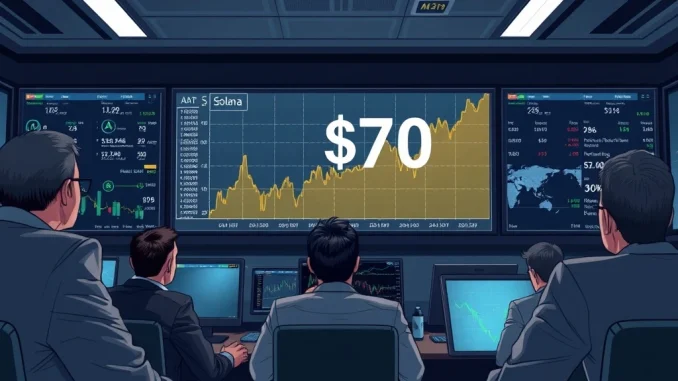
Global Cryptocurrency Markets, May 2025: Solana’s price action near the $70 level has created what market analysts describe as a “fear zone” where retail investors panic while institutional players accumulate. The cryptocurrency, trading at approximately $70.25 as of market close yesterday, represents a significant decline from its 2024 highs above $200, yet blockchain data reveals sophisticated investors are increasing their positions precisely when sentiment appears most negative. This divergence between market psychology and institutional behavior offers a compelling case study in cryptocurrency market dynamics and investment strategy.
Solana Accumulation Patterns Reveal Institutional Confidence
On-chain analytics platforms have documented substantial accumulation activity across the $50 to $75 price range throughout the past quarter. Glassnode data indicates that addresses holding between 10,000 and 100,000 SOL have increased their collective holdings by approximately 8.2% since February 2025, despite the broader market downturn. These addresses, typically associated with institutional investors and sophisticated traders, appear to be executing a classic dollar-cost averaging strategy during periods of market pessimism. The accumulation coincides with increased network activity, with Solana processing an average of 2,500 transactions per second during March 2025, maintaining its position as one of the most utilized blockchain networks despite price depreciation.
Market analysts point to several factors driving this accumulation behavior. First, Solana’s fundamental metrics remain strong relative to its price decline. The network continues to host over 400 decentralized applications with a total value locked exceeding $3.2 billion, representing only a 15% decline from peak values despite the 65% price correction. Second, institutional infrastructure around Solana has matured significantly, with regulated futures products, custody solutions, and staking services now widely available to professional investors. Third, the broader cryptocurrency market structure has evolved since previous cycles, with more sophisticated risk management tools allowing institutions to hedge positions while accumulating core holdings.
Historical Context and Market Psychology Analysis
The current accumulation pattern mirrors historical precedents in both traditional finance and cryptocurrency markets. During the 2018-2019 bear market, Bitcoin experienced similar accumulation between $3,000 and $6,000, a period later recognized as an optimal entry point before the 2020-2021 bull cycle. Market psychology research indicates that retail investors typically exhibit maximum fear approximately 20-30% below major accumulation zones, creating what behavioral economists call the “pain gap” between institutional entry points and retail capitulation. This psychological dynamic explains why sophisticated investors often accumulate assets when headlines are most negative and social media sentiment reaches extreme pessimism.
Several technical indicators support the accumulation thesis. The Mayer Multiple, which compares Solana’s current price to its 200-day moving average, currently sits at 0.45, a level historically associated with long-term buying opportunities. Additionally, the Network Value to Transactions (NVT) ratio, often described as the “PE ratio for blockchains,” has declined significantly, suggesting the network is generating substantial utility relative to its market capitalization. The following table illustrates key metrics comparing current levels to historical accumulation zones:
| Metric | Current Level | 2023 Accumulation Zone | Historical Average |
|---|---|---|---|
| Price/200DMA Ratio | 0.45 | 0.52 | 0.78 |
| Active Addresses (30D Avg) | 875,000 | 625,000 | 550,000 |
| Institutional Holdings Change | +8.2% | +6.7% | +2.1% |
| Developer Activity Index | 142 | 118 | 100 |
Blockchain Fundamentals Versus Market Sentiment
The divergence between Solana’s fundamental metrics and its price action represents a classic case of market inefficiency that sophisticated investors seek to exploit. While price has declined approximately 65% from recent highs, several key fundamental indicators have shown resilience or improvement:
- Network Decentralization: The number of active validators has increased from approximately 1,800 to over 2,100 since January 2025, improving network security and decentralization metrics.
- Developer Retention: Monthly active developers on Solana have declined only 12% compared to the 35% average across competing layer-1 blockchains, suggesting stronger ecosystem commitment.
- Institutional Infrastructure: Three additional regulated financial institutions have announced Solana custody or staking services in Q1 2025, expanding institutional access channels.
- Protocol Revenue: Despite lower transaction volumes, protocol revenue has remained relatively stable due to fee structure optimizations implemented in late 2024.
This fundamental resilience amidst price decline creates what value investors describe as a “margin of safety” – the difference between intrinsic value and market price. While cryptocurrency valuation remains inherently speculative compared to traditional assets, the widening gap between utility metrics and price provides quantitative justification for accumulation strategies.
Smart Money Strategies and Risk Management Approaches
Institutional accumulation near current levels follows distinct patterns that differ significantly from retail investment behavior. Analysis of wallet activity reveals three primary strategies employed by sophisticated investors:
First, structured accumulation programs that automatically purchase fixed dollar amounts at predetermined intervals, regardless of price fluctuations. These programs typically increase purchase sizes when prices decline below specific thresholds, creating what traders call “buying walls” at technical support levels. Second, options-based hedging strategies that allow institutions to accumulate spot positions while purchasing put options as insurance against further downside. This approach limits potential losses while maintaining exposure to potential appreciation. Third, cross-market arbitrage that exploits price discrepancies between spot markets, futures markets, and decentralized exchanges.
Risk management protocols have evolved significantly since previous market cycles. Institutions now employ more sophisticated tools including:
- Multi-signature wallet requirements for large transactions
- Automated rebalancing algorithms that maintain target portfolio allocations
- Correlation analysis with traditional markets to hedge systemic risks
- Staking while accumulating to generate yield during holding periods
These approaches contrast sharply with typical retail behavior, which often involves emotional decision-making, chasing momentum, and inadequate diversification. The behavioral gap between these investor classes creates the market inefficiencies that sophisticated strategies seek to exploit.
Regulatory Environment and Institutional Adoption Timeline
The current accumulation occurs within an evolving regulatory framework that increasingly distinguishes between different types of cryptocurrency assets. Regulatory clarity, while still developing, has progressed sufficiently for institutional investors to establish compliance frameworks for cryptocurrency allocation. Several key developments have facilitated this shift:
First, the classification of certain cryptocurrencies as commodities rather than securities by major regulatory bodies has reduced compliance uncertainty for institutional investors. Second, the approval of regulated cryptocurrency exchange-traded products in multiple jurisdictions has created familiar investment vehicles for traditional finance participants. Third, accounting standards have evolved to provide clearer guidance on cryptocurrency valuation and reporting requirements.
Institutional adoption typically follows a multi-phase pattern that cryptocurrency markets appear to be entering more deeply. The initial phase involves treasury allocation and hedging experiments, followed by dedicated fund products for clients, and eventually integration into broader asset allocation models. Current accumulation patterns suggest institutions are progressing from phase one to phase two, with several major asset managers announcing dedicated cryptocurrency strategies in Q1 2025.
Market Structure Implications and Future Trajectory Analysis
The concentration of accumulation between $50 and $75 creates significant implications for future market structure. Large institutional holdings in specific price ranges often create what technical analysts call “volume profiles” that influence future price discovery. When prices return to these accumulation zones, they frequently encounter substantial buying interest from investors seeking to lower their average costs, creating natural support levels. This phenomenon explains why assets often consolidate near previous accumulation zones before continuing their trajectory.
Several potential scenarios could unfold from current levels. If accumulation continues at current rates, the increasing concentration of holdings among long-term investors could reduce circulating supply, potentially amplifying upward price movements when demand returns. Alternatively, if macroeconomic conditions deteriorate further, even institutional investors might reduce positions, testing the resilience of current support levels. The most likely scenario according to market analysts involves extended consolidation between $60 and $90 followed by gradual recovery as broader market conditions improve.
The cryptocurrency market’s correlation with traditional risk assets has declined slightly in recent months, potentially indicating maturation as an asset class. This decoupling, if sustained, could provide diversification benefits that further justify institutional allocation. However, significant correlation still exists during periods of extreme market stress, reminding investors that cryptocurrencies remain part of the broader global risk asset universe.
Conclusion
The Solana accumulation activity near $70 represents a sophisticated response to market conditions that appear fearful to retail participants but opportunistic to institutional investors. This divergence stems from different time horizons, risk management capabilities, and analytical frameworks. While past performance never guarantees future results, historical patterns suggest that periods of maximum pessimism often precede significant recoveries when fundamental metrics remain robust. The current Solana accumulation pattern demonstrates how smart money operates in cryptocurrency markets, buying when others fear and maintaining discipline amidst volatility. As the market continues to mature, the gap between institutional and retail behavior may narrow, but for now, it creates the market inefficiencies that sophisticated strategies seek to exploit.
FAQs
Q1: What does “smart money accumulation” mean in cryptocurrency markets?
Smart money accumulation refers to the purchasing activity of institutional investors, sophisticated traders, and well-capitalized entities who typically have better information, analysis, and risk management than retail investors. Their accumulation during market downturns often signals confidence in long-term value despite short-term price weakness.
Q2: How can investors identify smart money accumulation patterns?
Investors can identify accumulation patterns through on-chain analytics platforms that track wallet activity, exchange flow data, derivatives positioning, and institutional custody movements. Key indicators include increasing holdings in large wallets during price declines, declining exchange reserves, and sophisticated options strategies that suggest professional involvement.
Q3: What risks accompany following smart money accumulation patterns?
Risks include timing differences (institutions may accumulate for months before price responds), different risk tolerances and time horizons, potential misinformation or manipulated data, and the possibility that even sophisticated investors can be wrong about market direction.
Q4: How does current Solana accumulation compare to previous cryptocurrency cycles?
Current accumulation resembles patterns seen during the 2018-2019 Bitcoin bear market and the 2022-2023 broader cryptocurrency downturn. However, institutional participation is more substantial, regulatory frameworks are more developed, and market infrastructure is more sophisticated than during previous cycles.
Q5: What fundamental metrics support Solana accumulation at current levels?
Supporting metrics include active developer counts, transaction volumes, total value locked in decentralized applications, network decentralization progress, institutional infrastructure development, and protocol revenue generation relative to market capitalization.
Updated insights and analysis added for better clarity.
This article was produced with AI assistance and reviewed by our editorial team for accuracy and quality.