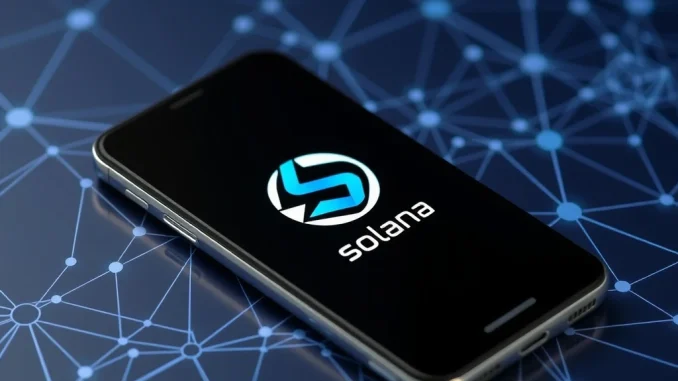
January 24, 2025: The launch of Solana Mobile’s second-generation Web3 smartphone, the Seeker, has catalyzed a dramatic market response, with its associated ecosystem token, SKR, skyrocketing over 200% in the days following its Token Generation Event (TGE). This surge underscores a pivotal experiment within the cryptocurrency sector: leveraging consumer hardware as a tangible driver for blockchain adoption and creating direct, tokenized value alignment between a physical product and its digital community.
Solana Seeker Smartphone: A Hardware Bet on Mainstream Crypto Adoption
Solana Mobile’s strategy represents a significant departure from traditional tech or crypto company playbooks. Instead of competing directly with flagship Android or iOS devices on pure specifications, the $500 Seeker smartphone is engineered from the ground up as a native portal to the Solana blockchain. The core thesis is to reduce the friction and complexity that often deter mainstream users from engaging with decentralized applications (dApps) and managing digital assets.
The device integrates several critical Web3 functionalities directly into its operating system. A secure, isolated “Seed Vault” houses private keys, removing the need for external hardware wallets or cumbersome seed phrase management on less secure devices. Furthermore, the phone features a built-in biometric signature system for transaction validation, allowing users to approve swaps, stakes, or transfers with a fingerprint or face scan directly within dApps. This seamless integration aims to make crypto interactions feel as native as sending a text message.
Perhaps most importantly, the Seeker provides direct access to the Solana dApp Store, a curated marketplace for blockchain applications. This bypasses traditional app store gatekeepers and policies that have historically been hostile to crypto, offering developers a direct channel to users and giving those users a unified hub for their on-chain activity. Solana Mobile reported over 150,000 pre-orders for the device’s first chapter, indicating substantial early interest from a dedicated community.
The SKR Token Launch and Mechanics Behind the Surge
The SKR token serves as the utility and governance asset for the growing Seeker ecosystem. With a fixed total supply of 10 billion tokens, its distribution was strategically designed to bootstrap usage and reward early adopters. Approximately 30% of the supply was allocated for a massive airdrop to Seeker device owners and active participants in the Solana mobile ecosystem, with claims processed directly through the phone’s integrated wallet.
The immediate price explosion of SKR can be attributed to a confluence of technical and behavioral factors common in nascent crypto markets, yet amplified by the unique hardware tie-in.
- Temporary Supply Scarcity: A significant portion of the airdropped tokens was immediately locked in staking contracts, attracted by an advertised Annual Percentage Yield (APY) nearing 24%. This staking mechanism actively removed liquid supply from the open market during the initial price discovery phase.
- Concentrated Demand at Launch: The token debuted with a relatively low Fully Diluted Valuation (FDV), which market participants often interpret as having higher potential upside. This, combined with the novelty and hype surrounding the physical product launch, created concentrated buying pressure.
- Low Initial Liquidity: New tokens typically launch on decentralized exchanges with limited liquidity pools. When buy orders outpace the available sell-side depth, even moderate demand can cause sharp price appreciations, a phenomenon known as a “liquidity squeeze.”
This dynamic created a powerful, if potentially transient, bullish feedback loop in the first 72 hours post-launch.
Contextualizing the Move: Hardware-Backed Tokens in Crypto History
The concept of linking a token to a physical hardware product is not entirely novel but has seen mixed results. Previous projects have attempted to tie mining devices or network routers to token rewards with varying degrees of long-term success. Solana’s approach differs by focusing on a mass-market consumer device (a smartphone) with clear utility beyond mere token generation. The value proposition of the SKR token is intrinsically linked to the growth and usage of the Seeker’s ecosystem—its dApp Store, staking services, and future developer initiatives—rather than just the act of owning the hardware.
This model draws parallels to successful ecosystem tokens in gaming or decentralized finance, where the token’s utility drives demand. The critical challenge, as seen in those sectors, is transitioning from speculative launch dynamics to sustainable, usage-driven demand. The Seeker’s success in attracting developers to build compelling mobile-first dApps will be the ultimate determinant of SKR’s long-term value floor.
Market Implications and Risks Following the Initial Spike
While a 200% gain captures headlines, seasoned market observers analyze the sustainability of such moves. The current price action for SKR is heavily influenced by distribution mechanics. The high staking APY, funded largely by token inflation, serves as a powerful incentive to lock tokens and discourage immediate selling. However, this also means the circulating supply will increase over time as staking rewards are distributed.
Key risks on the horizon include the eventual unlocking of staked tokens, the return of unclaimed airdrop tokens to the treasury (and potentially the market), and the natural cooling of the “novelty effect.” As liquidity deepens on exchanges, the market’s ability to absorb larger sell orders will be tested. The true test for SKR will begin once the initial airdrop and staking frenzy subsides, and price discovery becomes more closely tied to measurable metrics like active Seeker users, transaction volume through the dApp Store, and developer adoption.
Nevertheless, the powerful initial market response sends a clear signal. It demonstrates strong community belief in Solana’s hardware strategy and highlights a market appetite for investment vehicles directly tied to tangible products aiming to grow the crypto user base. Analysts at firms like ARK Invest have projected that the broader tokenization of real-world assets and systems could represent a multi-trillion-dollar opportunity by 2030. Solana’s Seeker and SKR token represent an early, ambitious attempt to tokenize the value of a consumer hardware ecosystem within that macro trend.
Conclusion
The explosive surge of the SKR token following the Solana Seeker smartphone launch is a multifaceted event. It is a story about innovative tokenomics, initial market mechanics, and a bold strategic bet by the Solana ecosystem. The Solana Seeker smartphone is more than just a new device; it is a testbed for a fully integrated Web3 experience. While the future price trajectory of the SKR token remains uncertain and subject to market forces, the successful hardware launch and subsequent token volatility have undeniably shifted the conversation around crypto adoption. They prove there is significant interest in bridging the digital asset world with physical, usable products, moving blockchain technology another step closer to everyday utility.
FAQs
Q1: What is the Solana Seeker smartphone?
The Solana Seeker is a $500 Android smartphone designed specifically for Web3 and cryptocurrency use. It features integrated security like a Seed Vault for private keys, a Solana dApp Store, and biometric transaction signing, aiming to make blockchain interactions seamless.
Q2: What is the SKR token and why did its price surge?
SKR is the native utility token of the Solana Seeker ecosystem. Its price surged over 200% primarily due to a combination of a large airdrop to phone users, immediate high-yield staking options that locked up supply, and concentrated buying pressure during its initial low-liquidity launch phase.
Q3: How is the SKR token distributed?
The token has a fixed supply of 10 billion. Roughly 30% was allocated to an airdrop for Seeker smartphone owners and active Solana mobile users. The remainder is allocated to the project treasury, team, and future ecosystem development.
Q4: What are the main risks for the SKR token after this surge?
Key risks include potential selling pressure when staked tokens unlock, the dilutionary effect of high staking APY rewards, and the need to transition from launch speculation to value driven by actual Seeker phone usage and dApp ecosystem growth.
Q5: How does this compare to Solana’s first phone, the Saga?
The Saga was Solana Mobile’s first-generation device, which later gained notoriety for its lucrative BONK token airdrop. The Seeker is a more affordable, refined second-generation device with a clearer focus on integrated Web3 utilities and a dedicated ecosystem token (SKR) from the outset.