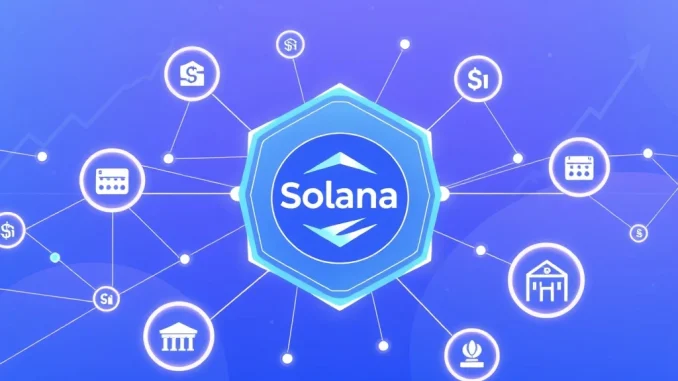
Global, May 2025: The Solana blockchain has solidified its role in the future of finance by surpassing $1.66 billion in tokenized real-world assets (RWAs). This crucial milestone, confirmed by on-chain data aggregators, highlights a significant pivot within the $24.83 billion RWA sector. The growth is primarily fueled by investor demand for stable, yield-generating blockchain assets like tokenized U.S. Treasury bills and short-term credit products, marking a maturation phase for decentralized finance.
Solana’s Strategic Advance in the Tokenized RWA Market
The $1.66 billion figure represents more than just capital inflow; it signifies growing institutional and retail trust in blockchain-based financial infrastructure. Real-world assets refer to tangible or traditional financial instruments—like government debt, real estate, or commodities—that are represented digitally on a blockchain. Solana’s high throughput and low transaction costs have positioned it as a competitive layer-1 platform for this asset class. Analysts note that the growth trajectory on Solana has accelerated sharply over the past twelve months, coinciding with broader macroeconomic trends seeking predictable yield outside traditional volatile crypto markets.
Drivers of Growth: Tokenized Treasuries and Credit Products
Two primary instruments are leading Solana’s rise in this sector: tokenized treasury bills and tokenized private credit. Platforms like Ondo Finance and Maple Finance have launched significant products on Solana, offering users exposure to U.S. Treasury yields or corporate debt through blockchain tokens. This model provides several advantages:
- Accessibility: Global investors can access U.S. Treasury yields without traditional brokerage barriers.
- Transparency: All transactions and underlying collateral are visible on the public blockchain.
- 24/7 Markets: These digital assets trade around the clock, unlike their traditional counterparts.
- Composability: Tokenized RWAs can integrate into broader decentralized finance (DeFi) protocols for lending or as collateral.
The appeal lies in the “stable yield” proposition. In a climate of economic uncertainty, assets backed by government debt or vetted credit agreements offer a perceived safety net while generating returns, a stark contrast to the speculative nature of many cryptocurrencies.
Contextualizing the $24.83 Billion RWA Landscape
Solana’s achievement must be viewed within the broader competitive landscape. The total value of tokenized RWAs across all blockchains now exceeds $24.83 billion, according to data from RWA.xyz. While Ethereum currently holds the largest market share, Solana’s recent growth rate is notable. Its market share has increased from approximately 3% to nearly 7% in the past year. This growth is not occurring in a vacuum. It reflects a strategic focus by developers and institutions who are building specifically for scale and cost-efficiency, two critical factors for mass adoption of financial products.
Technical Infrastructure and Institutional Trust
Solana’s architecture is a key factor in its RWA success. The network’s ability to process thousands of transactions per second at a fraction of a cent makes it economically viable to tokenize and trade smaller units of high-value assets. Furthermore, the development of the Solana Program Library (SPL) token standard and robust oracle networks like Pyth provide the necessary technical foundation for representing off-chain asset values accurately and securely. This technical reliability, combined with increasing regulatory clarity in jurisdictions like the European Union and parts of Asia, is building the authoritativeness required for large-scale financial adoption. Institutions are no longer just experimenting; they are deploying capital with clear operational expectations.
The Implications for Traditional and Decentralized Finance
The convergence of TradFi and DeFi, often called “on-chain finance,” is the central narrative behind Solana’s RWA milestone. The movement of treasury products on-chain suggests that blockchain technology is evolving beyond speculative assets to become a legitimate settlement layer for global capital markets. For traditional finance, it offers efficiency gains and new customer acquisition channels. For the native crypto ecosystem, it provides a bridge to trillions of dollars in traditional asset value, potentially bringing greater stability and diversified yield opportunities to DeFi platforms. However, this growth also brings heightened scrutiny regarding compliance, asset custody, and regulatory adherence, challenges the entire sector must navigate.
Conclusion
Solana’s $1.66 billion real-world asset milestone is a definitive signal of blockchain’s expanding utility in global finance. The growth, driven by yield-focused products like tokenized treasuries and credit, demonstrates a market demand for stability and income within the digital asset ecosystem. This achievement strengthens Solana’s position not just as a high-speed blockchain, but as a credible platform for the next generation of financial instruments. As the tokenized RWA market continues to expand toward and beyond its current $24.83 billion valuation, the infrastructure and trust being built today will likely define the landscape of on-chain finance for years to come.
FAQs
Q1: What are tokenized real-world assets (RWAs)?
Tokenized RWAs are digital representations of traditional physical or financial assets—like government bonds, real estate, or commodities—issued and traded on a blockchain. They combine the benefits of blockchain (transparency, divisibility, 24/7 trading) with the underlying value of established off-chain assets.
Q2: Why is Solana’s $1.66B RWA milestone significant?
This milestone is significant because it demonstrates substantial and growing trust in Solana’s blockchain to handle serious financial instruments. It moves the narrative beyond speculation and highlights its utility for stable, yield-generating applications, competing directly with traditional finance infrastructure.
Q3: What are the main types of RWAs driving growth on Solana?
The primary drivers are tokenized U.S. Treasury bills (offering exposure to government debt yields) and tokenized private credit or loans. These products appeal to investors seeking lower-risk returns compared to volatile cryptocurrencies.
Q4: How does this benefit the average investor?
It provides global access to investment vehicles that were previously difficult or expensive to access, such as U.S. Treasuries. It also allows for smaller investment amounts, 24/7 trading, and the potential to use these tokenized assets within other DeFi protocols for additional financial strategies.
Q5: What are the risks associated with tokenized RWAs?
Key risks include smart contract vulnerabilities, potential regulatory changes, the custody model of the underlying off-chain asset, and counterparty risk from the institution that issues the tokenized asset. Investors must assess the legal structure and issuer credibility alongside the technological risks.