Global, March 2025: The cryptocurrency market continues to navigate a complex corrective phase, with Solana (SOL) presenting particularly interesting technical patterns. As the blockchain platform trades below the psychologically significant $120 level, market analysts are closely monitoring two specific price zones that historical data suggests could determine the asset’s next major directional move. This analysis examines the technical foundations, historical precedents, and market dynamics surrounding these critical support areas.
Understanding Solana’s Current Market Structure
Solana has experienced significant volatility throughout 2024 and into 2025, reflecting broader cryptocurrency market trends while also responding to platform-specific developments. The blockchain’s performance has been characterized by rapid growth periods followed by substantial corrections, creating distinct technical patterns that analysts use to identify potential future movements. The current market phase shows Solana struggling to maintain momentum above $120, a level that previously served as both support and resistance during different market cycles.
Technical analysts note that failed recovery attempts below this threshold typically indicate broader market weakness rather than isolated asset performance. The cryptocurrency’s inability to sustain rallies above this level suggests that market participants remain cautious about committing capital at current valuations. This behavior aligns with historical patterns observed during previous cryptocurrency market corrections, where assets test and retest key psychological levels before establishing new directional trends.
The First Critical Support Zone: $60-$70 Range
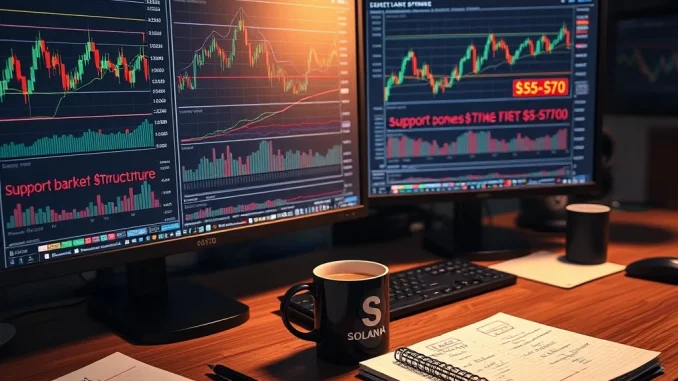
Market analysts identify the $60-$70 price range as Solana’s first significant support zone based on multiple technical factors. This area represents a confluence of historical price action, volume profile data, and Fibonacci retracement levels from previous market cycles. During the 2023-2024 bull market, this zone served as a launching pad for Solana’s most substantial rally, with the asset gaining approximately 400% from these levels before reaching its all-time high.
The technical significance of this zone extends beyond simple price memory. On-chain data reveals substantial accumulation occurred between $60 and $70 during previous market cycles, creating what analysts call “volume nodes” where significant trading activity historically concentrated. These areas often provide stronger support than arbitrary price levels because they represent zones where market participants previously demonstrated conviction through actual buying and selling activity.
- Historical Significance: This range marked the transition from bear market to bull market in 2023
- Volume Profile: High trading volume established this as a value area during accumulation phases
- Technical Confluence: Multiple Fibonacci levels converge in this price range
- Psychological Factor: Round numbers often attract institutional and retail interest
Market Mechanics Behind Support Zones
Support zones in cryptocurrency markets function differently than in traditional financial markets due to the 24/7 trading environment, global participation, and different market microstructure. When assets approach historically significant support areas, several market mechanisms typically activate. Algorithmic trading systems often increase buying activity near these levels based on programmed parameters, while human traders watch for price reactions that might signal reversal opportunities.
The $60-$70 zone for Solana represents more than just a price level—it embodies a collective market memory of where value previously emerged. Market participants who missed earlier accumulation opportunities often view retests of these zones as second-chance entries, potentially creating buying pressure that stabilizes prices. However, if fundamental conditions have deteriorated significantly since the zone was established, this historical support may prove less reliable than in previous cycles.
The Secondary Demand Zone: $25-$35 Historical Foundation
Should the $60-$70 support zone fail to hold, analysts point to the $25-$35 range as Solana’s next substantial demand area. This zone carries profound historical significance, representing the price range from which Solana launched its monumental 2021-2022 rally. During that period, Solana transformed from a relatively obscure blockchain project to a top-tier cryptocurrency, with its price increasing nearly 100-fold from these levels at the peak of the bull market.
The $25-$35 zone represents what technical analysts describe as “generational support”—a price area so historically significant that it tends to attract substantial buying interest across multiple market cycles. This zone coincides with Solana’s breakout above its previous all-time high from 2021, creating a technical phenomenon known as “support turned resistance turned support again.” Market psychology suggests that returning to this foundational level would represent a complete retracement of the entire bull market structure, potentially resetting market dynamics entirely.
| Price Zone | Historical Role | Time Period | Subsequent Performance |
|---|---|---|---|
| $25-$35 | Launch pad for 2021 bull run | Q1 2021 | +9,800% to ATH |
| $60-$70 | Accumulation zone 2023 | H2 2023 | +400% to local high |
| $120+ | Resistance turned support | 2024 | Failed multiple tests |
Technical Indicators and Warning Signals
Multiple technical indicators currently flash cautionary signals for Solana and the broader cryptocurrency market. The Relative Strength Index (RSI) on weekly timeframes shows bearish divergence, with price making lower highs while momentum indicators make higher highs—a classic warning sign of weakening trend strength. Additionally, trading volume during recent decline phases has exceeded volume during rally attempts, suggesting distribution rather than accumulation is occurring.
On-chain metrics provide further context for Solana’s technical position. Network activity, while still robust compared to many blockchain platforms, has shown signs of moderation from peak levels. Transaction counts and active addresses remain elevated historically but have plateaued in recent months. This technical backdrop creates an environment where support zones become increasingly important as potential stabilization areas, but their effectiveness depends on both technical and fundamental factors aligning.
- Volume Analysis: Declining volume on rallies suggests weakening buyer conviction
- Moving Averages: Price trading below key weekly moving averages indicates bearish structure
- Market Structure: Lower highs and lower lows confirm corrective phase
- Sentiment Indicators: Fear and Greed Index shows extreme fear in cryptocurrency markets
The Role of Broader Market Conditions
Solana’s price action does not occur in isolation from broader cryptocurrency and financial market trends. The asset’s performance correlates significantly with Bitcoin and Ethereum movements, particularly during market stress periods. Current macroeconomic conditions, including interest rate environments, inflation concerns, and geopolitical tensions, create headwinds for risk assets like cryptocurrencies. These factors influence whether historical support zones will hold or break during the current market phase.
Institutional participation represents another critical variable. During previous cycles, institutional interest often emerged near key technical levels, providing the buying pressure necessary to reverse downtrends. Current data shows mixed institutional sentiment, with some entities continuing accumulation while others reduce exposure. The reaction at Solana’s identified support zones will likely provide clarity about whether institutional capital views current levels as attractive entry points or premature during an ongoing correction.
Historical Precedents and Pattern Recognition
Cryptocurrency markets exhibit repetitive patterns across cycles, though never in identical form. Analyzing Solana’s previous interactions with key support zones provides context for potential future behavior. During the 2022 bear market, Solana tested the $25-$35 zone multiple times before establishing it as a multi-month bottom. This process involved several false breakdowns below the zone followed by rapid recoveries—a pattern technical analysts describe as “bear traps” designed to shake out weak hands before sustainable rallies.
The $60-$70 zone played a different historical role, serving as consolidation area during the early stages of the 2023 rally rather than as a bear market bottom. This distinction matters because zones that function as accumulation areas during bull markets may provide different types of support than zones that served as bear market bottoms. The former often involves more gradual buying over extended periods, while the latter typically features rapid, high-conviction accumulation during moments of peak fear.
Pattern recognition suggests that if Solana approaches the $60-$70 zone, market participants should monitor several key behaviors: trading volume spikes, order book depth at these levels, and the speed of any potential breakdown. Historical data indicates that the most sustainable bottoms form when prices spend extended time testing support zones rather than bouncing immediately. This process allows for distribution of assets from weak to strong hands, creating a more stable foundation for future advances.
Conclusion: Navigating Solana’s Critical Juncture
Solana stands at a technical crossroads, with two historically significant price zones likely to determine its next major market move. The $60-$70 range represents the immediate support zone where previous accumulation occurred, while the $25-$35 zone embodies the foundational level from which Solana’s most impressive rally launched. Market participants should monitor these areas not as precise price predictions but as zones of increased probability for significant market reactions.
The cryptocurrency’s ability to hold these support zones will depend on both technical factors and fundamental developments within the Solana ecosystem and broader blockchain industry. Network upgrades, developer activity, adoption metrics, and competitive positioning will ultimately determine whether historical support translates to future price stability. As with all technical analysis, these zones represent areas of interest rather than guarantees, reminding investors that cryptocurrency markets remain influenced by both pattern recognition and unpredictable innovation.
FAQs
Q1: What makes the $60-$70 price range significant for Solana?
This zone represents a historical accumulation area where substantial trading volume previously occurred, creating what analysts call a “volume node.” It served as the launch point for Solana’s 2023-2024 rally and aligns with multiple Fibonacci retracement levels from previous market cycles.
Q2: Why is the $25-$35 zone considered “generational support” for Solana?
This price range marks where Solana broke out to new all-time highs in 2021, beginning its transformation into a top-tier cryptocurrency. The zone represents the foundation of Solana’s entire bull market structure and has profound psychological significance for long-term market participants.
Q3: How do support zones function differently in cryptocurrency versus traditional markets?
Cryptocurrency support zones operate in a 24/7 global market with different microstructure, often showing stronger reactions at round numbers due to retail participation. Algorithmic trading plays a significant role, and historical levels sometimes hold more weight due to the market’s shorter history and stronger collective memory of key price points.
Q4: What technical indicators suggest Solana is in a corrective phase?
Multiple indicators flash caution, including bearish RSI divergence on weekly charts, price trading below key moving averages, declining volume on rallies compared to declines, and a market structure of lower highs and lower lows—all classic signs of corrective market action.
Q5: Can historical support zones fail during severe market conditions?
Yes, historical support represents probability zones rather than guarantees. During extreme market stress or fundamental deterioration, even historically significant levels can break. The 2022 cryptocurrency bear market demonstrated multiple instances where long-standing support zones failed before eventually becoming resistance during recovery attempts.