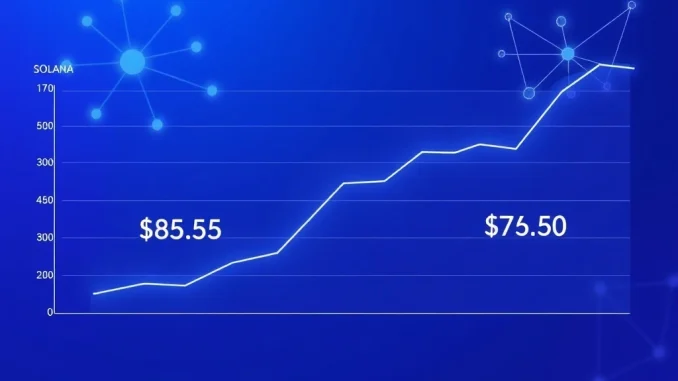
Global, May 2025: The Solana blockchain network enters a pivotal phase as its native cryptocurrency, SOL, approaches a decisive technical juncture. Market analysts and network observers now focus intently on two specific price thresholds: the $85.55 resistance and $76.70 support levels. These levels are not arbitrary numbers but represent significant psychological and technical barriers that will likely shape SOL’s market trajectory throughout 2026. This analysis comes at a crucial time, as the Solana development community prepares for a series of scheduled network upgrades designed to enhance performance, security, and scalability. The interplay between these technical market levels and fundamental network improvements creates a complex landscape for investors and developers alike.
Solana’s 2026 Price Outlook: A Technical Perspective
Technical analysis provides a framework for understanding market sentiment and potential price movements. For Solana, the $85.55 level represents a formidable resistance zone. Historical data shows this price point has acted as both support and resistance multiple times in recent market cycles. A sustained break above this level, confirmed by increased trading volume, could signal a shift in market structure and open a path toward higher valuations. Conversely, the $76.70 level serves as a critical support floor. This zone has provided a foundation for price recoveries during previous market corrections. A decisive break below this support, especially on high volume, would indicate weakening demand and could lead to a test of lower price levels. Market technicians monitor these levels alongside other indicators like moving averages, relative strength, and on-chain transaction flows to gauge the balance of power between buyers and sellers.
The Role of Network Upgrades in Solana’s Valuation
Beyond pure price action, Solana’s fundamental value proposition is intrinsically linked to its technological roadmap. The planned 2026 network upgrades are not mere incremental improvements but are designed to address core challenges and expand the network’s capabilities. These upgrades typically focus on several key areas:
- Transaction Processing: Enhancements to the Sealevel parallel execution runtime to increase transactions per second (TPS) and reduce latency.
- Network Stability: Improvements to Turbine, the block propagation protocol, and Gulf Stream, the mempool-less transaction forwarding protocol, to bolster network resilience.
- Developer Experience: Upgrades to the Solana Program Library (SPL) and core development tools to lower barriers for building decentralized applications (dApps).
- Validator Economics: Adjustments to staking rewards, slashing conditions, and delegation mechanisms to ensure a robust and decentralized validator set.
Successful implementation of these upgrades can strengthen network effects, attract more developers and users, and ultimately support the utility and demand for the SOL token. History shows that major blockchain upgrades can serve as catalysts for price revaluation, but the market’s reaction often depends on the seamless execution and immediate tangible benefits of the changes.
Historical Context: Learning from Past Market Cycles
Solana’s market history provides essential context for its current position. The network experienced rapid growth and adoption in 2021, followed by a significant contraction during the broader crypto market downturn. It also faced well-documented network outages, which impacted investor confidence. The development team’s response to these challenges—through rigorous testing, client diversity initiatives, and protocol improvements—has been a focal point for the community. The 2026 upgrade cycle represents a continuation of this maturation process. Analysts often compare Solana’s journey to other layer-1 blockchains that successfully navigated early instability to achieve greater reliability and market share. This historical perspective reminds market participants that blockchain development is iterative, and long-term value accrual is often tied to sustained technical progress and ecosystem growth rather than short-term price fluctuations.
Market Dynamics and External Factors Influencing SOL
While internal network developments are crucial, Solana does not exist in a vacuum. Broader cryptocurrency market trends exert a powerful influence. The regulatory environment for digital assets continues to evolve, with clarity from major jurisdictions potentially impacting investor appetite. Macroeconomic conditions, including interest rate policies and institutional adoption trends, also play a significant role in capital flows into the crypto asset class. Furthermore, competitive dynamics are intense. Solana competes for developers, users, and market capitalization with other smart contract platforms like Ethereum, Avalanche, and Cardano. Its ability to differentiate through superior speed, lower cost, or unique ecosystem applications will be a key determinant of its market position. The 2026 upgrades are, in part, a strategic effort to solidify and advance its competitive advantages in this crowded field.
Expert Analysis on Support and Resistance Psychology
Financial market experts emphasize that key support and resistance levels often become self-fulfilling prophecies due to collective market psychology. A large number of traders and algorithms place buy orders near established support, like $76.70, creating concentrated demand. Similarly, sell orders cluster near resistance, such as $85.55, creating a supply overhang. When these levels break, it can trigger a cascade of stop-loss orders or momentum-driven trading, leading to accelerated price movements. For a blockchain asset like SOL, these technical levels interact with fundamental news flow. A positive development, such as the successful rollout of a major upgrade, can provide the impetus to overcome resistance. Conversely, a network issue or negative broader market sentiment can amplify selling pressure at support. Savvy investors monitor both the technical chart structure and the calendar of fundamental events to assess probable outcomes.
Conclusion: A Defining Period for Solana
The convergence of Solana’s technical price action around the $85.55 resistance and $76.70 support levels with a scheduled series of network upgrades sets the stage for a defining period in 2026. The price outlook for SOL will be shaped by the market’s interpretation of both its immediate technical strength and the long-term value created by its evolving technology. A break above resistance could reaffirm bullish narratives centered on scalability and adoption, while a failure to hold support might signal a period of consolidation or reevaluation. Ultimately, the Solana price outlook for 6 rests on the network’s ability to execute its vision, improve reliability, and grow its ecosystem, transforming technical upgrades into tangible utility that sustains and increases demand for the SOL token. The coming months will provide critical evidence of whether the network can successfully navigate this complex juncture.
FAQs
Q1: What do the $85.55 and $76.70 levels specifically mean for Solana’s price?
These levels are identified by market analysts as key technical thresholds. The $85.55 level is a resistance point where selling pressure has historically increased, potentially halting upward moves. The $76.70 level is a support point where buying interest has historically emerged, potentially halting declines. Their significance is derived from past price action and market psychology.
Q2: How do network upgrades typically affect a cryptocurrency’s price?
Network upgrades can affect price by altering the fundamental utility and security of the blockchain. Successful upgrades that improve performance, reduce costs, or add features can increase demand for the network and its native token. However, the market reaction depends on whether the upgrade meets expectations and is implemented smoothly without disruptions.
Q3: What are the main goals of Solana’s planned 2026 upgrades?
While specific details are outlined by the Solana Foundation closer to deployment, typical upgrade goals include enhancing network speed and throughput (TPS), improving stability and resilience to prevent outages, upgrading developer tools and execution environments, and refining the economic model for validators and stakers to ensure decentralization.
Q4: Is technical analysis reliable for predicting cryptocurrency prices?
Technical analysis is a tool for assessing market sentiment and probability, not a guaranteed prediction method. It is based on historical patterns and volume data. For cryptocurrencies, it should be used in conjunction with fundamental analysis of the technology, adoption metrics, developer activity, and broader market conditions.
Q5: What other factors, besides network upgrades, could influence Solana’s price in 2026?
Multiple external factors could influence SOL’s price, including overall cryptocurrency market trends (bull or bear markets), regulatory developments globally, adoption by major institutions or for new use cases (like DeFi, NFTs, or real-world assets), competitive developments from other blockchains, and broader macroeconomic conditions affecting risk assets.