
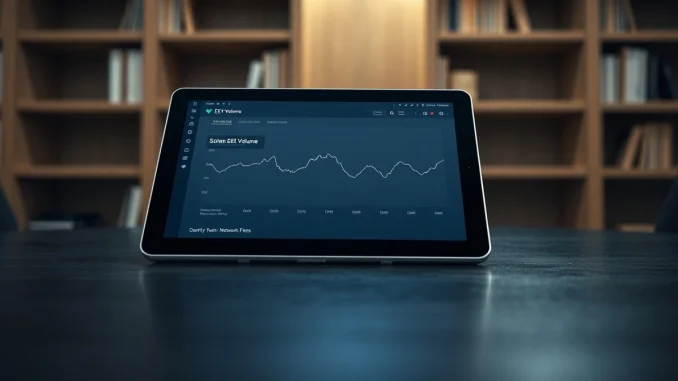
Solana’s decentralized exchange activity has slumped to its weakest point since late 2024, putting intense pressure on the SOL token’s essential $80 price floor. Data from DefiLlama shows monthly DEX volumes on the network fell to $55.5 billion in March 2026, marking a steep decline from earlier highs. This drop in core trading activity has directly contributed to a 42% reduction in network fees, raising questions about SOL’s near-term stability. Traders are now watching to see if the network’s underlying strength in decentralized application revenue can offset the bearish pressure from fading trading volumes.
Solana DEX Volumes Hit a Wall
According to DefiLlama, Solana’s decentralized exchange volumes in March 2026 represented the lowest monthly total since September 2024. The $55.5 billion figure is a significant retreat from the peaks seen earlier in the year. This isn’t an isolated trend. Network fees, which are heavily driven by DEX transactions, followed suit. Fees collected in March totaled approximately $18.5 million, down from around $30 million in January. This correlation is clear. Fewer trades mean less fee revenue for the network.
Also read: Bitfarms' Stunning Pivot: $285M Loss Amid Bitcoin Slump Ignites 6.6% Share Surge on AI Bet
Analysts note this creates a headwind for SOL’s price. “Transaction fees are a direct measure of economic activity on a blockchain,” said a market analyst from data firm IntoTheBlock. “When that activity cools, it often precedes or accompanies price consolidation or correction.” The SOL token has felt this pressure, facing an 11% pullback after being rejected at the $93 level last week. It has repeatedly tested the $80 support zone, a level it has not decisively broken below since late 2025.
The Ethereum Layer 2 Challenge Intensifies
Solana’s declining dominance in DEX trading isn’t happening in a vacuum. The competitive field is shifting rapidly. While Solana still leads in absolute DEX volume, Ethereum’s aggregated ecosystem is gaining ground. When combining the volumes from Ethereum’s mainnet with its major Layer 2 networks—Base, Arbitrum, Polygon, and Optimism—the picture changes. Data shows this aggregated Ethereum ecosystem captured 42% of the total DEX market share in March, up from 33% in January.
Also read: Bitcoin-Backed Bond Reality Check: Moody's Slaps New Hampshire with Speculative Rating
This surge is largely due to incentives designed to push activity onto Layer 2 rollups. These solutions use temporary data blobs to drastically lower transaction costs for users. The strategy is working. Ethereum’s mainnet DEX volume alone was $41 billion in March, but the Layer 2 networks added tens of billions more. This collective growth presents a structural challenge for Solana, which has marketed itself as a single, fast, and low-cost chain. The implication is that traders now have more viable, low-cost options, potentially fragmenting liquidity and volume.
A Fundamental Cushion in DApp Revenue
Despite the DEX slowdown, Solana displays remarkable strength in another key metric: high-revenue decentralized applications. No other blockchain network hosts as many applications generating substantial income. DefiLlama data from the past 30 days shows Solana leads with 13 DApps each earning $1 million or more in revenue. Ethereum follows with 11, while BNB Chain and Base have just 4 each.
This revenue is a powerful signal. It suggests developers are building sustainable businesses on Solana, not just speculative trading venues. Protocols like Pump, Helium Network, and ORE Protocol are cited as examples. “Protocol revenue drives long-term investor attention,” notes a report from blockchain analytics firm Artemis. “A healthy, revenue-generating ecosystem is a fundamental cushion against short-term market volatility.” This could be the factor that prevents a deeper SOL price correction, even as trading activity wanes.
Network Health Beyond Trading Volumes
To assess Solana’s true position, one must look beyond DEX charts. The network’s total value locked (TVL) remains substantial at $6.3 billion, though it trails Ethereum’s $54.1 billion significantly. However, in a striking contrast, Solana generated 80% more in total network fees than Ethereum over the last 30 days. This paradox—higher fees but lower TVL—highlights the different economic models and user behaviors on each chain.
Solana’s model has historically relied on high-throughput, low-cost transactions to attract users. The recent fee decline directly challenges that narrative. But the strong DApp revenue offers a counter-narrative of depth and utility. What this means for investors is a mixed signal. The short-term price action is bearish, pressured by declining usage metrics. The long-term fundamental story, supported by developer activity and application revenue, remains notably strong. The battle at the $80 support level will test which narrative the market prioritizes.
Historical Context and Market Sentiment
The current test at $80 is not Solana’s first encounter with volatility. The network has weathered several significant downturns, including major outages in 2025 that shook investor confidence. Its recovery from those events was a key part of its 2024 rally. The current pressure stems from a different source: competitive displacement and a broader cooling in cryptocurrency trading enthusiasm.
Market sentiment, as measured by funding rates in perpetual futures markets, has turned neutral to slightly negative for SOL. This suggests leveraged traders are not aggressively betting on a rebound. Open interest has declined alongside the price, indicating a reduction in speculative positioning. This could actually be a healthy reset, reducing the risk of a cascading liquidation event if $80 breaks. The market is waiting for a clearer signal.
Conclusion
Solana faces a clear inflection point. A sharp contraction in DEX volumes and network fees has pushed its native token, SOL, against a critical support level at $80. The rising dominance of aggregated Ethereum Layer 2 solutions presents a sustained competitive threat. However, the network’s unparalleled strength in hosting high-revenue decentralized applications provides a fundamental bulwark. The outcome of this test will likely depend on whether short-term trading flows or long-term developer economics exert greater influence on market psychology. A hold above $80 could reinforce the resilience narrative, while a break below may signal a deeper correction toward $75.
FAQs
Q1: What caused Solana’s DEX volumes to drop?
Data shows Solana’s decentralized exchange volumes fell to $55.5 billion in March 2026, the lowest since September 2024. This is primarily due to a broader cooling in crypto trading activity and increased competition from lower-cost Ethereum Layer 2 networks, which are attracting users.
Q2: Why are network fees important for SOL’s price?
Network fees are a direct indicator of economic activity and demand for block space. Lower fees, driven by lower DEX volumes, suggest reduced usage. This can negatively impact investor sentiment and the perceived value of the native token, as it implies lower future revenue potential for the network.
Q3: How does Solana’s DApp revenue compare to Ethereum’s?
Despite lower DEX volumes, Solana leads all blockchains in the number of high-revenue decentralized applications. In the last 30 days, 13 Solana DApps earned $1 million or more, compared to 11 on Ethereum. This suggests a strong and sustainable developer ecosystem beyond just trading.
Q4: What is the significance of the $80 support level for SOL?
The $80 price level has acted as a key floor for SOL on multiple occasions in recent months. A sustained break below it could trigger further selling, with analysts eyeing a potential move toward $75. Holding above it would signal that underlying demand remains despite weak trading volumes.
Q5: How are Ethereum Layer 2 networks affecting Solana?
Ethereum Layer 2 networks like Base and Arbitrum offer very low transaction fees. By aggregating their volumes with Ethereum’s mainnet, the combined ecosystem’s DEX market share rose to 42% in March 2026. This provides traders with cheap alternatives, directly competing with one of Solana’s primary value propositions.

This article was produced with AI assistance and reviewed by our editorial team for accuracy and quality.




Be the first to comment