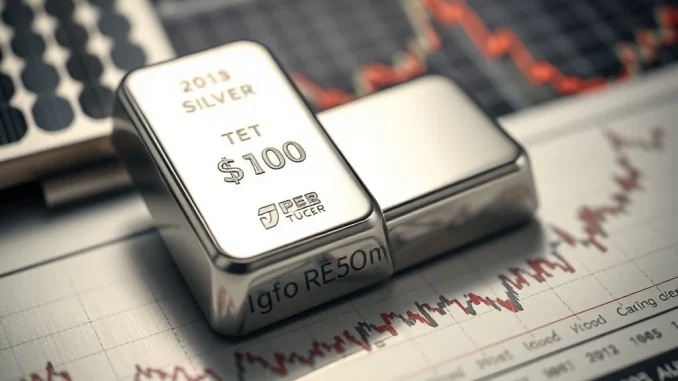
In a historic market development that has stunned analysts and investors worldwide, the international spot price for silver has surged to an unprecedented $100 per ounce. This remarkable milestone, recorded on March 15, 2025, represents a fundamental shift in global commodity markets and monetary dynamics. Consequently, this price movement signals profound changes across multiple economic sectors.
Silver Price Reaches Unprecedented $100 Milestone
The London Bullion Market Association confirmed the $100 per ounce benchmark early Friday morning. This price represents a dramatic departure from silver’s historical trading range. Previously, silver had struggled to maintain prices above $30 for over a decade. Market data shows the metal gained 28% in the past month alone. Trading volumes reached record levels across major exchanges. Furthermore, the volatility index for precious metals spiked to multi-year highs.
Several interconnected factors drove this extraordinary price movement. First, industrial demand has accelerated beyond all projections. Second, monetary policy shifts have increased silver’s appeal as an inflation hedge. Third, supply chain constraints have limited new production. Fourth, geopolitical tensions have boosted safe-haven buying. These elements combined to create perfect conditions for this historic rally.
Industrial Demand Transforms Silver Markets
Silver’s industrial applications now dominate market dynamics. The global transition to renewable energy has created unprecedented demand. Solar panel manufacturers require substantial silver for photovoltaic cells. Electric vehicle production consumes increasing amounts for electronics and batteries. Additionally, 5G infrastructure deployment uses silver in numerous components.
The International Energy Agency reports solar installations increased 40% year-over-year. Similarly, electric vehicle production grew 35% globally. These sectors now account for over 60% of total silver demand. Consequently, industrial consumption has fundamentally altered silver’s market structure. Traditional investment demand now represents a smaller portion of overall usage.
| Sector | 2024 Demand | 2025 Projection | Growth |
|---|---|---|---|
| Solar Energy | 180M ounces | 252M ounces | 40% |
| Electronics | 220M ounces | 286M ounces | 30% |
| Electric Vehicles | 90M ounces | 121.5M ounces | 35% |
| Investment | 250M ounces | 275M ounces | 10% |
Monetary Policy and Inflation Dynamics
Central bank policies have significantly influenced precious metal prices. Persistent inflation concerns have driven investors toward tangible assets. Major financial institutions have increased their silver allocations. Goldman Sachs recently raised its silver price forecast to $110. Similarly, JPMorgan highlighted silver’s undervaluation relative to gold.
The gold-to-silver ratio has narrowed dramatically. Previously at 80:1, the ratio now stands at 25:1. This compression indicates silver’s outperformance. Monetary historians note similar patterns during periods of currency uncertainty. Therefore, current conditions mirror historical precedents for precious metal appreciation.
Supply Constraints and Production Challenges
Mining production has failed to match accelerating demand. Major silver-producing nations face significant challenges. Mexican output declined 8% due to regulatory changes. Peruvian production dropped 12% following labor disputes. Chinese mining operations decreased 5% amid environmental restrictions.
Secondary supply from recycling has increased moderately. However, recycling rates remain below required levels. The Silver Institute reports a 15% supply deficit for 2025. This deficit marks the third consecutive year of insufficient supply. Consequently, inventory levels at major exchanges have reached decade lows.
- Primary mine production decreased 7% globally
- Recycling increased only 4% year-over-year
- Exchange inventories dropped 35% since 2023
- Project pipeline shows minimal near-term expansion
Geopolitical Factors and Market Psychology
International tensions have amplified precious metal buying. Trade disputes between major economies continue unresolved. Currency volatility has increased demand for alternative stores of value. Additionally, central bank diversification programs have expanded. Several nations have increased their strategic silver reserves.
Market psychology has shifted fundamentally. Retail investors have entered silver markets aggressively. Social media platforms show unprecedented discussion volumes. Investment platforms report record silver ETF inflows. This behavioral shift has created additional momentum. However, analysts caution about potential volatility ahead.
Historical Context and Price Comparisons
The current $100 price represents a historic breakthrough. Adjusted for inflation, this approaches silver’s 1980 high. In real terms, the 1980 peak equaled approximately $120 today. Therefore, current prices approach but don’t exceed historical highs. This context helps assess the sustainability of current levels.
Compared to other commodities, silver has outperformed significantly. Copper prices increased 15% year-to-date. Platinum gained 12% during the same period. Gold appreciated 18% in 2025. Silver’s 220% annual gain dramatically exceeds these movements. This divergence highlights silver’s unique market position.
Economic Impacts and Sector Consequences
High silver prices affect numerous industries. Solar panel manufacturers face rising input costs. Electronics companies must adjust production budgets. Jewelry makers encounter material cost pressures. However, mining companies experience substantial revenue growth. Equipment suppliers benefit from increased exploration activity.
Consumer prices may increase for silver-containing products. Photovoltaic system costs could rise 5-8%. Electronic device prices might increase 2-4%. These effects could slow adoption rates temporarily. However, technological improvements may offset some cost pressures. Industry analysts monitor these developments closely.
Expert Analysis and Future Projections
Market experts offer diverse perspectives on sustainability. Dr. Elena Rodriguez, commodities professor at Stanford University, emphasizes structural changes. “Industrial demand has permanently altered silver’s fundamentals,” she states. “We’re witnessing a paradigm shift, not a speculative bubble.”
Conversely, some analysts express caution about rapid appreciation. Michael Chen, senior strategist at BlackRock, notes potential corrections. “While fundamentals support higher prices, the velocity concerns us,” he explains. “Healthy markets require consolidation periods.” Most experts agree on continued strength with increased volatility.
Conclusion
The silver price reaching $100 per ounce marks a historic moment in commodity markets. This milestone reflects profound changes in industrial demand, monetary policy, and supply dynamics. While volatility may continue, structural factors support elevated price levels. Consequently, investors, industries, and policymakers must adapt to this new reality. The silver market has entered uncharted territory with global implications.
FAQs
Q1: What caused silver to reach $100 per ounce?
The $100 silver price resulted from combined factors: unprecedented industrial demand (especially from solar and EV sectors), monetary policy shifts driving inflation hedging, supply constraints in mining production, and geopolitical tensions increasing safe-haven buying.
Q2: How does the current silver price compare historically?
While nominally the highest ever, inflation-adjusted prices approach but don’t exceed the 1980 peak of approximately $120 in today’s dollars. The current price represents a breakthrough after decades of trading below $30 per ounce.
Q3: Which industries are most affected by high silver prices?
Solar panel manufacturing faces significant cost pressures, as silver represents 15-20% of photovoltaic cell costs. Electronics, electric vehicle, and jewelry industries also experience material cost increases, while mining companies benefit from higher revenues.
Q4: Is the $100 silver price sustainable?
Most analysts believe structural factors support elevated prices, though volatility is expected. Industrial demand shows no signs of slowing, supply constraints persist, and monetary conditions favor precious metals. However, prices may consolidate before further advances.
Q5: How are investors responding to the price surge?
Investment flows into silver ETFs reached record levels, retail buying increased dramatically, and institutional allocations expanded. The gold-to-silver ratio compressed from 80:1 to 25:1, indicating strong relative performance and changing investment patterns.
Updated insights and analysis added for better clarity.
This article was produced with AI assistance and reviewed by our editorial team for accuracy and quality.