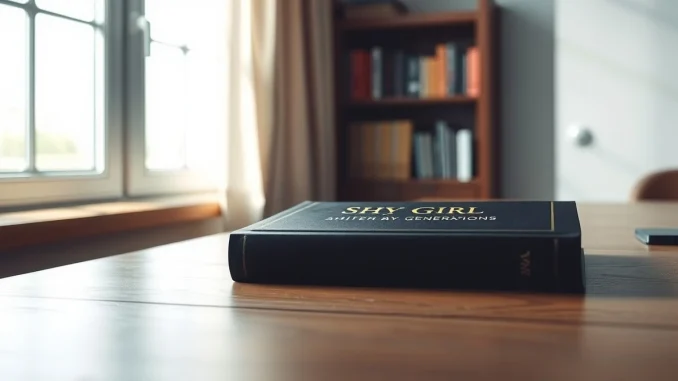
In a landmark decision that has sent shockwaves through the publishing industry, Hachette Book Group announced on March 21, 2026, that it would withdraw the horror novel ‘Shy Girl’ from publication following substantial concerns that artificial intelligence generated the text. This unprecedented move represents one of the first major instances where a traditional publisher has publicly retracted a title specifically due to AI authorship allegations, setting a crucial precedent for literary authenticity standards.
Hachette’s Decision to Pull ‘Shy Girl’
Hachette Book Group, one of the world’s largest publishing houses, confirmed it would not publish ‘Shy Girl’ in the United States this spring. Furthermore, the company stated it would discontinue the book in the United Kingdom, where it had already reached the market. The publisher based this decisive action on a thorough internal review of the novel’s text. Consequently, this review followed mounting speculation from literary reviewers on platforms including GoodReads and YouTube. These reviewers had consistently noted unusual textual patterns suggesting non-human authorship.
The New York Times reported it had contacted Hachette about these concerns just one day before the official announcement. Industry analysts immediately recognized the significance of this development. Publishing contracts traditionally include warranties regarding originality and authorship. Therefore, confirmed AI generation could constitute a material breach of these agreements.
Author’s Defense and Industry Practices
Author Mia Ballard vehemently denied using AI to write ‘Shy Girl’ in an email statement to The New York Times. Instead, Ballard attributed the problematic text to an acquaintance she hired to edit the original, self-published version. Ballard stated she is pursuing legal action regarding the matter. Additionally, she expressed profound personal distress, noting her mental health had suffered and her reputation was damaged for actions she claims she did not commit.
This controversy highlights a critical tension in modern publishing. Writer and industry observer Lincoln Michel, along with other experts, has noted that U.S. publishers frequently acquire titles that have seen prior publication in other forms. In these cases, publishers often perform minimal additional editing. This standard practice now faces scrutiny in the age of generative AI, where the line between human editing and machine generation can become dangerously blurred.
The Technical and Ethical Challenge of AI Detection
The ‘Shy Girl’ incident underscores a growing technical crisis for the publishing industry. Currently, no universally reliable tool exists for definitively detecting AI-generated text. Detection software often analyzes statistical patterns, such as:
- Perplexity: Measures how predictable text is to a language model.
- Burstiness: Evaluates variation in sentence structure and length.
- Semantic coherence: Assesses logical flow and depth of ideas across paragraphs.
However, these tools yield probabilities, not certainties. Sophisticated human editing can mask AI origins, while some human writing may falsely trigger AI detectors. This ambiguity places publishers in a difficult position. They must balance due diligence with the risk of falsely accusing authors. The Association of American Publishers has established no formal guidelines on this issue as of March 2026, leaving each house to develop its own policy.
Broader Impact on Literary Trust and Contracts
The withdrawal of ‘Shy Girl’ has immediate and far-reaching consequences. Primarily, it erodes reader trust in new authors and imprints. When consumers question a book’s provenance, they may hesitate to purchase it. This dynamic could disproportionately affect debut and indie authors who lack established reputations. Moreover, literary agents now face pressure to implement more rigorous vetting processes for client submissions.
Publishing contracts will likely undergo significant revision. Future agreements may explicitly require authors to warrant that their work is primarily human-generated. They might also define permissible levels of AI assistance for tasks like grammar checking or research. The following table outlines potential new contractual clauses:
| Contractual Element | Traditional Clause | Potential AI-Era Adaptation |
|---|---|---|
| Authorship Warranty | Warranty of original, non-plagiarized work | Warranty of primarily human authorship with disclosure of AI tools used |
| Acceptance Criteria | Manuscript meets professional standards | Manuscript passes specified AI detection screening at acquisition |
| Remedies for Breach | Advance repayment, copyright reversion | Specific penalties for material AI misrepresentation |
Simultaneously, the controversy raises ethical questions about ghostwriting and collaboration. The publishing industry has long accepted work produced by ghostwriters for public figures. The central issue with AI is not collaboration itself, but transparency. Readers and publishers have a reasonable expectation to know a work’s fundamental nature of creation.
Historical Context and Legal Precedents
While the ‘Shy Girl’ case is novel in its AI focus, publishing history contains relevant precedents. For instance, the 1970s saw controversy around the purported autobiography of Howard Hughes, later revealed to be a fabrication. More recently, numerous cases of plagiarism have led to book retractions. The fundamental legal principle involves the warranty of authorship in publishing contracts. A proven material misrepresentation about a work’s origin typically voids the agreement.
Legal experts suggest Ballard’s threatened lawsuit would hinge on several factors. First, can Hachette conclusively prove the text is AI-generated? Second, does Ballard’s contract contain warranties that would be breached by such a finding? Third, if an editor introduced AI-generated text, does liability fall on the author for failing to supervise the work? These unresolved questions will likely shape publishing law for years to come.
The Path Forward for Publishers and Authors
In response to this crisis, industry stakeholders are exploring multiple solutions. Some publishers are investing in advanced detection technology and training editorial staff to recognize AI stylistic hallmarks. Others advocate for a disclosure system, where authors voluntarily state if and how they used AI in the creative process. This approach mirrors initiatives in academic publishing and journalism.
Author advocacy groups, however, warn against overreach. They argue that excessive suspicion could chill creativity and unfairly target writers who use AI for legitimate辅助 tasks, such as overcoming writer’s block or checking prose rhythm. The key challenge is distinguishing between AI as a tool and AI as a primary author. A balanced policy must protect literary integrity without stifling technological innovation that can aid human creativity.
Conclusion
The decision by Hachette Book Group to pull the ‘Shy Girl’ novel over AI concerns marks a pivotal moment for the global publishing industry. This action highlights the urgent need for clear standards, reliable detection methods, and updated contractual frameworks to address the reality of generative AI. The controversy surrounding this AI-generated novel underscores a fundamental struggle to preserve human authorship’s value and trust in an increasingly automated creative landscape. As the industry grapples with these challenges, the ‘Shy Girl’ case will undoubtedly serve as a critical reference point for future policy, legal judgments, and ethical discussions in literary publishing.
FAQs
Q1: What exactly did Hachette Book Group announce regarding ‘Shy Girl’?
Hachette Book Group announced on March 21, 2026, that it would not publish the horror novel ‘Shy Girl’ in the United States and would discontinue its sale in the United Kingdom. The publisher cited concerns that artificial intelligence was used to generate the book’s text following an internal review.
Q2: What has the author, Mia Ballard, said in response to the allegations?
Author Mia Ballard has denied using AI to write the novel. In a statement, she blamed an acquaintance hired to edit the original self-published version for introducing AI-generated content. Ballard claims she is pursuing legal action and that the controversy has severely impacted her mental health and reputation.
Q3: How can publishers detect AI-generated text?
Publishers currently use a combination of software detection tools and human editorial review. Detection tools analyze statistical patterns like perplexity and burstiness. However, these tools are not foolproof, and the industry lacks a universal, definitive standard for identification, making cases like ‘Shy Girl’ particularly challenging.
Q4: What are the potential legal implications of this case for publishing contracts?
The case may lead to stricter contractual warranties where authors must explicitly confirm the human authorship of their work. It could also define permissible uses of AI assistance. A proven material misrepresentation about a work’s origin could be grounds for contract termination and recovery of advances paid.
Q5: Has this happened before in publishing?
While there are historical precedents for books being pulled due to plagiarism or fabrication, the ‘Shy Girl’ incident is among the first major cases where a large publisher has publicly withdrawn a title specifically over AI-generation concerns. It sets a significant new precedent for how the industry handles authorship in the age of generative AI.
Q6: What does this mean for readers and book buyers?
This incident highlights growing questions about authenticity and transparency in publishing. Readers may become more skeptical of new works, especially from unknown authors. It emphasizes the importance of publisher due diligence and could eventually lead to some form of disclosure system about the use of AI in book creation.
Updated insights and analysis added for better clarity.
This article was produced with AI assistance and reviewed by our editorial team for accuracy and quality.