In a move that has sent ripples through Washington D.C. and financial markets alike, U.S. Senator Lummis, a prominent figure known for her strong stance on fiscal responsibility and digital assets, has publicly called for the resignation of Federal Reserve Chair Jerome Powell. This direct challenge to the leadership of the nation’s central bank highlights growing concerns over economic stability and the direction of U.S. monetary policy. For those invested in cryptocurrencies, understanding the nuances of such political shifts and their potential impact on the broader economy is paramount, as the actions of the Federal Reserve often dictate the tides of the financial world.
Senator Lummis’s Stance: Why the Call for Resignation?
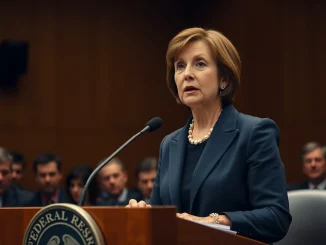
Senator Cynthia Lummis, a Republican from Wyoming, did not mince words when she stated that Jerome Powell is “unfit to run the Fed,” as reported by Watcher Guru on X. Her criticism stems from a deep-seated belief that the current leadership has mismanaged the economy, leading to inflationary pressures and instability that impact everyday Americans and the broader financial system.
- Inflation Concerns: Lummis has been a vocal critic of the Fed’s handling of inflation, arguing that the central bank was too slow to react to rising prices, contributing to the cost-of-living crisis.
- Fiscal Responsibility: As a proponent of sound money and limited government intervention, Senator Lummis often scrutinizes the Fed’s expansive balance sheet and its quantitative easing programs.
- Broader Economic Strategy: Her call reflects a sentiment among some lawmakers that the current Fed Chair has deviated from the core principles necessary for long-term economic health.
This isn’t the first time a lawmaker has voiced dissatisfaction with the Federal Reserve, but a direct call for the Chair’s resignation from a sitting senator is a significant development, signaling a potential escalation of political pressure on the independent institution.
Jerome Powell’s Tenure: A Look at the Federal Reserve’s Challenges
Jerome Powell‘s time as Fed Chair has been marked by unprecedented challenges and pivotal decisions. Appointed in 2018, his tenure has encompassed a period of significant economic upheaval, from the COVID-19 pandemic and subsequent economic shutdowns to a rapid surge in inflation not seen in decades.
Under Powell’s leadership, the Federal Reserve implemented aggressive monetary stimulus measures to combat the pandemic’s economic fallout, including slashing interest rates to near zero and launching massive quantitative easing programs. While these actions were credited with preventing a deeper recession, they have also drawn criticism for potentially overheating the economy and fueling inflation.
Here’s a brief overview of key challenges during Powell’s tenure:
| Period | Key Economic Challenge | Fed’s Response (Monetary Policy) |
|---|---|---|
| Early Tenure (2018-2019) | Trade tensions, global slowdown | Gradual rate hikes, then cuts |
| Pandemic Era (2020-2021) | Economic shutdown, deflationary fears, then inflation surge | Near-zero rates, quantitative easing, forward guidance |
| Post-Pandemic (2022-Present) | Persistent high inflation | Aggressive interest rate hikes (fastest in decades), quantitative tightening |
The balancing act between managing inflation, fostering full employment, and maintaining financial stability is incredibly complex, and any misstep can have profound consequences.
The Ripple Effect: How This Impacts Monetary Policy and Beyond
A call for the resignation of the Fed Chair, especially one as prominent as Jerome Powell, inevitably raises questions about the future of U.S. monetary policy and the broader economic landscape. While such calls are not uncommon in the political sphere, they highlight the increasing scrutiny faced by the central bank.
The independence of the Federal Reserve is a cornerstone of its effectiveness, designed to insulate it from short-term political pressures. However, public statements from influential figures like Senator Lummis can erode public confidence and potentially influence future policy decisions, even if indirectly.
For financial markets, including the volatile cryptocurrency space, any perceived instability at the Fed’s helm can lead to uncertainty. Investors closely watch central bank actions as they significantly impact:
- Interest Rates: The cost of borrowing for businesses and consumers, directly affecting economic growth and asset valuations.
- Inflation Expectations: The market’s belief about future price levels, influencing investment decisions and consumer spending.
- Dollar Strength: The value of the U.S. dollar against other currencies, impacting global trade and commodity prices.
A change in leadership could signal a shift in the Fed’s approach to these critical areas, potentially leading to new strategies for combating inflation or stimulating growth. This uncertainty can trigger volatility in both traditional and digital asset markets.
What Does This Mean for Economic Stability and Crypto?
The debate surrounding Jerome Powell‘s leadership and the direction of the Federal Reserve‘s monetary policy has significant implications for overall economic stability. A central bank’s primary goal is to maintain stable prices and maximize employment, and deviations from these objectives can lead to economic distress.
For the cryptocurrency market, the Fed’s actions are often a major catalyst. When the Fed embarks on aggressive rate hikes, as it has done recently to combat inflation, it typically leads to a “risk-off” environment. This means investors tend to pull capital from riskier assets, including cryptocurrencies, and move it into safer havens like U.S. Treasury bonds or cash.
Conversely, periods of quantitative easing or lower interest rates can create a “risk-on” environment, where liquidity flows into speculative assets, often benefiting cryptocurrencies. Therefore, the ongoing political pressure on the Fed, as exemplified by Senator Lummis‘s remarks, adds another layer of complexity for crypto investors to consider.
Key Considerations for Crypto Investors:
- Inflation Hedge Narrative: While Bitcoin is often touted as an inflation hedge, its performance during recent inflationary periods has been mixed, closely tied to broader macro trends influenced by the Fed.
- Liquidity: Changes in the Fed’s balance sheet (quantitative tightening or easing) directly impact global liquidity, which is a significant driver for crypto valuations.
- Regulatory Environment: While not directly tied to monetary policy, political discourse around the Fed can sometimes spill over into broader regulatory discussions concerning digital assets.
The interplay between political calls for change, the Fed’s response, and the subsequent market reactions will continue to be a critical factor for economic stability and the trajectory of digital assets.
Challenges and Future Perspectives
The call for Jerome Powell‘s resignation by Senator Lummis underscores the intense scrutiny faced by central bankers in an era of complex global economics. The challenge for the Federal Reserve lies in navigating these pressures while maintaining its independence and executing policies that serve the long-term interests of the nation.
Different perspectives exist on Powell’s performance. Supporters often point to his decisive actions during the pandemic and the subsequent efforts to tame inflation. Critics, like Lummis, argue that the initial response to inflation was too slow, leading to greater economic pain down the line. This ongoing debate highlights the inherent difficulties in setting monetary policy for a dynamic and interconnected global economy.
Looking ahead, market participants and the public will closely watch for any further developments. While a change in Fed Chair is not imminent solely due to a senator’s call, it adds to the political discourse surrounding the central bank’s role and effectiveness. This discussion is vital for transparency and accountability, even if it introduces an element of uncertainty.
Compelling Summary
The recent call by Senator Lummis for Jerome Powell‘s resignation as Fed Chair has injected a significant political dimension into the ongoing debate about the U.S. Federal Reserve‘s monetary policy. Citing concerns over Powell’s fitness to lead and the Fed’s handling of inflation, Lummis’s remarks underscore the growing pressure on the central bank to navigate a complex economic landscape. While the Fed’s independence is crucial, such high-profile criticisms highlight the challenges in balancing economic stability with political accountability. For cryptocurrency investors and the broader financial community, this development serves as a powerful reminder of how intertwined politics, central banking, and market dynamics truly are, urging a close watch on future economic indicators and policy shifts.
Frequently Asked Questions (FAQs)
Q1: Who is Senator Cynthia Lummis?
A1: Senator Cynthia Lummis is a Republican U.S. Senator representing Wyoming. She is known for her conservative stance on fiscal issues and has been a vocal proponent of cryptocurrency and blockchain technology in Congress.
Q2: Why is Senator Lummis calling for Jerome Powell’s resignation?
A2: Senator Lummis believes that Federal Reserve Chair Jerome Powell is “unfit to run the Fed,” primarily due to his handling of inflation and broader monetary policy decisions that she argues have contributed to economic instability.
Q3: What is the role of the Federal Reserve Chair?
A3: The Federal Reserve Chair is the head of the U.S. central banking system. They are responsible for leading the Federal Open Market Committee (FOMC), which sets monetary policy, including interest rates, to achieve maximum employment and stable prices.
Q4: How does the Federal Reserve’s monetary policy affect the cryptocurrency market?
A4: The Federal Reserve’s monetary policy, particularly interest rate decisions and quantitative easing/tightening, significantly impacts global liquidity and investor risk appetite. When rates rise or liquidity tightens, it often leads to a “risk-off” environment where capital flows out of speculative assets like cryptocurrencies. Conversely, loose monetary policy can fuel crypto rallies.
Q5: Can a Senator force the Fed Chair to resign?
A5: No, a U.S. Senator cannot unilaterally force the Fed Chair to resign. The Fed Chair is appointed by the President and confirmed by the Senate for a four-year term. While a senator can express strong opinions and apply political pressure, the Chair’s removal would typically require a presidential decision, often for cause.
Q6: What are the implications if Jerome Powell were to resign or be replaced?
A6: A change in Fed Chair would likely introduce significant uncertainty into financial markets. It could signal a shift in the Federal Reserve’s approach to monetary policy, potentially affecting interest rate paths, inflation targets, and overall economic strategy, which would have ripple effects across all asset classes, including traditional stocks, bonds, and cryptocurrencies.