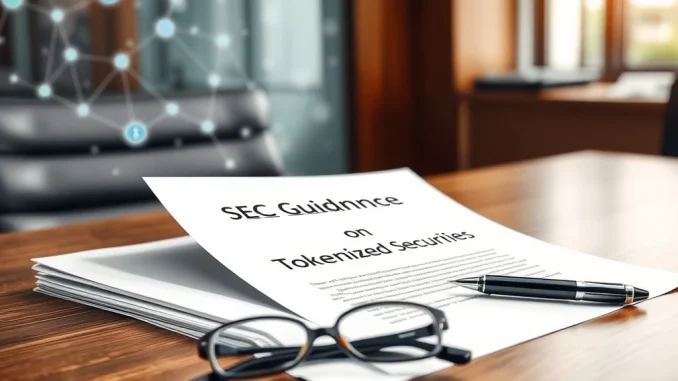
Washington, D.C., April 2025: The U.S. Securities and Exchange Commission (SEC) has released pivotal new guidance on tokenized securities, a move that provides long-awaited clarity for the digital asset industry. This formal guidance, confirmed by Eleanor Terrett, host of Crypto in America, specifies how existing federal securities laws apply to assets represented on a blockchain. Crucially, the framework distinguishes between tokenization structures initiated directly by an asset’s issuer and those involving independent third parties. This development marks a significant step in the regulatory maturation of blockchain-based finance.
SEC Tokenized Securities Guidance: Decoding the New Framework
The newly released SEC guidance addresses a core tension in modern finance: applying decades-old securities laws to novel, blockchain-based asset representations. Tokenization involves creating a digital token on a distributed ledger that represents ownership of a traditional financial asset, such as a stock, bond, or real estate interest. Until now, market participants operated under a patchwork of enforcement actions, speeches, and no-action letters. This document consolidates and clarifies the SEC’s position, offering a more structured analytical path. The guidance does not create new law but interprets how the Securities Act of 1933 and the Securities Exchange Act of 1934 apply to these digital instruments. It emphasizes that the economic substance of the transaction, not the technological wrapper, determines its regulatory status.
Issuer-Led vs. Third-Party Tokenization: A Critical Distinction
A central pillar of the SEC’s new guidance is its clear differentiation between two fundamental models for creating tokenized securities. This distinction has profound implications for liability, disclosure obligations, and operational compliance.
- Issuer-Led Tokenization: In this structure, the entity that creates the underlying security (the issuer) also initiates and controls the tokenization process. The issuer mints the digital tokens and directly offers them to investors. The SEC guidance treats this model analogously to a traditional securities offering. Consequently, the issuer bears full responsibility for registration statements, prospectuses, and ongoing reporting under laws like the Securities Act. All standard disclosure and anti-fraud provisions apply directly.
- Third-Party Tokenization: This model involves an independent entity that tokenizes an existing, already-issued security. For example, a financial technology firm might tokenize shares of a publicly traded company that are held in a custodial vault. The guidance scrutinizes the role of this third party. If the third party’s actions are deemed to constitute an “offer” or “sale” of the security, or if it operates a platform facilitating transactions, it may be acting as an unregistered broker-dealer or exchange. The guidance outlines specific factors to assess this, including the level of control, promotion, and facilitation provided.
The table below summarizes the key regulatory focuses for each model:
| Tokenization Model | Primary Regulatory Focus | Key Compliance Concerns |
|---|---|---|
| Issuer-Led | Issuer Registration & Disclosure | Securities Act registration, prospectus delivery, ongoing reporting (e.g., 10-K, 10-Q), issuer liability for misstatements. |
| Third-Party | Intermediary Registration & Conduct | Broker-dealer registration, exchange/ATS registration, custody rules, anti-money laundering (AML) obligations, conflicts of interest. |
The Historical Context: From Howey to Hinman to Today
This guidance is the latest chapter in the SEC’s evolving approach to digital assets. The foundational legal test remains the Howey Test, established by the Supreme Court in 1946, which defines an investment contract. For years, the SEC applied this test through enforcement actions against initial coin offerings (ICOs). A notable prior attempt at clarity was the 2019 “Hinman Speech,” where then-Director William Hinman suggested a token might transform from a security to a non-security as its network became sufficiently decentralized. However, that speech was not formal guidance and led to legal ambiguity. The new document moves beyond philosophical debates about decentralization. It focuses pragmatically on the structure of the tokenization process and the roles of the involved parties, providing a more actionable and predictable framework for compliant innovation.
Immediate Implications for the Financial and Crypto Industries
The release of this guidance has immediate, tangible consequences. For traditional financial institutions exploring blockchain, the path for issuer-led tokenization of assets like treasury bonds or private equity funds is now clearer, albeit within the full scope of securities regulations. This could accelerate pilot projects from major banks and asset managers. For the cryptocurrency and fintech sector, the guidance creates a compliance roadmap. Third-party tokenization platforms must rigorously assess whether their activities trigger broker-dealer or exchange registration requirements. This may lead to strategic pivots, partnerships with registered entities, or adjustments to platform functionality to fall within safe harbors. Legal and compliance teams across both industries are now tasked with mapping their existing and planned projects against this new framework.
Global Regulatory Alignment and Market Consequences
The SEC’s action does not occur in a vacuum. Other major jurisdictions, including the European Union with its Markets in Crypto-Assets (MiCA) regulation and the United Kingdom’s phased regulatory approach, are also defining rules for digital assets. The SEC’s focus on the substance of the transaction, rather than the technology, aligns broadly with principles-based approaches in other developed markets. This growing, if imperfect, alignment helps reduce cross-border regulatory arbitrage and provides multinational firms with more consistent guardrails. Market consequences are likely to include a short-term consolidation, where well-capitalized, compliance-focused projects gain a competitive advantage. It may also spur a new wave of regulatory technology (RegTech) solutions designed to automate compliance reporting for tokenized securities.
Conclusion
The SEC’s new guidance on tokenized securities represents a watershed moment, replacing uncertainty with a structured analytical framework. By clearly distinguishing between issuer-led and third-party tokenization models, the guidance provides essential clarity for applying federal securities laws to blockchain-based assets. This move supports the legitimate growth of digital asset markets by establishing predictable rules of the road. While compliance will require significant effort, the guidance ultimately fosters an environment where innovation in tokenization can proceed with a clearer understanding of its regulatory obligations. The evolution of this SEC tokenized securities guidance will undoubtedly shape the future of capital formation and asset management for years to come.
FAQs
Q1: What exactly are “tokenized securities”?
Tokenized securities are digital representations of traditional financial assets, like stocks or bonds, issued and recorded on a blockchain or distributed ledger. The token acts as a digital certificate of ownership for the underlying asset.
Q2: Does this SEC guidance create new laws?
No. The guidance is an interpretive release that explains how the SEC applies existing federal securities laws—primarily the Securities Act of 1933 and the Securities Exchange Act of 1934—to the novel context of asset tokenization.
Q3: Why is the distinction between issuer-led and third-party tokenization so important?
This distinction determines which party bears primary regulatory responsibility. Issuer-led tokenization places compliance duties on the asset creator, while third-party tokenization focuses on whether the intermediary must register as a broker-dealer or exchange.
Q4: How does this guidance affect existing cryptocurrency exchanges?
If a cryptocurrency exchange lists tokenized securities that fall under the third-party model, the guidance may require that exchange to register with the SEC as a national securities exchange or an alternative trading system (ATS), subjecting it to a different set of rules.
Q5: What should a company currently developing a tokenization project do first?
The first step is to conduct a legal analysis to categorize the project as either issuer-led or third-party tokenization under the new framework. Then, map all project functions against the corresponding registration, disclosure, and conduct requirements outlined in the guidance.