
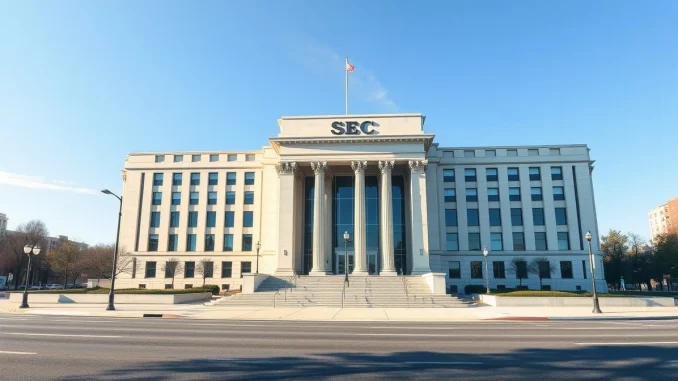
WASHINGTON, D.C. — In a striking admission, the U.S. Securities and Exchange Commission (SEC) stated that numerous past enforcement actions against cryptocurrency companies provided no clear benefit to investors. This acknowledgment, made in April 2026, signals a profound change in regulatory philosophy. The agency is now explicitly moving away from a strategy critics labeled ‘regulation by enforcement.’
SEC Admits Flawed Crypto Enforcement Strategy
According to an official statement reviewing its 2025 enforcement results, the SEC conceded that many cases lacked a direct link to investor harm. The agency specifically cited 95 actions and $2.3 billion in penalties related to ‘book-and-record violations’ since the 2022 fiscal year. It also pointed to seven cases concerning crypto firm registration and six involving the ‘definition of a dealer.’
Also read: Bitcoin Hashrate in Iran Plummets 77% as Conflict and Price Slump Reshape Global Mining Map
‘Together… these cases identified no direct investor harm from those violations, produced no investor benefit or protection,’ the SEC said. The statement criticized a prior ‘bias for volume of cases brought versus matters of investor protection.’ This suggests a significant misallocation of resources and a flawed interpretation of federal securities laws during that period.
Data from consulting firm Cornerstone Research supports this shift. Their November 2025 report showed a roughly 30% drop in SEC enforcement actions against public companies in fiscal 2025 compared to 2024. This decline coincided with the tenure of new SEC Chair Paul Atkins.
Also read: Changpeng Zhao's Revealing Memoir: Inside Binance's Tumultuous Rise and Fall
A New Direction Under Chair Paul Atkins
The critical self-assessment is the clearest sign yet of the regulator’s new path. Paul Atkins assumed leadership of the SEC in April 2025. His predecessor, Gary Gensler, faced persistent accusations of using enforcement actions as a primary tool for establishing crypto policy. The current commission views that approach as ineffective.
Atkins has publicly outlined a different mission. ‘We have redirected resources toward the types of misconduct that inflict the greatest harm—particularly fraud, market manipulation, and abuses of trust,’ he stated. The goal is to end ‘regulation by enforcement’ and refocus on the SEC’s core mandate. This means prioritizing cases that offer tangible investor protection and strengthen overall market integrity.
The agency’s statement connected the previous aggressive posture to the political transition before Donald Trump’s 2025 inauguration. It described an ‘rare rush’ to bring cases and an ‘aggressive pursuit of novel legal theories.’ The implication is that speed and headline-grabbing penalties sometimes overshadowed substantive outcomes.
What the Enforcement Numbers Reveal
The shift in philosophy is reflected in the enforcement data. For 2025, the SEC obtained orders for $17.9 billion in total monetary relief. This figure breaks down into $7.2 billion in civil penalties, with the remainder from disgorgement and interest.
But the agency now argues the raw dollar amount is not the sole measure of success. ‘This year’s enforcement results clarify the flaws of these actions and their respective penalties,’ the SEC said. It aims to ‘re-establish the definition and measure of enforcement effectiveness.’ The new standard is grounded in congressional intent and focused on preventing actual investor harm.
Industry watchers note this could signal a more predictable regulatory environment for legitimate crypto businesses. The previous approach created uncertainty, as companies struggled to comply with rules that seemed to be defined through lawsuits rather than clear guidance.
Not a Free Pass: Enforcement Continues for Fraud
Despite the strategic pivot, the SEC’s enforcement division remains active against clear misconduct. The change is one of focus, not inaction. Several crypto companies faced significant actions in 2025.
In May 2025, the SEC sued Unicoin and four executives. The agency alleged they raised $100 million by misleading investors about certificates linked to Unicoin tokens and stock. Unicoin has contested the charges, accusing the SEC of distorting its regulatory statements.
A more severe case concluded in April 2025. The SEC filed a civil complaint against Ramil Ventura Palafox, CEO of Praetorian Group International, for an alleged $200 million Ponzi scheme. A parallel criminal case by the U.S. Department of Justice led to Palafox receiving a 20-year prison sentence in February 2026.
These cases illustrate the new priority structure. The SEC under Atkins appears to be drawing a sharper line between technical violations and schemes causing direct financial harm. Fraud and market manipulation are squarely in the crosshairs.
Implications for Crypto Markets and Investors
This policy shift has immediate and long-term consequences. For investors, the SEC’s admission validates long-held complaints from parts of the crypto industry. Many argued that aggressive enforcement on technical grounds did little to protect them from actual scams.
What this means for investors is a potential recalibration of risk. The regulatory spotlight may move away from certain operational compliance issues and toward outright fraud. This could help investors distinguish between innovative projects with compliance growing pains and fundamentally deceptive enterprises.
For the crypto market, the change may reduce one source of legal overhang. Companies operating in good faith might face less existential threat from enforcement actions over record-keeping or registration nuances. However, the bar for prosecuting fraud is now explicitly higher. The SEC will need to demonstrate clear investor harm to justify its cases.
This new stance could also influence legislative efforts. Lawmakers seeking to craft clear digital asset rules may see the SEC’s admission as evidence that the old enforcement-first approach was insufficient. The need for comprehensive legislation becomes more apparent.
Conclusion
The SEC’s admission that past crypto enforcement cases delivered no investor benefit marks a key moment in U.S. financial regulation. It is a rare instance of a major regulator publicly critiquing its own recent strategy. Under Chair Paul Atkins, the agency is prioritizing quality over quantity, targeting fraud and manipulation while reassessing technical violations. This shift aims to provide genuine investor protection and could lead to a more stable, predictable framework for the digital asset industry. The ultimate test will be whether this refined focus better safeguards investors and fosters responsible innovation.
FAQs
Q1: What exactly did the SEC admit about its past crypto enforcement?
The SEC stated that many past enforcement actions, including 95 ‘book-and-record’ cases and several others, identified no direct investor harm and provided no benefit or protection to investors. It called this a misallocation of resources.
Q2: Who is SEC Chair Paul Atkins and how has he changed the agency’s approach?
Paul Atkins became SEC Chair in April 2025. He has shifted the agency’s focus away from a high volume of cases and toward pursuing misconduct that causes the greatest investor harm, like fraud and market manipulation, ending what he calls ‘regulation by enforcement.’
Q3: Does this mean the SEC will stop enforcing laws against crypto companies?
No. The SEC is still actively pursuing enforcement actions, particularly against alleged frauds and Ponzi schemes. The change is one of priority, emphasizing cases with clear evidence of investor harm over technical or record-keeping violations.
Q4: What was the ‘regulation-by-enforcement’ approach?
This term, often used by critics of former Chair Gary Gensler, describes a strategy where regulators use enforcement actions and lawsuits to effectively create legal precedents and rules, rather than first providing clear guidance or rules for the industry to follow.
Q5: How significant was the drop in SEC enforcement actions under the new leadership?
According to a report from Cornerstone Research, the number of SEC enforcement actions against public companies decreased by about 30% in fiscal year 2025 compared to fiscal year 2024, reflecting the new policy direction.

This article was produced with AI assistance and reviewed by our editorial team for accuracy and quality.





Be the first to comment