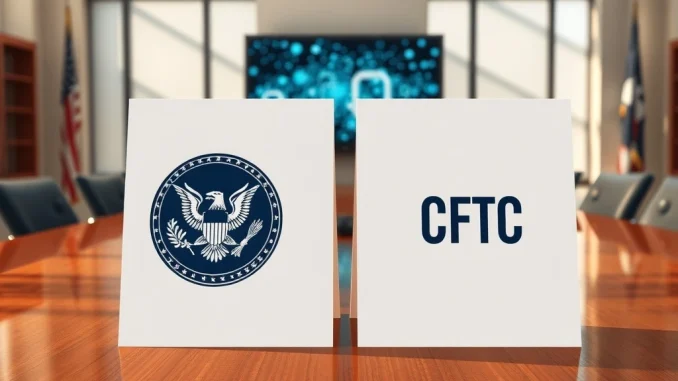
WASHINGTON, D.C. — In a landmark move that could reshape America’s financial regulatory landscape, the U.S. Securities and Exchange Commission (SEC) and Commodity Futures Trading Commission (CFTC) signed a comprehensive memorandum of understanding on Wednesday, March 12, 2026, committing to coordinated oversight of cryptocurrency markets and other financial sectors. The agreement represents a deliberate shift from decades of jurisdictional conflicts between the two powerful agencies, aiming instead to provide regulatory clarity through what officials term a “minimum effective dose” approach. This SEC CFTC crypto regulation coordination comes as digital assets increasingly blur traditional jurisdictional lines, creating urgency for harmonized oversight that maintains U.S. competitiveness while protecting investors.
Ending Decades of Regulatory ‘Turf Wars’
The memorandum, signed at the Ronald Reagan Building in Washington, D.C., establishes formal mechanisms for information sharing, joint examinations, and consistent rule interpretation between the agencies. SEC Chair Paul Atkins described the agreement as “the latest step toward repairing a relationship strained by decades of regulatory turf wars.” He emphasized that duplicative registrations and conflicting regulations have historically stifled innovation and pushed market participants to other jurisdictions. The CFTC’s acting chair, Sarah Bloom Raskin, echoed this sentiment, noting that “new trading models, digital infrastructure, and onchain, automated systems” make isolated oversight increasingly ineffective.
Background context reveals this coordination follows years of industry pressure and legislative proposals. Since 2022, at least seven congressional bills have attempted to clarify crypto jurisdiction between the SEC and CFTC, with none reaching the president’s desk. The agencies’ previous memorandum of understanding, last updated in 2008, contained no specific provisions for digital assets. Wednesday’s agreement explicitly mentions crypto assets, AI-driven trading systems, and decentralized finance platforms as areas requiring “fit-for-purpose regulatory frameworks.”
The ‘Minimum Effective Dose’ Regulatory Strategy
Central to the new approach is what both agencies call a “minimum effective dose” regulatory strategy—a pharmacological term adapted to policy meaning the smallest regulatory intervention that produces desired market outcomes. This strategy aims to foster innovation while maintaining market integrity and keeping the U.S. competitive globally. Officials explained this means avoiding overly prescriptive rules that could stifle technological development while ensuring sufficient safeguards against fraud and manipulation.
- Technology-Neutral Frameworks: Regulations will focus on economic functions rather than specific technologies, allowing rules to adapt as markets evolve.
- Coordinated Examinations: The agencies will conduct joint reviews of entities operating across securities and derivatives markets, reducing compliance burdens.
- Unified Data Repositories: Market participants will report to shared data systems rather than submitting duplicate information to separate agencies.
Expert Perspectives on the Regulatory Shift
Financial regulation experts have responded with cautious optimism. “This represents the most significant interagency coordination effort since Dodd-Frank,” said Dr. Meredith Whitney, former SEC chief economist and now director of the Stanford Digital Assets Program. “The ‘minimum effective dose’ philosophy acknowledges that over-regulation can be as harmful as under-regulation, particularly in fast-moving technological spaces.” Whitney’s research, cited in a 2025 Brookings Institution report, found that regulatory uncertainty cost the U.S. crypto sector approximately $15 billion in investment capital between 2023 and 2025.
Conversely, consumer advocacy groups have expressed concerns. “While coordination is welcome, the ‘minimum effective dose’ language worries us,” said Lisa Gilbert, executive vice president of Public Citizen. “In medicine, minimum effective doses are carefully calibrated through clinical trials. Financial regulation lacks that precision, and under-dosing could leave investors exposed.” Gilbert referenced the 2024 collapse of the Terra-Luna ecosystem, which affected approximately 40,000 U.S. investors despite existing regulations.
Broader Context: Global Competition for Crypto Leadership
The memorandum arrives amid intense global competition to establish regulatory standards for digital assets. The European Union’s Markets in Crypto-Assets (MiCA) framework, fully implemented in December 2025, has already attracted several major crypto firms to relocate European operations. Singapore’s Payment Services Act and Japan’s revised Payment Services Act similarly provide clearer regulatory pathways than the previous U.S. approach of enforcement actions and regulatory ambiguity.
| Jurisdiction | Primary Regulatory Approach | Key Implementation Date |
|---|---|---|
| United States (New) | Coordinated SEC-CFTC oversight with “minimum effective dose” | March 2026 (Memorandum signed) |
| European Union | Comprehensive MiCA framework with licensing requirements | December 2025 (Full implementation) |
| United Kingdom | Financial Services and Markets Act 2023 with phased crypto integration | January 2026 (First phase operational) |
| Singapore | Payment Services Act with specific digital payment token rules | January 2024 (Latest amendments) |
Implementation Timeline and Next Steps
The memorandum establishes a 90-day implementation period during which the agencies will create joint working groups, develop shared examination protocols, and establish formal escalation procedures for interagency disputes. Market participants should expect updated guidance on registration requirements by June 2026, with full operational coordination targeted for January 2027. The agencies specifically noted they will provide clarity for entities operating across trading platforms, clearinghouses, data repositories, pooled investment vehicles, dealers, and intermediaries.
Industry and Political Reactions
Crypto industry representatives have largely welcomed the development. “This is precisely the regulatory clarity we’ve advocated for since 2018,” said Sheila Warren, CEO of the Crypto Council for Innovation. “The commitment to coordinated oversight and technology-neutral regulation addresses our core concerns about fragmented enforcement.” Warren noted that her organization’s member companies have collectively delayed approximately $8 billion in planned U.S. investments pending regulatory clarity.
Political reactions have split along predictable lines. Senator Cynthia Lummis (R-WY), co-sponsor of the Responsible Financial Innovation Act, called the memorandum “a positive step that should have happened years ago.” Meanwhile, Senator Elizabeth Warren (D-MA) issued a statement urging caution: “Better coordination between regulators is necessary, but we must ensure this doesn’t become a race to the bottom in consumer protections.”
Conclusion
The SEC CFTC crypto regulation memorandum represents a historic shift from jurisdictional conflict to coordinated oversight, potentially ending regulatory uncertainty that has hampered U.S. digital asset markets for nearly a decade. The “minimum effective dose” strategy acknowledges the unique challenges of regulating fast-evolving technologies while attempting to balance innovation with investor protection. As implementation proceeds over the coming months, market participants should monitor the development of joint working groups and updated guidance. The success of this coordinated approach will likely influence whether the U.S. can reclaim its position as the global leader in financial innovation or cede further ground to jurisdictions with clearer regulatory frameworks.
Frequently Asked Questions
Q1: What does the SEC-CFTC memorandum actually change for crypto companies?
The memorandum establishes formal coordination mechanisms between the agencies, potentially reducing duplicate examinations and conflicting guidance. Crypto companies operating across securities and derivatives markets should experience more consistent regulatory treatment, though specific rule changes will follow through separate processes.
Q2: How will the “minimum effective dose” strategy work in practice?
Regulators will aim to apply the least restrictive rules necessary to achieve market integrity and investor protection goals. This means avoiding overly prescriptive requirements that could stifle innovation while maintaining core safeguards against fraud and manipulation.
Q3: What is the timeline for implementing these coordinated regulations?
The agencies have established a 90-day period to create joint working groups and protocols, with updated guidance expected by June 2026. Full operational coordination is targeted for January 2027, though some aspects may roll out gradually.
Q4: How does this U.S. approach compare to crypto regulation in other countries?
The U.S. coordinated approach differs from the EU’s comprehensive MiCA framework but shares similarities with the UK’s phased integration model. Unlike some jurisdictions that created entirely new regulatory categories, the U.S. is adapting existing securities and commodities frameworks.
Q5: Will this memorandum require new legislation from Congress?
Not immediately. The memorandum operates within existing statutory authorities. However, both agencies have indicated that certain aspects of their coordination might eventually require legislative updates, particularly regarding data sharing and examination authorities.
Q6: How might this affect ordinary cryptocurrency investors?
Investors should benefit from clearer rules and potentially reduced compliance costs that could translate to better services. However, consumer advocates caution that the “minimum effective dose” approach must be carefully calibrated to ensure adequate investor protections remain in place.