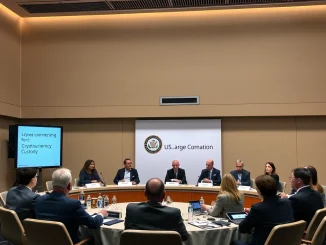
WASHINGTON, D.C., March 13, 2026 — U.S. financial regulators took unprecedented steps toward coordinated cryptocurrency oversight today while banking giant JPMorgan Chase faced explosive allegations of enabling a massive Ponzi scheme. The Commodity Futures Trading Commission (CFTC) opened public comment on groundbreaking prediction markets regulations, marking the most significant regulatory development for this emerging crypto asset class. Simultaneously, investors filed a $328 million class action lawsuit accusing JPMorgan of facilitating fraudulent transactions for now-defunct Goliath Ventures. These parallel developments occurred against the backdrop of a historic memorandum of understanding between the CFTC and Securities and Exchange Commission (SEC), signaling an end to decades of jurisdictional conflicts that have hampered crypto innovation. Today’s crypto news reveals a regulatory landscape undergoing rapid transformation with immediate consequences for investors, platforms, and traditional financial institutions.
CFTC Chair Proposes First-Ever Prediction Markets Framework
CFTC Chair Michael Selig issued an Advanced Notice of Proposed Rulemaking on Thursday, March 12, 2026, seeking public input on how the Commodity Exchange Act should apply to event contracts on prediction markets platforms. The regulator’s staff advisory formally classified these contracts as a “financial asset class,” providing much-needed regulatory clarity for platforms like Kalshi and Polymarket. Selig announced the move in a Thursday post on X, stating, “Prediction markets are one of the most exciting innovations in financial markets. Yet for too long, the CFTC has failed to provide guidance for these markets being used by millions of Americans. This ends today.” The comment period will remain open for 60 days, with final rules expected by late 2026. This regulatory initiative directly responds to the explosive growth of prediction markets, which have seen trading volumes increase by over 300% since 2024 according to industry analytics firm PredictWall.
Market participants have operated in a legal gray area since prediction markets gained mainstream traction around 2023. Previously, the CFTC maintained that certain event contracts involving political outcomes or sports constituted illegal gambling under the 2006 Unlawful Internet Gambling Enforcement Act. However, Selig’s proposal distinguishes between pure gambling and legitimate financial instruments that allow hedging against real-world events. The new framework would establish clear listing standards, capital requirements, and consumer protection measures specifically tailored to prediction markets. Industry analysts note this move could unlock billions in institutional capital currently sitting on the sidelines due to regulatory uncertainty.
JPMorgan Faces Class Action Over Alleged $328M Crypto Ponzi Facilitation
Investors filed a proposed class action lawsuit on Tuesday, March 10, 2026, in the U.S. District Court for the Northern District of California, alleging JPMorgan Chase ignored obvious red flags while serving as the primary banking conduit for Goliath Ventures’ fraudulent scheme. The complaint states JPMorgan was the sole banking institution for Goliath from January 2023 through May 2025, processing transactions despite the firm operating as an unlicensed “private equity cryptocurrency pool operator.” Court documents reveal Goliath obtained at least $328 million from over 2,000 investors between January 2023 and January 2026. The lawsuit creates a striking contrast with JPMorgan CEO Jamie Dimon’s repeated public criticisms of Bitcoin and cryptocurrency generally.
The complaint alleges specific failures in JPMorgan’s anti-money laundering protocols. “Chase, by virtue of its Know Your Customer procedures, actually knew that Goliath was acting as a ‘private equity’ cryptocurrency pool operator investing money for investors, without being licensed at all to sell these investments,” the filing states. This case follows the February 24, 2026 arrest of Goliath CEO Christopher Delgado by the U.S. Attorney’s Office for the Middle District of Florida. Delgado faces a maximum penalty of 30 years in federal prison if convicted on all counts. The lawsuit seeks compensatory and punitive damages, arguing JPMorgan’s alleged negligence enabled the scheme’s scale and duration. Banking compliance experts note this case could establish new precedents for financial institution liability in crypto-related fraud.
- Regulatory Scrutiny Intensifies: The lawsuit arrives as banking regulators increase examination of crypto exposure at traditional financial institutions.
- Investor Protection Focus: The case highlights growing judicial attention to investor losses in crypto schemes involving mainstream banks.
- Compliance Costs Rise: Financial institutions face increased due diligence requirements for crypto-related clients following this litigation.
Legal Experts Weigh In on Banking Liability
Sarah Jenkins, a former SEC enforcement attorney now with the Financial Integrity Network, told reporters, “This lawsuit tests the boundaries of bank liability under the Bank Secrecy Act. The central question is whether JPMorgan had actual knowledge of the fraud or merely should have known through better monitoring.” Jenkins noted that while banks aren’t generally liable for customer fraud, they can face enforcement actions for willful blindness to suspicious activity. The lawsuit cites multiple allegedly suspicious patterns, including rapid movement of funds between accounts and transactions inconsistent with Goliath’s stated business model. JPMorgan has not yet filed a formal response to the allegations, but banking industry representatives have previously argued that detecting sophisticated crypto fraud presents unique challenges beyond traditional financial monitoring systems.
SEC and CFTC Sign Historic Cooperation Agreement
In what regulators describe as a “pivotal time” for financial markets, the SEC and CFTC signed a memorandum of understanding on Wednesday, March 11, 2026, committing to harmonized oversight of emerging technologies including cryptocurrency. The agreement explicitly aims to end “regulatory turf wars” that have created compliance headaches for crypto firms operating across jurisdictional lines. SEC Chair Paul Atkins stated, “For decades, regulatory turf wars, duplicative agency registrations, and different sets of regulations between the SEC and CFTC have stifled innovation and pushed market participants to other jurisdictions.” The memo establishes formal consultation procedures, joint examination protocols, and information-sharing mechanisms specifically for crypto assets.
The agencies noted they strive to provide a “fit-for-purpose regulatory framework for crypto assets” that balances innovation with investor protection. This cooperation follows years of tension between the agencies, most notably during the 2023-2024 period when conflicting statements about Ethereum’s regulatory status created market uncertainty. The new framework establishes clear principles for determining whether a digital asset constitutes a security under SEC jurisdiction or a commodity under CFTC oversight. Market participants have long complained that the previous ambiguous division created compliance costs estimated at $2.3 billion annually according to a 2025 Crypto Council for Innovation report.
| Agency | Primary Crypto Focus | Key Recent Actions |
|---|---|---|
| Securities and Exchange Commission (SEC) | Security tokens, investment contracts, crypto ETFs | Approved spot Bitcoin ETFs (2024), Ethereum classification review |
| Commodity Futures Trading Commission (CFTC) | Commodity tokens, derivatives, prediction markets | Prediction markets rulemaking (2026), enforcement against unregistered exchanges |
| Joint Initiatives | Jurisdictional clarity, harmonized rules | Memorandum of Understanding (March 2026), coordinated enforcement |
What These Developments Mean for Crypto Markets
The convergence of these three developments creates immediate implications for cryptocurrency markets and participants. Regulatory clarity typically reduces risk premiums and attracts institutional capital, potentially supporting asset prices over the medium term. However, increased enforcement against fraudulent schemes may temporarily dampen retail participation. The prediction markets rulemaking could create an entirely new regulated asset class, while the SEC-CFTC cooperation reduces compliance uncertainty for cross-jurisdictional operations. Market analysts will watch Bitcoin’s reaction to these developments, as the leading cryptocurrency often serves as a barometer for regulatory sentiment.
Industry and Community Reactions
Crypto industry representatives have responded cautiously optimistically to the regulatory developments. “The SEC-CFTC memo is a welcome step toward the regulatory clarity our industry has sought for years,” said Maya Rodriguez, Executive Director of the Blockchain Association. “However, the proof will be in implementation.” Prediction markets platforms have expressed support for the CFTC’s approach, with Polymarket stating they “look forward to engaging constructively during the comment period.” Meanwhile, investor advocacy groups have praised the JPMorgan lawsuit as necessary accountability. “When mainstream financial institutions enable crypto fraud, they must face consequences,” stated David Chen of the Investor Protection Institute. The crypto community on social media has shown mixed reactions, with some celebrating regulatory progress and others expressing concern about overreach.
Conclusion
March 13, 2026, marks a watershed moment in cryptocurrency regulation with three interconnected developments reshaping the landscape. The CFTC’s prediction markets initiative creates a pathway for legitimizing an innovative financial tool, while the SEC-CFTC cooperation agreement addresses longstanding jurisdictional conflicts that have hampered crypto innovation. Simultaneously, the JPMorgan lawsuit highlights increasing legal accountability for traditional financial institutions involved with crypto assets. These developments collectively signal a maturation of regulatory approaches toward cryptocurrency, moving from adversarial positioning toward structured frameworks. Market participants should monitor the CFTC’s comment period, the JPMorgan litigation’s progress, and the implementation of the interagency cooperation agreement. The coming months will reveal whether today’s actions deliver the regulatory clarity needed to support sustainable crypto market growth while protecting investors from fraudulent schemes like the Goliath Ventures Ponzi.
Frequently Asked Questions
Q1: What exactly did the CFTC propose regarding prediction markets?
The CFTC issued an Advanced Notice of Proposed Rulemaking on March 12, 2026, seeking public comment on regulations for event contracts on prediction markets platforms. The agency formally classified these contracts as a financial asset class and will develop specific rules over the next year.
Q2: How much money was allegedly lost in the Goliath Ventures Ponzi scheme?
Court documents state Goliath Ventures obtained at least $328 million from over 2,000 investors between January 2023 and January 2026. The scheme operated under both the Goliath Ventures and Gen-Z Venture Firm names.
Q3: What does the SEC-CFTC memorandum of understanding actually do?
The March 11, 2026 agreement establishes formal consultation procedures, joint examination protocols, and information-sharing mechanisms specifically for crypto assets. It aims to end jurisdictional conflicts and create a harmonized regulatory approach.
Q4: Why is the JPMorgan lawsuit significant for cryptocurrency?
The case tests the boundaries of bank liability for crypto-related fraud and could establish new precedents for financial institution due diligence requirements when dealing with cryptocurrency businesses.
Q5: How will prediction markets regulation affect ordinary crypto investors?
Clear regulations should increase platform security and consumer protections while potentially expanding investment opportunities. However, compliance costs may reduce some platform offerings or increase fees.
Q6: What happens next with these regulatory developments?
The CFTC will collect public comments for 60 days, the JPMorgan lawsuit will proceed through discovery, and the SEC-CFTC cooperation will be implemented through joint working groups. Further rule proposals are expected by late 2026.