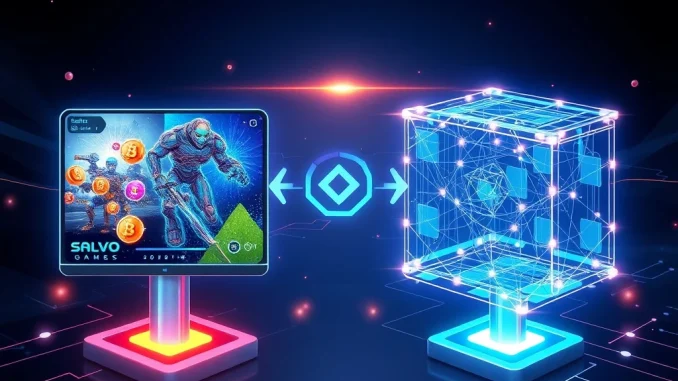
Singapore, March 2025: The Web3 gaming landscape enters a new phase of development as Salvo Games announces a strategic partnership with Manadia. This collaboration represents a significant convergence of artificial intelligence and blockchain infrastructure, aiming to address persistent challenges in decentralized gaming ecosystems. The partnership attempts to combine AI-led gameplay mechanisms of Salvo Games with the low-trust AI coordination and data settlement infrastructure of Manadia, potentially creating a more robust foundation for next-generation gaming experiences.
AI-Driven Web3 Gaming Partnership Details
The partnership between Salvo Games and Manadia formalizes a technical integration that began with exploratory discussions in late 2024. According to documentation released by both companies, the collaboration focuses on three primary objectives: enhancing in-game AI behavior through decentralized coordination, improving data settlement efficiency for player transactions, and creating more immersive gameplay experiences through adaptive AI systems. The technical integration will occur in phases throughout 2025, with initial implementation scheduled for the third quarter.
Salvo Games brings to this partnership their proprietary AI gameplay engine, which has been in development since 2022. This system utilizes machine learning algorithms to create dynamic, responsive game environments that adapt to player behavior. Their technology has demonstrated particular effectiveness in strategy and role-playing game genres, where non-player character behavior significantly impacts gameplay quality. The company’s previous work includes partnerships with traditional gaming studios seeking to incorporate AI elements into their existing franchises.
Manadia contributes their specialized infrastructure for low-trust AI coordination across decentralized networks. Their system addresses a fundamental challenge in Web3 gaming: how multiple AI agents can coordinate actions and decisions without relying on centralized servers. This technology enables more complex multiplayer interactions while maintaining the decentralized principles of blockchain gaming. Manadia’s infrastructure has undergone testing in various decentralized applications since 2023, with published results showing improved transaction finality and reduced coordination latency.
Technical Integration and Gaming Implications
The technical integration between these two platforms involves several interconnected systems. Salvo Games’ AI engine will interface with Manadia’s coordination layer, allowing game AI to make decisions based on real-time blockchain data. This connection enables several novel gaming features previously difficult to implement in Web3 environments. For instance, in-game economies can respond dynamically to player actions, with AI-controlled entities adjusting their behavior based on market conditions recorded on-chain.
The partnership addresses specific technical challenges in current Web3 gaming:
- Scalable AI Coordination: Current Web3 games often limit AI complexity due to coordination challenges across decentralized networks. The combined system aims to support more sophisticated AI behaviors without compromising decentralization principles.
- Real-time Data Settlement: Traditional blockchain gaming experiences latency between player actions and game state updates. The integration seeks to minimize this delay through optimized data settlement protocols.
- Adaptive Gameplay Systems: Most blockchain games feature static game mechanics due to upgrade limitations. The partnership enables more dynamic gameplay that can evolve based on collective player behavior and preferences.
Industry analysts note that this partnership represents a maturation of Web3 gaming technology. Previous attempts at integrating AI with blockchain gaming often focused on singular aspects, such as AI-generated assets or basic automated opponents. The Salvo-Manadia collaboration attempts a more comprehensive integration, addressing both gameplay mechanics and underlying infrastructure simultaneously.
Historical Context of AI in Gaming
The integration of artificial intelligence in gaming has evolved through several distinct phases. Early gaming AI in the 1980s and 1990s relied on simple rule-based systems and scripted behaviors. The 2000s saw the introduction of more sophisticated pathfinding and decision-making algorithms, particularly in strategy and simulation games. The 2010s brought machine learning approaches, though these remained largely confined to major studios with significant computational resources.
Web3 gaming introduced new challenges for AI implementation. Decentralized architectures require different approaches to AI coordination, as traditional centralized server models conflict with blockchain principles. Previous attempts at Web3 gaming AI often resulted in compromised experiences—either sacrificing decentralization for better AI or limiting AI complexity to maintain decentralization. The Salvo-Manadia partnership represents an attempt to overcome this fundamental tension through specialized infrastructure designed specifically for decentralized environments.
Market Position and Competitive Landscape
The Web3 gaming market has experienced significant growth since 2021, with total value locked in gaming-related protocols exceeding $15 billion by the end of 2024. However, user retention remains a challenge, with many players citing limited gameplay depth compared to traditional games. Industry reports consistently identify improved gameplay mechanics as a critical factor for broader Web3 gaming adoption.
Several other companies are pursuing similar AI-blockchain integrations, though with different technical approaches:
| Company | Primary Focus | Current Status |
|---|---|---|
| Salvo Games + Manadia | Comprehensive AI gameplay + coordination infrastructure | Partnership announced, implementation planned for Q3 2025 |
| Neural Games Network | AI-generated game content and assets | Live on testnet, limited game integration |
| BlockAI Studios | AI opponents for strategy games | Two games launched, moderate user adoption |
| Decentralized AI Arena | Competitive AI tournaments on blockchain | Concept stage, whitepaper released |
The Salvo-Manadia partnership distinguishes itself through its dual focus on both gameplay AI and the underlying coordination infrastructure. This comprehensive approach addresses what industry experts identify as the “full stack” challenge in Web3 gaming—the need for innovation at both the application and infrastructure layers simultaneously.
Implementation Timeline and Development Roadmap
Both companies have published detailed implementation plans for their integration. The development follows a phased approach designed to manage technical complexity and allow for iterative testing. Phase one, scheduled for completion by June 2025, focuses on basic integration of Salvo’s AI decision-making engine with Manadia’s coordination protocols. This initial phase will support simple game scenarios with limited AI complexity.
Phase two, targeting September 2025 completion, expands the integration to support more sophisticated multiplayer interactions. This includes coordination between multiple AI agents across decentralized nodes and more complex data settlement scenarios. The companies plan to release developer documentation and SDKs alongside this phase to encourage third-party game development using their combined technology.
The final implementation phase, scheduled for December 2025, aims to achieve full integration of all planned features. This includes support for massively multiplayer scenarios, advanced economic simulation, and dynamic game world evolution based on collective player behavior. Both companies have committed to open-source portions of their integration code to promote standardization and interoperability within the Web3 gaming ecosystem.
Technical Challenges and Risk Factors
Several technical challenges could impact the partnership’s success. Coordination latency remains a significant concern, as blockchain consensus mechanisms inherently introduce delays that can affect real-time gameplay. The companies are exploring layer-2 solutions and optimized consensus algorithms specifically designed for gaming applications. Additionally, the computational requirements of sophisticated AI systems may conflict with the decentralized nature of Web3 infrastructure, potentially requiring compromises in either AI complexity or decentralization principles.
Security considerations also present challenges. More complex AI systems increase the attack surface for potential exploits, particularly in games with significant economic value at stake. Both companies have emphasized security as a primary concern, with plans for extensive auditing and bug bounty programs throughout the development process.
Conclusion
The partnership between Salvo Games and Manadia represents a significant development in the evolution of AI-driven Web3 gaming. By combining advanced gameplay AI with specialized coordination infrastructure, the collaboration addresses fundamental challenges in creating engaging, decentralized gaming experiences. While technical implementation hurdles remain, the comprehensive approach distinguishes this partnership from previous attempts at AI-blockchain integration in gaming.
The success of this collaboration could influence broader trends in both gaming and decentralized application development. As Web3 gaming continues to mature, the integration of sophisticated AI systems may become increasingly important for competing with traditional gaming experiences. The Salvo-Manadia partnership provides a concrete case study in how such integration might be achieved while maintaining the decentralized principles that define Web3 ecosystems. The coming months will reveal whether this technical approach can deliver on its promise of accelerating the development of truly next-generation AI-driven Web3 gaming experiences.
FAQs
Q1: What is the primary goal of the Salvo Games and Manadia partnership?
The partnership aims to combine Salvo Games’ AI gameplay technology with Manadia’s low-trust coordination infrastructure to create more sophisticated and engaging Web3 gaming experiences that maintain decentralization principles.
Q2: How will this partnership benefit Web3 game developers?
Developers will gain access to integrated tools for implementing complex AI behaviors in decentralized games, potentially reducing development time and technical barriers for creating more immersive Web3 gaming experiences.
Q3: What technical challenges does this partnership address?
The collaboration specifically targets coordination latency between AI agents in decentralized networks, data settlement efficiency for real-time gameplay, and the integration of adaptive AI systems within blockchain-based game architectures.
Q4: When will games using this combined technology be available?
Initial implementations are scheduled for the third quarter of 2025, with full integration planned by December 2025. Game development using these tools will depend on individual studio timelines.
Q5: How does this partnership differ from other AI and blockchain gaming projects?
Unlike projects focusing solely on AI-generated content or basic automated opponents, this partnership addresses both gameplay AI and the underlying coordination infrastructure simultaneously, representing a more comprehensive approach to AI integration in Web3 gaming.