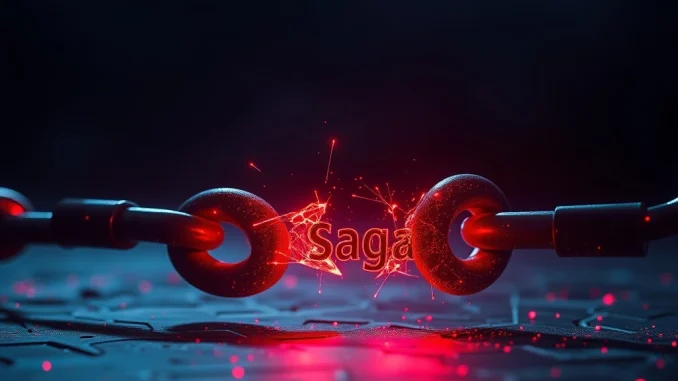
In a significant blow to blockchain security, the Layer 1 protocol Saga confirmed a devastating exploit resulting in the loss of approximately $7 million. The attack targeted its SagaEVM chain on June 15, 2025, prompting immediate network suspension. This incident underscores persistent vulnerabilities within the rapidly expanding smart contract ecosystem. Consequently, the Saga team initiated a comprehensive investigation and recovery protocol.
Saga Exploit Halts Network Operations
The Saga protocol, a notable Layer 1 blockchain, suffered a critical security breach. According to a report from The Block, attackers drained an estimated $7 million in digital assets. The exploit specifically targeted the protocol’s SagaEVM chain, a dedicated environment for Ethereum Virtual Machine compatibility. Following the discovery, the project’s core team made the decisive move to temporarily suspend all network operations. This suspension aims to contain the damage and prevent further unauthorized withdrawals. Furthermore, the team is actively assessing the full scope of the compromise.
Blockchain analytics firms first flagged anomalous transaction patterns. These patterns indicated a potential vulnerability in the chain’s bridge or a core smart contract. The Saga team responded within hours, publicly acknowledging the incident on their official communication channels. They assured users that a post-mortem analysis and recovery plan are their top priorities. This swift response is crucial for maintaining user trust during a crisis.
Anatomy of the Layer 1 Protocol Hack
While the full technical details remain under investigation, early analysis points to a sophisticated attack vector. Layer 1 protocols like Saga form the foundational blockchain layer, making their security paramount. The SagaEVM chain is designed to execute smart contracts compatible with Ethereum’s ecosystem. Experts suggest the exploit may have involved a cross-chain bridge or a flaw in the chain’s consensus mechanism.
Historically, bridges between blockchains have been frequent targets for hackers. These bridges lock assets on one chain and mint representative tokens on another. A flaw in this process can allow infinite minting or unauthorized withdrawals. The Saga incident follows a worrying trend of high-value exploits in the crypto space throughout 2024 and 2025. For instance, similar bridge attacks have previously compromised other networks for hundreds of millions.
- Attack Vector: Likely involved a smart contract vulnerability or bridge exploit.
- Asset Type: The $7 million loss presumably includes native SAGA tokens and other bridged assets.
- Response: Network suspension and forensic investigation are standard crisis procedures.
Expert Analysis on Blockchain Security Posture
Security researchers emphasize that new Layer 1 chains face immense pressure. They must balance rapid innovation with robust security auditing. “Every new virtual machine implementation introduces unique attack surfaces,” noted Dr. Alena Kovač, a blockchain security lead at ChainSafe Analysis. “The Saga exploit highlights the need for exhaustive, multi-firm audits before mainnet launch, especially for EVM-compatible chains.”
The financial impact extends beyond the direct $7 million loss. Market confidence in the Saga protocol and similar emerging Layer 1 solutions may waver. The native SAGA token’s price typically experiences high volatility following such news. Moreover, projects building on the SagaEVM chain now face operational delays and uncertainty. This event will likely trigger a renewed industry-wide focus on security over feature velocity.
Comparative Impact of Recent Crypto Exploits
The Saga $7 million theft is substantial, yet it sits within a broader context of crypto security incidents. The following table compares it to other notable Layer 1 and bridge exploits from the past two years, illustrating the evolving threat landscape.
| Protocol | Date | Estimated Loss | Attack Vector |
|---|---|---|---|
| Saga (SagaEVM) | June 2025 | $7 Million | Under Investigation (Suspected Bridge) |
| Poly Network | July 2023 | $10 Million | Smart Contract Exploit |
| Wormhole Bridge | February 2024 | $325 Million | Signature Verification Flaw |
| Ronin Bridge | March 2023 | $625 Million | Compromised Validator Keys |
This comparative data shows that while the Saga exploit is significant, the industry has weathered larger storms. However, each event erodes overall trust in decentralized systems. Therefore, the response and transparency from the Saga team will be critically analyzed. The protocol’s future depends on its ability to recover funds and upgrade its security model convincingly.
Recovery Efforts and Industry Implications
The Saga development team has prioritized a methodical recovery process. First, they suspended the network to prevent further damage. Next, they engaged with leading blockchain forensic firms like CertiK and Halborn to trace the stolen funds. Often, hackers use decentralized exchanges and cross-chain swaps to launder assets. Tracking these flows can sometimes lead to identification or freezing of funds.
Additionally, the team is likely exploring options for a network restart or upgrade. This upgrade would patch the exploited vulnerability before resuming operations. For users, the key questions revolve around asset safety and potential compensation. Some protocols have used treasury funds to cover user losses after an exploit. Others have attempted to negotiate with the attackers for a bounty return. The path Saga chooses will set a precedent for its community governance.
This incident serves as a stark reminder for all cryptocurrency participants. Investors must understand the inherent risks of smart contract platforms. Developers must advocate for more rigorous audit standards. Ultimately, the long-term health of the blockchain industry hinges on learning from these costly breaches. The Saga exploit is another data point in the ongoing battle between security innovators and malicious actors.
Conclusion
The Saga exploit resulting in a $7 million loss is a serious event for the Layer 1 protocol and its ecosystem. It highlights the continuous security challenges facing emerging blockchain networks, especially those implementing EVM compatibility. The temporary suspension of the SagaEVM chain represents a necessary step for damage assessment and remediation. Moving forward, the industry will closely watch Saga’s recovery efforts and post-mortem report. This response will influence trust not only in Saga but in the security promises of next-generation Layer 1 protocols. Ultimately, robust security practices must remain the foundational priority over pure scalability or speed.
FAQs
Q1: What is the Saga protocol and what happened?
The Saga protocol is a Layer 1 blockchain. It suffered a security exploit on its SagaEVM chain on June 15, 2025, leading to an estimated loss of $7 million. The team has suspended the network to investigate.
Q2: How was the SagaEVM chain exploited?
The exact technical vector is under investigation. Early speculation from security experts points to a potential vulnerability in a cross-chain bridge or a core smart contract on the EVM-compatible chain.
Q3: What does ‘network suspension’ mean for users?
It means all transactions, deposits, and withdrawals on the Saga chain are temporarily halted. This is a standard emergency measure to prevent further unauthorized access and allow the team to assess the breach safely.
Q4: Has the Saga team provided a timeline for recovery?
As of now, the team has not released a specific timeline. Recovery involves completing a forensic investigation, developing a security patch, and formulating a plan for resuming operations or addressing user losses.
Q5: How does this Saga exploit compare to other crypto hacks?
The $7 million loss is significant but smaller than some historical bridge exploits, which have exceeded $300 million. It underscores a persistent industry-wide issue with securing cross-chain infrastructure and new Layer 1 implementations.
Updated insights and analysis added for better clarity.
This article was produced with AI assistance and reviewed by our editorial team for accuracy and quality.