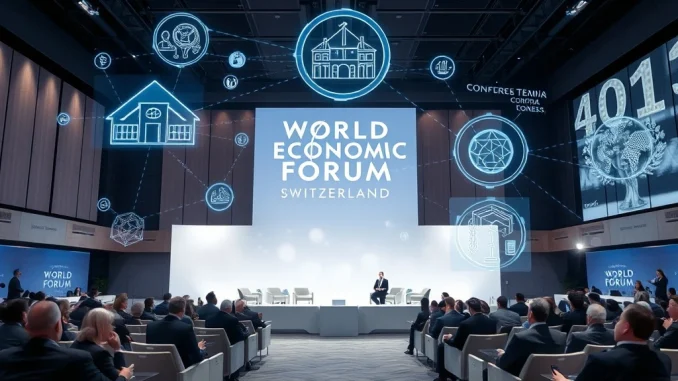
DAVOS, SWITZERLAND — January 2026 — The 2026 World Economic Forum annual meeting has witnessed a remarkable shift in financial discourse as real-world asset (RWA) tokenization emerges as the dominant conversation across every major panel and private discussion. This transformation represents a pivotal moment for global finance, particularly as the RWA tokenization market recently surpassed the $21 billion valuation milestone. Industry leaders, central bank officials, and regulatory experts have converged in the Swiss Alps to explore how blockchain-based asset representation could fundamentally reshape global markets.
RWA Tokenization Takes Center Stage at Davos
The World Economic Forum’s 2026 gathering has established RWA tokenization as its central financial technology theme. This development follows years of gradual blockchain integration into traditional finance. The forum’s agenda now features dedicated sessions examining how tokenization transforms asset liquidity, ownership structures, and market accessibility. Major financial publications report that discussions have moved beyond theoretical possibilities to practical implementation strategies.
Industry analysts note that this year’s focus represents a significant evolution from previous Davos conversations about cryptocurrency volatility and speculative trading. Instead, participants now examine how blockchain technology creates tangible value through asset digitization. The shift reflects growing institutional acceptance of distributed ledger technology for traditional finance applications. Furthermore, recent regulatory developments have provided the clarity necessary for serious institutional engagement.
The $21 Billion Market and Its Explosive Growth Trajectory
The RWA tokenization market’s recent achievement of $21 billion in total value locked demonstrates accelerating institutional adoption. This figure represents a compound annual growth rate exceeding 300% since 2023. Market analysts attribute this expansion to several key factors including regulatory advancements, technological improvements, and increasing investor demand for alternative asset exposure.
Market Composition and Leading Asset Classes
Tokenized real estate currently represents approximately 45% of the total RWA market value. Commercial properties, residential developments, and infrastructure projects have all seen successful tokenization initiatives. Meanwhile, tokenized commodities including precious metals, agricultural products, and energy resources constitute roughly 25% of market value. Financial instruments such as bonds, private equity, and venture capital funds account for another 20%. The remaining 10% includes diverse assets ranging from fine art to intellectual property rights.
| Asset Class | Market Share | Growth Rate (2025-2026) |
|---|---|---|
| Real Estate | 45% | 320% |
| Commodities | 25% | 280% |
| Financial Instruments | 20% | 350% |
| Other Assets | 10% | 410% |
Market participants highlight several advantages driving this expansion. Tokenization enables fractional ownership of previously illiquid assets, thereby democratizing investment opportunities. Additionally, blockchain-based settlement reduces transaction times from days to minutes while enhancing transparency through immutable record-keeping. These efficiency gains have attracted both institutional investors seeking portfolio diversification and retail investors pursuing previously inaccessible markets.
Industry Leaders Shape the Davos Dialogue
Prominent cryptocurrency executives have played crucial roles in advancing the RWA tokenization discussion at Davos. Coinbase CEO Brian Armstrong participated in multiple panels addressing regulatory frameworks and institutional adoption pathways. Armstrong emphasized the importance of clear compliance standards for sustainable market growth. He specifically highlighted how proper regulation protects investors while fostering innovation.
Ripple CEO Brad Garlinghouse contributed perspectives on cross-border settlement applications for tokenized assets. His discussions focused on how blockchain technology reduces international transaction costs and settlement times. Garlinghouse noted that tokenization could revolutionize correspondent banking relationships by creating more efficient asset transfer mechanisms. European Central Bank officials engaged directly with these industry leaders, signaling unprecedented collaboration between traditional regulators and blockchain innovators.
The presence of central bank representatives at these discussions marks a significant development. Previously, regulatory bodies approached cryptocurrency with caution, focusing primarily on consumer protection concerns. Now, these institutions actively explore how blockchain technology might enhance financial system efficiency. This shift reflects growing recognition of tokenization’s potential benefits for traditional finance.
Regulatory Clarity Fuels Optimistic Projections
Experts consistently reference 2025’s regulatory advancements as the catalyst for current market optimism. Comprehensive frameworks established in major jurisdictions including the European Union, United States, and Singapore have provided the certainty necessary for institutional investment. These regulations address critical concerns including:
- Legal recognition of digital asset ownership – Clear definitions of tokenized asset rights
- Custody requirements – Standards for safeguarding digital assets
- Anti-money laundering compliance – Protocols for transaction monitoring
- Investor protection mechanisms – Safeguards against fraud and manipulation
- Tax treatment clarity – Consistent reporting and liability frameworks
This regulatory foundation has enabled financial institutions to develop compliant tokenization platforms. Consequently, major banks, asset managers, and insurance companies have announced significant RWA initiatives throughout 2025. Industry analysts believe this institutional participation will drive the next phase of market expansion.
The $16 Trillion Vision for 2030
Davos discussions frequently reference ambitious projections for RWA tokenization market growth. Multiple analysts predict the market could reach $16 trillion by 2030, representing nearly 800-fold expansion from current levels. This projection assumes continued regulatory support, technological advancement, and institutional adoption. Several factors could contribute to this remarkable growth trajectory.
First, tokenization could capture significant portions of traditionally illiquid markets. Global real estate values exceed $300 trillion, while private equity markets approach $10 trillion. Even fractional adoption of tokenization within these sectors would generate substantial market capitalization. Second, emerging economies might leverage tokenization to attract foreign investment without traditional infrastructure requirements. Finally, generational wealth transfer could accelerate adoption as younger investors seek digital-native investment vehicles.
Potential Challenges and Risk Factors
Despite overwhelming optimism, Davos participants acknowledge several potential obstacles. Technological standardization remains incomplete, with multiple blockchain platforms competing for dominance. Interoperability between different systems requires further development. Additionally, legal frameworks vary significantly across jurisdictions, creating complexity for cross-border transactions. Cybersecurity concerns persist as tokenized assets represent attractive targets for sophisticated attacks.
Market volatility represents another consideration. While tokenization enhances liquidity, it could also increase price fluctuations for traditionally stable assets. Furthermore, regulatory changes in major economies could significantly impact market development. Participants emphasize the importance of balanced approaches that encourage innovation while maintaining financial stability.
Global Implications and Economic Transformation
The widespread adoption of RWA tokenization could fundamentally reshape global economic structures. Developing nations might gain improved access to international capital markets through tokenized infrastructure projects. Small and medium enterprises could leverage tokenization for alternative financing outside traditional banking systems. Additionally, tokenization could enhance supply chain transparency by creating verifiable digital records for physical goods.
Environmental, social, and governance (ESG) investing could benefit significantly from tokenization’s transparency features. Investors could verify sustainable practices through immutable blockchain records. Carbon credits and other environmental assets might see increased efficiency through tokenized markets. These applications demonstrate how blockchain technology extends beyond financial innovation to address broader societal challenges.
Conclusion
The 2026 World Economic Forum has unequivocally established RWA tokenization as a transformative force in global finance. With the market surpassing $21 billion and projections pointing toward $16 trillion by 2030, tokenization represents one of the most significant financial innovations of the decade. The presence of cryptocurrency leaders alongside central bank officials at Davos signals unprecedented collaboration between traditional finance and blockchain technology. As regulatory frameworks mature and institutional adoption accelerates, RWA tokenization appears poised to redefine asset ownership, liquidity, and accessibility across global markets. The discussions in Switzerland this January may well be remembered as the moment when tokenization transitioned from theoretical possibility to inevitable financial reality.
FAQs
Q1: What exactly is RWA tokenization?
RWA tokenization refers to the process of converting rights to a real-world asset into a digital token on a blockchain. These tokens represent ownership or economic interest in assets including real estate, commodities, art, or financial instruments.
Q2: Why has RWA tokenization become so prominent at Davos 2026?
The technology has reached critical mass with $21 billion in market value and clear regulatory frameworks established in 2025. Institutional adoption has accelerated, making tokenization a practical concern rather than theoretical discussion for global financial leaders.
Q3: What are the main benefits of tokenizing real-world assets?
Key benefits include fractional ownership enabling smaller investments, enhanced liquidity for traditionally illiquid assets, reduced transaction times and costs, improved transparency through immutable records, and global accessibility to investment opportunities.
Q4: How realistic is the $16 trillion projection for 2030?
While ambitious, this projection reflects the vast addressable market of traditional assets that could be tokenized. The estimate assumes continued regulatory support, technological advancement, and institutional adoption at current growth rates.
Q5: What are the biggest challenges facing RWA tokenization adoption?
Primary challenges include achieving technological standardization across platforms, ensuring regulatory consistency across jurisdictions, addressing cybersecurity risks, managing market volatility for tokenized assets, and building necessary legal frameworks for digital ownership rights.
Updated insights and analysis added for better clarity.
This article was produced with AI assistance and reviewed by our editorial team for accuracy and quality.