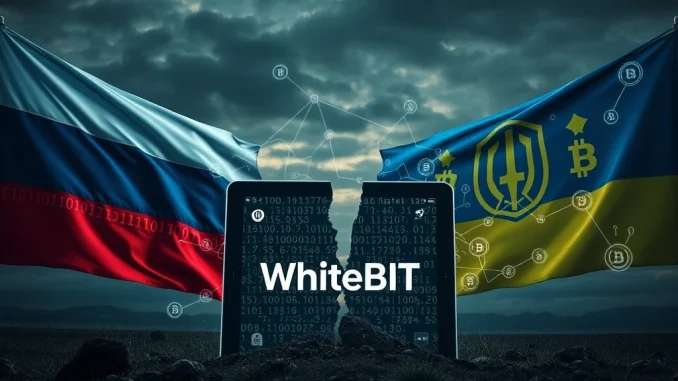
Moscow, April 2025: In a significant escalation of the digital front in the Russia-Ukraine conflict, Russian authorities have formally banned all transactions with the cryptocurrency exchange WhiteBIT. The stunning move designates WhiteBIT and its parent company, W Group, as “Undesirable Organizations,” rendering any related financial activities within Russian jurisdiction illegal. This decisive action directly targets the exchange’s substantial financial and technical support for the Ukrainian military since the war’s inception in February 2022, marking a pivotal moment in the geopolitical weaponization of cryptocurrency infrastructure.
Cryptocurrency Exchange WhiteBIT Faces Total Russian Ban
The Russian General Prosecutor’s Office, in coordination with the Ministry of Justice, issued the formal designation this week. The official statement, as reported by financial news outlet CoinDesk, accuses WhiteBIT and W Group of systematically supporting the Ukrainian armed forces. Authorities allege the companies provided not only financial infrastructure but also planned operations to move funds abroad, which they characterize as money laundering. This legal designation carries severe penalties for Russian citizens or entities engaging with the exchange, including potential criminal charges. The ban represents one of the most direct state-level actions against a specific crypto entity for geopolitical reasons, setting a stark precedent for how nations may leverage financial technology regulations during conflicts.
The Scale and Nature of WhiteBIT’s Support for Ukraine
Founded in Ukraine in 2018, WhiteBIT grew to become one of Europe’s prominent centralized cryptocurrency exchanges. Following Russia’s full-scale invasion, the company publicly committed its resources to Ukraine’s defense. Russian investigators cite that WhiteBIT has directed at least $11 million in aid to the Ukrainian military. A detailed breakdown of this support reveals its strategic nature:
- Drone Procurement: Approximately $1 million was allocated specifically for purchasing unmanned aerial vehicles (UAVs), a critical asset in modern warfare.
- Financial Infrastructure: The exchange reportedly facilitated channels for donations, allowing global supporters to convert crypto assets into usable military funding.
- Technical Support: Beyond money, WhiteBIT allegedly provided technological infrastructure, though specific details remain classified by Ukrainian authorities.
This support transformed the exchange from a neutral financial platform into an active participant in the conflict’s economic dimension, directly triggering the Russian state’s response.
A Timeline of Escalation in Crypto Warfare
The friction between Russia and cryptocurrency entities supporting Ukraine has evolved over three years. The initial phase saw informal warnings and technical blocks against donation websites in early 2022. By mid-2023, Russian financial monitors began flagging transactions linked to Ukrainian aid. The “Undesirable Organization” label, previously applied mainly to foreign NGOs and media outlets, now expands into the digital asset realm. This legal tool allows Russia to criminalize any association with the designated entity, creating a powerful deterrent for its citizens. The move against WhiteBIT is not isolated; it follows increased scrutiny and restrictions on global crypto platforms operating in Russia, reflecting a broader crackdown on uncontrolled financial flows.
Implications for the Global Cryptocurrency Industry
Russia’s ban on WhiteBIT sends shockwaves through the international crypto community, raising profound questions about neutrality, compliance, and survival. Exchanges now face an impossible dilemma: operating in a global market often requires adhering to conflicting national laws during wartime. The precedent suggests that any crypto business could become a geopolitical target based on the nationality of its founders or its charitable activities. Furthermore, the allegation of “planned money laundering operations” introduces a severe reputational risk that could affect WhiteBIT’s partnerships and banking relationships worldwide. Industry analysts warn this could accelerate the fragmentation of the global crypto landscape into separate, politically aligned spheres.
| Entity | Date | Action Taken | Stated Reason |
|---|---|---|---|
| Various Crypto Donation Sites | 2022 | Technical Blocking | Funding Ukrainian Military |
| Binance (Restrictions) | 2023 | Increased Scrutiny & Limits | Compliance Concerns |
| WhiteBIT / W Group | 2025 | Undesirable Organization Ban | Direct Military Support & Alleged Money Laundering |
The Legal and Operational Fallout for WhiteBIT
For WhiteBIT, the designation necessitates an immediate cessation of all business with Russian users and likely a comprehensive review of its user base to ensure compliance. The exchange must now navigate enhanced due diligence from global counterparties concerned about secondary sanctions. Legally, the “Undesirable” label is a powerful tool under Russian law (Article 32.3 of the Federal Law “On Measures to Affect Persons Involved in Violations of Fundamental Human Rights and Freedoms”). It prohibits the creation of Russian legal entities, distribution of materials, and any financial transactions. Russian nationals found cooperating with the exchange could face fines or imprisonment. WhiteBIT’s response will be closely watched as a case study for how crypto businesses manage such extreme sovereign risk.
Conclusion
Russia’s ban on the cryptocurrency exchange WhiteBIT marks a critical inflection point, demonstrating how digital asset platforms can become direct targets in international conflict. The move, justified by WhiteBIT’s provision of an estimated $11 million in aid to Ukraine—including $1 million for drones—showcases the tangible role crypto can play in modern warfare finance. This action transcends mere regulatory friction; it represents the formal weaponization of financial technology policy. As the lines between economic infrastructure and geopolitical tools blur, the global cryptocurrency industry must grapple with a new reality where code and consensus can collide with national security imperatives, with profound consequences for innovation, neutrality, and global finance.
FAQs
Q1: What does Russia’s “Undesirable Organization” designation mean for WhiteBIT?
It is a severe legal status under Russian law that makes all activities related to WhiteBIT and its parent company, W Group, illegal within Russia. This includes any financial transactions, partnerships, or distribution of its materials. Russian citizens face legal penalties for any interaction with the exchange.
Q2: How much aid did WhiteBIT provide to Ukraine, and what was it used for?
Russian authorities state WhiteBIT provided at least $11 million in aid to the Ukrainian military since February 2022. Reports indicate approximately $1 million of this sum was used to purchase drones, with the remainder supporting broader military financial and technical infrastructure.
Q3: Can WhiteBIT still operate globally after this ban?
Yes, the ban is specific to Russian jurisdiction. However, the designation and the associated allegations of supporting military activities and planned money laundering could strain the exchange’s relationships with global banking partners and other regulated entities, requiring enhanced compliance measures.
Q4: Is this the first time Russia has targeted a cryptocurrency exchange?
While Russia has previously restricted access to crypto donation sites for Ukraine and increased scrutiny on major exchanges like Binance, this is the first instance of a full “Undesirable Organization” designation against a crypto business, representing a significant escalation in tactic.
Q5: What are the broader implications for the crypto industry?
This event sets a precedent where cryptocurrency exchanges can be formally sanctioned by nation-states for the political alignments or charitable activities of their founders. It challenges the notion of crypto neutrality and may force exchanges to explicitly choose sides in geopolitical conflicts, potentially fragmenting the global market.