Robert Kiyosaki’s Strategic Bitcoin Purchase at $67K Reveals Deep Concerns Over Dollar’s Future
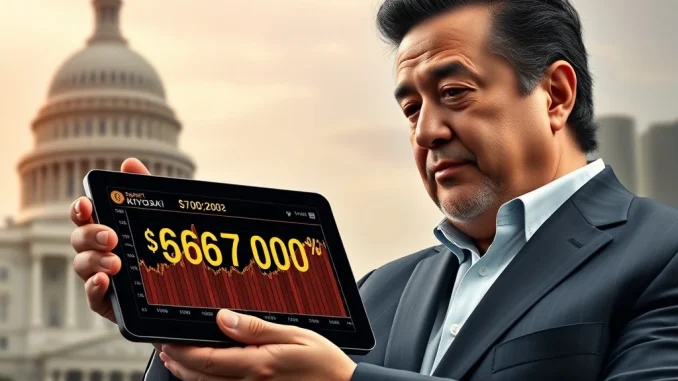
Global, May 2025: Prominent financial author and investor Robert Kiyosaki has executed a significant cryptocurrency transaction, purchasing one Bitcoin (BTC) at approximately $67,000. This move, confirmed during a recent market downturn, is not framed as short-term speculation. Instead, Kiyosaki cites structural concerns about U.S. fiscal policy, future currency devaluation, and Bitcoin’s programmed scarcity as the core rationale for his investment. His action provides a tangible case study in how macroeconomic fears are influencing capital allocation among high-profile investors.
Robert Kiyosaki’s Bitcoin Investment Rationale
Robert Kiyosaki, best known for his personal finance book “Rich Dad Poor Dad,” has long been a critic of traditional financial education and a proponent of tangible assets. His recent Bitcoin acquisition follows a consistent public narrative. In statements accompanying the purchase, Kiyosaki pointed directly to the escalating U.S. national debt, which surpassed $34 trillion in early 2024. He argues that the political and economic pressure to service this debt will inevitably lead to increased money printing by the Federal Reserve, a process formally known as quantitative easing.
Kiyosaki contrasts this potential for dollar inflation with Bitcoin’s immutable supply cap of 21 million coins. This fundamental scarcity, enforced by the cryptocurrency’s underlying code, positions Bitcoin as a potential hedge against currency devaluation in his view. His purchase at $67,000, a level considered a “dip” from recent all-time highs near $73,000, indicates a strategy of dollar-cost averaging into a position he views as a long-term store of value, rather than timing a momentary bottom.
The Macroeconomic Backdrop: Debt and Currency Devaluation
Kiyosaki’s investment thesis cannot be separated from the broader global macroeconomic environment. Central banks worldwide, including the Federal Reserve, engaged in unprecedented monetary expansion following the 2008 financial crisis and during the COVID-19 pandemic. While recent policy has focused on combating inflation through higher interest rates, many analysts question the long-term path for debt sustainability.
The U.S. government faces persistent budget deficits, meaning it spends more than it collects in revenue. To cover this gap, it issues Treasury bonds. If demand for these bonds wavers, the Federal Reserve has historically intervened by purchasing them, effectively creating new money. This dynamic is at the heart of Kiyosaki’s concern. He is not alone; this perspective aligns with a school of thought often associated with advocates of hard assets like gold and, more recently, Bitcoin. The table below outlines the core contrast driving this investment philosophy:
| Asset | Supply Characteristic | Primary Influence |
|---|---|---|
| U.S. Dollar (Fiat) | Unlimited, controlled by central bank policy | Federal Reserve decisions, government fiscal policy |
| Bitcoin (BTC) | Fixed maximum of 21 million, predictable issuance | Pre-programmed network protocol, decentralized consensus |
Bitcoin’s Evolution as a Macro Asset
The context of Kiyosaki’s purchase reflects Bitcoin’s maturation within the financial landscape. Initially perceived as a niche digital token or a medium for peer-to-peer transactions, a significant portion of its valuation now derives from its perceived role as “digital gold.” This narrative gained substantial traction after major institutional investors and publicly traded companies began adding Bitcoin to their treasury reserves in 2020 and 2021. These entities often cited similar macro-hedging reasons, lending credence to the argument Kiyosaki now personally executes.
Market data shows that Bitcoin’s price discovery is increasingly influenced by macro indicators such as inflation reports, interest rate expectations, and real Treasury yields. Its volatility remains high compared to traditional assets, but its 90-day correlation with traditional stock indices has decreased at times, suggesting it can behave as a distinct asset class. Kiyosaki’s move, therefore, is seen by market observers as a further endorsement of this macro-hedge narrative from a well-known, if controversial, financial personality.
Analyzing the Purchase Timing and Market Psychology
Buying at $67,000 represents a specific tactical decision. The cryptocurrency market experienced a significant correction from its March 2024 peak, with Bitcoin falling over 20% at one point. This pullback was attributed to profit-taking, outflows from spot Bitcoin ETFs, and shifting risk sentiment in global markets. For investors with a long-term, fundamentals-based view like Kiyosaki, such corrections are often seen as entry opportunities rather than signals to exit.
This behavior aligns with a core tenet of his published philosophy: buying assets when they are out of favor or undervalued relative to their long-term potential. It also demonstrates a key difference between trading and investing. Traders might focus on the short-term momentum and technical indicators around the $67,000 level. In contrast, Kiyosaki’s stated rationale ignores these short-term fluctuations, focusing solely on the multi-year thesis of fiat debasement versus digital scarcity. His public announcement may also aim to educate his audience on this distinction.
- Long-Term Horizon: The investment is framed as a multi-year hold, not a short-term trade.
- Value Perspective: The price is evaluated against a future potential of scarcity value, not past price action.
- Psychological Discipline: The purchase during a dip requires ignoring prevailing fear or negative sentiment in the market.
Conclusion
Robert Kiyosaki’s confirmation of a Bitcoin purchase at $67,000 is a noteworthy event that bridges celebrity finance commentary with actionable investment strategy. While his views are frequently debated, the clarity of his thesis is evident: he perceives a fundamental risk to the purchasing power of the U.S. dollar due to national debt levels and views Bitcoin’s fixed supply as a strategic counterbalance. This move underscores the growing intersection of macroeconomic policy analysis and cryptocurrency allocation. It highlights how digital assets are being evaluated not just for their technological promise, but as potential hedges against systemic financial risks, attracting a diverse range of investors from institutions to influential individuals like Kiyosaki.
FAQs
Q1: Why did Robert Kiyosaki buy Bitcoin specifically at $67,000?
Robert Kiyosaki purchased Bitcoin at that price point during a market decline, viewing it as a favorable long-term entry price. His primary reason was not short-term timing, but his belief in Bitcoin’s scarcity as a hedge against future U.S. dollar inflation driven by high national debt.
Q2: What does “future dollar printing” mean in this context?
It refers to the potential for the U.S. Federal Reserve to engage in further quantitative easing—creating new money to purchase government debt—in order to manage the servicing costs of the over $34 trillion national debt. This can decrease the dollar’s purchasing power over time.
Q3: How does Bitcoin’s fixed supply of 21 million coins work?
Bitcoin’s source code contains a hard cap that limits the total number of bitcoins that will ever be created to 21 million. New bitcoins are issued as a reward to miners who secure the network, but this issuance rate halves approximately every four years in an event called the “halving,” ensuring a predictable and decelerating supply until the cap is reached around the year 2140.
Q4: Is Robert Kiyosaki known for other investment advice?
Yes, Robert Kiyosaki is best known for his book “Rich Dad Poor Dad,” which advocates for financial literacy, investing in income-generating assets (like real estate and businesses), and understanding the difference between assets and liabilities. His endorsement of Bitcoin fits his historical preference for assets he believes are outside the traditional banking system.
Q5: Do all financial experts agree with Kiyosaki’s view on Bitcoin?
No, opinions are deeply divided. Some economists and investors echo his concerns about fiat currency and see Bitcoin as a viable hedge. Others criticize Bitcoin for its volatility, environmental impact from mining, regulatory uncertainty, and argue that it lacks intrinsic value, making it a speculative asset rather than a reliable store of value.
Related News
- Crypto Futures Liquidations: Short Positions Suffer Staggering Losses in 24-Hour Market Shakeout
- Dogecoin Struggling To Stabilize as Experts Predict Solaxy to Explode 100x
- BTC Perpetual Futures Reveal Cautious Market: Shorts Maintain Strategic Edge on Major Exchanges
Related: ASTER Consolidation Reaches Critical Juncture: Will $0.81 Breakout Materialize?
Related: Crypto Presale Projects: 5 Leading Contenders for the 2026 Market Cycle
Related: Fake Crypto Ads: Uniswap Founder's Urgent Warning After Devastating Six-Figure Loss