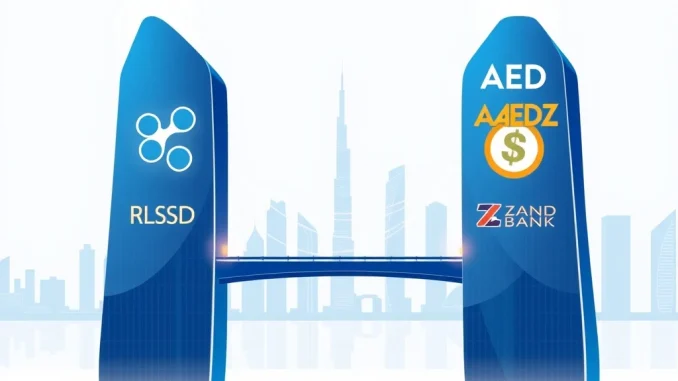
Dubai, UAE, April 2025: In a significant move for the United Arab Emirates’ digital economy, Ripple, the enterprise blockchain and crypto solutions provider, has partnered with Zand Bank, the UAE’s first digital-only bank, to launch a regulated liquidity bridge. This pivotal infrastructure connects Ripple’s U.S. dollar-pegged stablecoin, RLUSD, with Zand Bank’s digital dirham, AEDZ, directly on the XRP Ledger (XRPL). The collaboration represents a major step in creating a seamless, compliant framework for cross-border value transfer and institutional digital asset adoption in the region.
Anatomy of the RLUSD-AEDZ Liquidity Bridge
The newly launched bridge is not a simple token swap mechanism. It is a sophisticated, regulated financial rail built on the XRP Ledger’s native decentralized exchange (DEX). The bridge facilitates the instant, low-cost conversion between RLUSD and AEDZ stablecoins. Zand Bank, as a fully licensed UAE financial institution, provides the regulated custody and issuance framework for the AEDZ token, ensuring it is fully backed 1:1 by UAE dirhams held in reserve. Ripple’s RLUSD, also fully asset-backed, brings deep liquidity and connectivity to global markets. This partnership effectively creates a two-way corridor where institutional and corporate users can move value between the dollar and dirham ecosystems with unprecedented efficiency and regulatory clarity.
Strategic Implications for the UAE’s Digital Economy
This launch is a cornerstone of the UAE’s broader national strategy to become a global hub for digital finance. The bridge directly supports several key initiatives. First, it enhances the operational framework for cross-border trade and remittances, a vital sector for the UAE’s economy. Businesses can now settle invoices or make payments in near-real-time without traditional foreign exchange delays. Second, it provides a regulated on-ramp and off-ramp for digital assets within the UAE’s jurisdiction, aligning with the Central Bank’s digital dirham (CBDC) exploration. Finally, it positions the XRP Ledger as a preferred public blockchain for regulated financial innovation in the region, showcasing its capability to host compliant, institutional-grade applications.
Building on a Foundation of Previous Collaboration
This announcement expands upon an existing relationship between Ripple and Zand Bank. In late 2023, the two entities collaborated on a pilot for Ripple’s Central Bank Digital Currency (CBDC) platform. That successful trial demonstrated the technical viability of using blockchain for large-scale, secure currency management. The new RLUSD-AEDZ bridge represents a commercial evolution of that proof-of-concept, moving from experimentation to live, production-grade infrastructure. It signals a maturing partnership where both parties are now deploying solutions to address tangible market needs.
The Role of Regulated Custody and Compliance
A critical differentiator for this bridge is its embedded compliance architecture. Unlike many decentralized finance (DeFi) bridges that operate in a regulatory gray area, this solution is built with institutional requirements at its core. Zand Bank’s involvement ensures that all AEDZ transactions are subject to the UAE’s Anti-Money Laundering (AML) and Know Your Customer (KYC) regulations. The custody of the underlying fiat reserves is managed by a licensed bank, providing a layer of security and trust that is essential for corporate adoption. This model addresses one of the primary concerns for traditional finance entering the digital asset space: regulatory risk.
Technical Advantages of the XRP Ledger
The choice of the XRP Ledger as the underlying platform is strategic. XRPL offers several features that make it suitable for this application. Its consensus mechanism is fast and energy-efficient, enabling settlement in 3-5 seconds with minimal cost. The native DEX functionality allows for the direct issuance and trading of the stablecoins without relying on external smart contracts, which can introduce complexity and vulnerability. Furthermore, XRPL has a long-standing track record in handling tokenized value, originally designed for efficient cross-border payments. This technical foundation provides the necessary performance and reliability for a critical financial bridge.
Market Context and Competitive Landscape
The launch occurs amidst growing global competition in the stablecoin and digital payments corridor space. Other regions, particularly in Asia and Europe, are developing similar bridges using both public and private blockchains. The Ripple-Zand Bank partnership gives the UAE a first-mover advantage in the Middle East and North Africa (MENA) region. By establishing a regulated, bank-led model, they are setting a potential standard for how other nations in the region might integrate digital assets into their monetary systems. The bridge also strengthens Ripple’s position against other enterprise blockchain providers vying for dominance in the institutional cross-border payments market.
The table below outlines the core components of the bridge:
| Component | Provider | Function |
|---|---|---|
| RLUSD Stablecoin | Ripple | U.S. dollar-pegged digital asset for global liquidity. |
| AEDZ Stablecoin | Zand Bank | UAE dirham-pegged digital asset with regulated custody. |
| Blockchain Platform | XRP Ledger (XRPL) | Public decentralized ledger for issuance and exchange. |
| Liquidity Bridge | Joint Infrastructure | Smart contract/ DEX-based mechanism for instant conversion. |
| Regulatory Compliance | Zand Bank | Ensures AML/KYC adherence for AEDZ transactions. |
Conclusion
The launch of the RLUSD-AEDZ liquidity bridge by Ripple and Zand Bank is a landmark development that transcends a simple product announcement. It represents the convergence of innovative blockchain technology with robust, traditional banking regulation. This bridge provides a tangible, efficient, and compliant pathway for value movement between the U.S. dollar and UAE dirham, directly supporting the UAE’s vision for a technology-driven financial future. As the digital asset industry continues to seek institutional legitimacy, partnerships like this one demonstrate a viable blueprint for integrating public blockchains into the global regulated financial system. The success of this RLUSD-AEDZ bridge will likely be closely watched as a model for similar initiatives worldwide.
FAQs
Q1: What is the RLUSD-AEDZ liquidity bridge?
The RLUSD-AEDZ liquidity bridge is a regulated financial infrastructure on the XRP Ledger that allows for the instant and low-cost conversion between Ripple’s U.S. dollar stablecoin (RLUSD) and Zand Bank’s UAE dirham stablecoin (AEDZ).
Q2: Why is this bridge important for the UAE?
It advances the UAE’s digital economy by creating a fast, compliant corridor for cross-border payments and trade settlement. It integrates digital assets into the mainstream financial system under existing banking regulations, promoting innovation and efficiency.
Q3: How does this differ from other crypto bridges?
Unlike many decentralized bridges, this is a bank-led initiative with built-in regulatory compliance. Zand Bank ensures all AEDZ transactions follow UAE AML/KYC laws, and the underlying fiat reserves are held in regulated custody, offering greater security for institutions.
Q4: What role does the XRP Ledger play?
The XRP Ledger provides the public blockchain foundation. Its fast, low-cost consensus mechanism and native decentralized exchange functionality enable the secure issuance and efficient trading of the two stablecoins that form the bridge.
Q5: Who can use this liquidity bridge?
Initially, the primary users are expected to be institutional and corporate clients of Ripple and Zand Bank, such as businesses engaged in international trade, financial institutions, and payment providers. Access will be governed by the compliance protocols of the participating banks.
Updated insights and analysis added for better clarity.
This article was produced with AI assistance and reviewed by our editorial team for accuracy and quality.