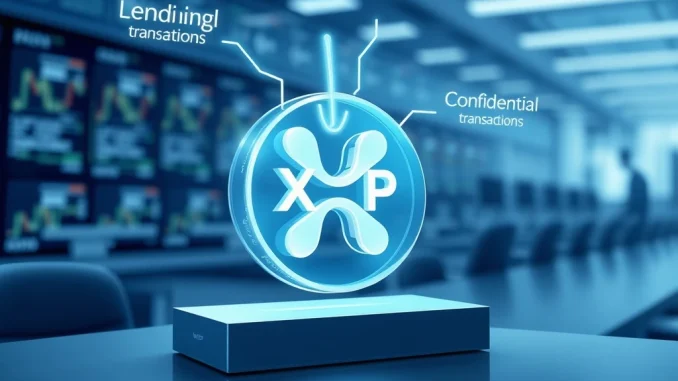
San Francisco, May 15, 2025: Ripple has formally declared its ambitious institutional DeFi roadmap, centering the XRP Ledger (XRPL) as a core infrastructure for regulated finance. The comprehensive plan, unveiled this week, details the development of a native XRP lending protocol, confidential transaction capabilities, and permissioned trading functionalities, all targeted for implementation by 2026. This strategic pivot positions XRP not just as a bridge currency, but as the foundational asset within a new, compliant decentralized finance ecosystem built for enterprise and institutional adoption.
Ripple XRP Lending Protocol: The Core of the Institutional Vision
The announcement of a native XRP lending protocol marks a significant evolution for the XRP Ledger. Historically, XRPL has excelled in fast, low-cost payment settlement, with XRP serving as a bridge asset in RippleNet’s cross-border payment solutions. The new lending protocol aims to unlock the capital efficiency of XRP holdings directly on the ledger. This means institutions and individuals will be able to lend and borrow XRP without relying on external, often less regulated, DeFi platforms built on other blockchains. The protocol is designed to facilitate on-chain lending markets, creating new yield opportunities for XRP holders and providing liquidity mechanisms that are native to the XRP ecosystem. This development directly addresses a long-standing critique from some quarters of the crypto community regarding XRP’s utility beyond payments and its role in decentralized finance.
Privacy Features and Permissioned Trade: Balancing Transparency and Confidentiality
Alongside lending, Ripple’s roadmap introduces two critical features aimed at institutional adoption: confidential transactions and permissioned trade. Confidential transactions will allow parties to obscure sensitive financial data, such as transaction amounts, on the public ledger while still maintaining the integrity and auditability of the network through cryptographic proofs. This feature is crucial for large financial institutions that require privacy for competitive and operational reasons but still need to comply with regulatory oversight. Permissioned trade will enable the creation of controlled, compliant trading environments on the XRPL. These could be used for private markets, institutional over-the-counter (OTC) desks, or regulated asset trading, where access and participation are gated to meet know-your-customer (KYC) and anti-money laundering (AML) requirements. This dual approach of public transparency and optional private layers is a calculated move to bridge the gap between traditional finance and blockchain technology.
The Regulatory Context and Enterprise Strategy
Ripple’s framing of the XRP Ledger as “the core of regulated finance” is not incidental. It reflects the company’s ongoing strategy and legal posture, particularly following its landmark legal victory against the U.S. Securities and Exchange Commission (SEC) in 2023. By building features like permissioned trade and confidential transactions, Ripple is proactively creating a technological framework that can more easily integrate with existing financial regulations. This contrasts with many DeFi protocols that operate in a permissionless manner, often creating friction with regulators. The 2026 timeline suggests a phased, deliberate rollout, allowing for development, security audits, and engagement with regulators and financial partners. This experience-driven approach leverages Ripple’s decade of work with banks and payment providers, aiming to bring them into the DeFi space on terms they understand and can legally navigate.
Technical Implications for the XRP Ledger Ecosystem
The introduction of these features will require significant upgrades to the XRP Ledger’s core protocol. The XRPL community, including validators and developers, will need to adopt these new amendments through its unique consensus process. The lending protocol will likely be built using XRPL’s native smart contract functionality, Hooks (small, efficient smart contracts), or as a new native protocol feature like the existing decentralized exchange. The privacy features may involve advanced cryptographic techniques like zero-knowledge proofs or ring signatures, adapted for the ledger’s performance requirements. These upgrades will test the network’s scalability and security but, if successful, could dramatically expand its use cases beyond simple value transfer.
The roadmap also has implications for the broader XRPL developer community. It signals Ripple’s commitment to enhancing the ledger’s capabilities, which could attract more projects and liquidity. However, it also raises questions about the balance between Ripple’s institutional vision and the decentralized, community-driven development of other DeFi applications on XRPL. The success of this initiative will depend on widespread validator adoption and the ability of independent developers to build complementary services on top of these new primitives.
Market Impact and Competitive Landscape
Ripple’s move places it in direct competition with other blockchain projects targeting institutional DeFi, such as Ethereum with its layer-2 scaling solutions, enterprise-focused chains like Hyperledger Fabric, and other payment-focused networks. XRPL’s key differentiators remain its speed, low cost, and established use in payments. Adding sophisticated DeFi and privacy features could make it a more compelling all-in-one platform for financial institutions looking to experiment with blockchain. For the XRP market, a successful lending protocol could create new demand dynamics, as XRP becomes a productive, yield-bearing asset directly on its native chain. This could influence its utility and valuation beyond its traditional role as a bridge currency in Ripple’s On-Demand Liquidity (ODL) product.
Conclusion: A Strategic Pivot for the Future of Finance
Ripple’s unveiling of its institutional DeFi roadmap, featuring the XRP lending protocol and advanced privacy features, represents a strategic and necessary evolution. It is an attempt to capture the innovation of decentralized finance while adhering to the compliance and operational requirements of the global financial system. By targeting 2026, Ripple has set a clear, multi-year direction that aligns with its core strengths and regulatory experience. The success of this ambitious plan will hinge on flawless technical execution, broad ecosystem adoption, and continued positive engagement with regulators worldwide. If realized, it could fundamentally reshape the role of the XRP Ledger and solidify XRP’s position as a cornerstone of both traditional and decentralized finance infrastructure.
FAQs
Q1: What is the main goal of Ripple’s new DeFi roadmap?
The primary goal is to transform the XRP Ledger into a comprehensive platform for institutional decentralized finance (DeFi) by introducing native lending markets, privacy features, and permissioned trading, all designed to operate within regulatory frameworks.
Q2: How will the XRP lending protocol work?
While specific technical details are pending, the protocol will be built directly on the XRP Ledger, allowing users to lend and borrow XRP in a decentralized, on-chain market. This will enable XRP holders to earn yield on their assets and borrowers to access liquidity without leaving the XRPL ecosystem.
Q3: Why are confidential transactions important for institutions?
Large financial institutions often need to keep transaction amounts private for competitive, strategic, and client confidentiality reasons. Confidential transactions would allow them to use a public blockchain like XRPL while protecting sensitive commercial data, making adoption more feasible.
Q4: What does “permissioned trade” mean on the XRP Ledger?
Permissioned trade refers to creating controlled trading environments on the ledger where participation is restricted to verified entities. This is essential for building compliant markets for securities, private assets, or institutional OTC trading that require strict KYC/AML checks.
Q5: How does this roadmap affect the average XRP holder?
For holders, the most direct impact will be the potential to earn yield through the lending protocol. More broadly, if successful, these developments could increase utility, demand, and institutional adoption of XRP, potentially affecting its long-term ecosystem growth and value.
Updated insights and analysis added for better clarity.
This article was produced with AI assistance and reviewed by our editorial team for accuracy and quality.