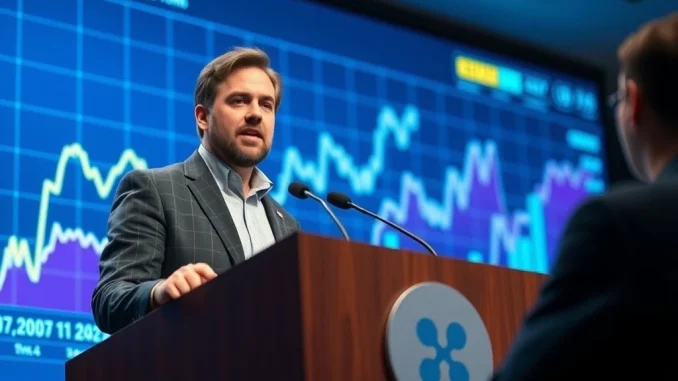
New York, January 2026: In a significant statement that has captured the attention of the financial world, Ripple CEO Brad Garlinghouse has publicly forecast a new all-time high for the cryptocurrency market. Speaking on CNBC, Garlinghouse positioned himself as “very bullish,” explicitly putting his credibility on the line with a prediction that hinges not on retail speculation, but on a fundamental and enduring transformation in market structure. This declaration arrives as the digital asset sector shows signs of stabilization following a period of notable volatility in late 2025, prompting analysts to scrutinize the underlying drivers of this renewed optimism.
Garlinghouse’s Bullish Thesis: A Decade Shift in Market Dynamics
Brad Garlinghouse’s prediction is not presented as a short-term trading call but as a reflection of a profound, structural evolution within the cryptocurrency ecosystem. His analysis points to a “massive sea change” primarily driven by the deepening involvement of traditional financial institutions. This transition marks a departure from previous market cycles, which were often characterized by retail-driven euphoria and rapid, sentiment-fueled price movements. According to Garlinghouse, the current phase is defined by a more methodical and thesis-driven allocation of capital from Wall Street firms, pension funds, and asset managers.
This institutional entry is not a monolithic event but a gradual process with observable milestones. The approval and subsequent flows into various cryptocurrency exchange-traded products (ETPs) throughout 2024 and 2025 provided a clear conduit for institutional capital. However, as Garlinghouse and other market observers note, this engine operates with distinct characteristics. Institutional demand can be powerful but is also sensitive to macroeconomic conditions, regulatory developments, and internal risk management protocols. The market correction following the October 2025 highs demonstrated this sensitivity, as risk committees re-evaluated exposures amid shifting liquidity conditions.
The Regulatory Catalyst: Clarity Versus Uncertainty
A central pillar of Garlinghouse’s optimistic outlook is the evolving regulatory landscape, particularly in the United States. Cryptocurrency markets have historically shown a greater aversion to regulatory uncertainty than to defined risk. The ongoing legislative progress of frameworks like the proposed CLARITY Act represents a potential turning point. Such legislation aims to delineate jurisdictional boundaries between agencies like the SEC and CFTC, providing the clear rules of engagement that institutional capital requires to operate at scale.
The market impact of regulation is complex and rarely linear. While clarity can unlock significant institutional participation by reducing compliance risk, it can also impose new costs and operational requirements. This dynamic may act as a filter, strengthening projects with robust fundamentals and viable use cases while challenging those built primarily on speculative narratives. The market’s tendency to anticipate, react, and then re-evaluate regulatory news means the path forward is unlikely to be a simple “law equals pump” scenario. Instead, a settled regulatory framework could provide the stable foundation necessary for sustainable, long-term growth, which is the core of Garlinghouse’s prediction.
From Hype to Utility: The Maturing Narrative for XRP and Beyond
Garlinghouse’s commentary extends beyond a generic price forecast for Bitcoin or the aggregate market. He articulates a trajectory for the industry with a five- to ten-year horizon, emphasizing real-world applications in cross-border payments, stablecoin infrastructure, and enterprise blockchain solutions. This narrative shift from pure speculation to tangible utility is strategically aimed at the institutional investors now entering the space.
Within this framework, assets like Ripple’s XRP are presented as “use” assets integral to specific financial plumbing, rather than merely “cycle” assets that rise and fall with broader market sentiment. The argument suggests that as real-world adoption and utility stabilize, the extreme volatility that has defined cryptocurrencies may gradually moderate, making the asset class more palatable for conservative portfolios. This maturation process is critical for the sustained institutional engagement that Garlinghouse identifies as the primary lever for a new market peak.
Institutional Demand: A New Type of Market Driver
The nature of institutional capital differs fundamentally from retail investment. The following table contrasts the key characteristics of these two market forces:
| Driver | Investment Thesis | Time Horizon | Risk Appetite | Primary Influence |
|---|---|---|---|---|
| Retail Investors | Often momentum-based, influenced by social media and price trends. | Short to medium term. | Can be very high, seeking rapid returns. | Market sentiment, hype cycles, fear of missing out (FOMO). |
| Institutional Investors | Allocation-based, focused on portfolio diversification, inflation hedging, and technological disruption. | Long term, strategic. | Managed, with strict risk parameters and due diligence. | Regulatory clarity, macroeconomic data, custody solutions, and long-term viability. |
This shift towards institutional dominance suggests a potential change in market behavior. Volatility may become more concentrated around macroeconomic announcements and regulatory news rather than social media trends. Furthermore, Garlinghouse’s point that this dynamic is “not yet fully priced in” suggests that the market may still be undervaluing the scale and permanence of this structural shift.
Conclusion: A Bumpy Road to Potential New Highs
Brad Garlinghouse’s prediction of a new all-time high for the cryptocurrency market is a confident bet on the sector’s ongoing institutionalization and regulatory maturation. His argument rests on a clear-eyed assessment of current trends: the entry of Wall Street capital, the slow but tangible progress of regulatory frameworks, and the industry’s own pivot toward building utility-driven infrastructure. While the path forward is unlikely to be smooth—described by many analysts as a “bumpy track” rather than a highway—the underlying fundamentals appear to be strengthening. The key differentiator for achieving and sustaining new highs will be the depth of institutional conviction, moving beyond fleeting enthusiasm to embedded, long-term allocation. As 2026 unfolds, the market will test whether Garlinghouse’s vision of a fundamentally transformed ecosystem can indeed power the next historic peak.
FAQs
Q1: What exactly did Ripple’s CEO predict?
Brad Garlinghouse stated during a CNBC interview that he expects the cryptocurrency market to reach a new all-time high. He cited the growing involvement of institutional investors and evolving regulatory clarity as the primary reasons for his bullish outlook.
Q2: Why does institutional adoption matter for crypto prices?
Institutional investors manage vastly larger pools of capital than retail investors. Their entry represents a new, substantial source of demand. Furthermore, their involvement often requires and drives improvements in infrastructure, regulation, and security, which can enhance overall market stability and legitimacy.
Q3: What is the CLARITY Act and why is it important?
The CLARITY Act is proposed U.S. legislation aimed at clarifying which federal regulators—the Securities and Exchange Commission (SEC) or the Commodity Futures Trading Commission (CFTC)—have jurisdiction over different types of digital assets. Clear rules reduce uncertainty for businesses and investors, which can encourage more widespread adoption and investment.
Q4: How does this prediction relate to XRP specifically?
While Garlinghouse’s prediction is for the overall crypto market, he frames Ripple and XRP as part of the industry’s shift toward real-world utility, particularly in cross-border payments. He suggests that as the market matures, assets with clear use cases may be evaluated differently than purely speculative tokens.
Q5: What are the main risks that could prevent a new all-time high?
Key risks include a reversal in regulatory progress, a severe tightening of global macroeconomic conditions that forces institutional de-risking, unforeseen security failures at major platforms, or a failure of key cryptocurrency projects to deliver on promised technological utility and adoption.