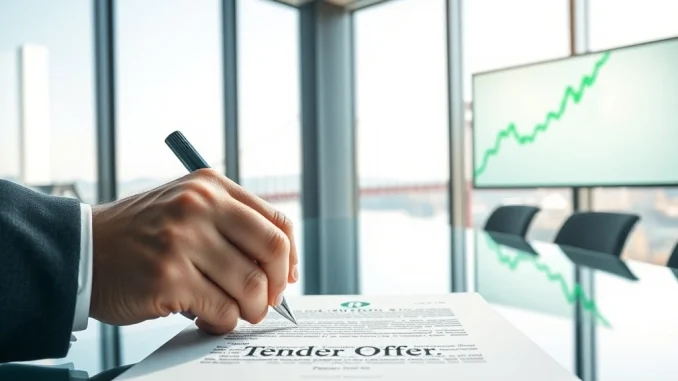
San Francisco, California — February 5, 2026: Blockchain payments giant Ripple Labs has launched a definitive tender offer to repurchase up to $750 million of its own shares from early investors and employees, a move that places a staggering $50 billion valuation on the company. According to a Bloomberg report confirmed by company sources on Wednesday, the Ripple share buyback program will run through April 2026. This valuation marks a significant 25% premium over the company’s $40 billion valuation following its $500 million funding round in November 2025. The announcement arrives amidst a complex period for Ripple, characterized by aggressive business expansion and a concurrent, steep decline in the market price of its associated digital asset, XRP.
Ripple’s $750 Million Tender Offer Details
The tender offer represents one of the largest share repurchase programs ever undertaken by a major private cryptocurrency company. According to financial data from Forge Global, a platform for trading private shares, Ripple’s private share price had dipped more than 9% as of Wednesday, potentially creating an attractive entry point for the company’s buyback. Consequently, the $50 billion valuation attached to this buyback is a powerful signal of internal confidence. Ripple President Monica Long had previously stated in late 2025 that the company had no immediate plans for an initial public offering (IPO), making this liquidity event crucial for long-term stakeholders. The structure of the offer allows shareholders to sell a portion of their holdings directly back to the company, providing cash exits without requiring Ripple to navigate public markets.
This strategic financial maneuver follows a period of substantial capital deployment. In October 2025, Ripple expanded beyond its core crypto payments infrastructure with the $1.2 billion acquisition of non-bank prime broker Hidden Road and treasury management system provider GTreasury. Furthermore, earlier this week, the company confirmed plans to pursue a financial services license in Australia through the acquisition of a local payments firm. These acquisitions demonstrate a clear pivot towards building a comprehensive, regulated financial services ecosystem, a strategy that the share buyback now helps to finance and consolidate.
Diverging Paths: Corporate Growth vs. XRP Market Performance
The buyback news highlights a stark divergence between Ripple’s corporate financial health and the market performance of the XRP token it is famously associated with. On Monday, Ripple reported processing over $100 billion in transactions through its network, with its dollar-pegged stablecoin, Ripple USD (RLUSD), surpassing a $1 billion market capitalization since its launch in December 2024. These metrics point to robust underlying business activity.
- Corporate Valuation Surge: The $50 billion valuation represents a $10 billion increase in just three months, defying broader market headwinds.
- Stablecoin Success: RLUSD’s rapid growth to a $1 billion market cap indicates strong adoption within Ripple’s institutional payment channels.
- XRP Price Pressure: In contrast, the price of XRP has fallen more than 53% over the previous six months, trading at approximately $1.39 at the time of publication. This decline continues a longer-term trend, with the asset down significantly year-over-year.
This divergence suggests Ripple is deliberately decoupling its corporate valuation from the speculative trading of XRP, focusing investor attention on its revenue-generating enterprise software and financial services instead.
Regulatory Context and Expert Analysis
The buyback occurs within a shifting regulatory landscape. In December 2025, the U.S. Office of the Comptroller of the Currency (OCC) announced conditional approval for Ripple and other crypto firms to obtain national trust bank charters. Notably, in its application, Ripple specified that this charter would not be used to issue RLUSD, likely to avoid regulatory complexity. According to Robert Lakin, a financial editor who reviewed the initial report, “A share buyback of this magnitude is atypical for a growth-stage tech company. It traditionally signals that leadership believes the shares are undervalued and that returning capital is a better use of cash than other investments.” He further notes that it also serves to reward and retain key employee shareholders who have been with the company through its lengthy legal challenges with the U.S. Securities and Exchange Commission.
Strategic Positioning in the 2026 Financial Ecosystem
Ripple’s actions position it uniquely within the 2026 fintech and crypto landscape. The company is no longer just a cross-border payments facilitator; it is assembling a full-stack financial services group. The acquisition of Hidden Road gives it prime brokerage capabilities, while GTreasury brings corporate treasury software. The Australian license pursuit opens the APAC region. The share buyback strengthens its balance sheet and cap table ahead of potential future fundraising or strategic partnerships. The following table compares Ripple’s recent valuation milestones with key business metrics:
| Date | Event | Valuation / Metric |
|---|---|---|
| Nov 2025 | $500M Funding Round | $40 Billion |
| Feb 2026 | $750M Share Buyback | $50 Billion |
| Dec 2024 – Present | RLUSD Market Cap | > $1 Billion |
| Last 6 Months | XRP Price Performance | -53% |
| Recent Processing Volume | RippleNet Transactions | $100 Billion+ |
What Happens Next for Ripple and Shareholders?
The tender offer will proceed through April, with the company likely to provide updates on uptake. Market analysts will watch closely to see if the buyback provides a floor for Ripple’s private share price on secondary markets. The $50 billion valuation sets a new benchmark for any future fundraising and intensifies scrutiny on the company’s ability to grow into this valuation through its expanded suite of services. Furthermore, Ripple’s progress on its U.S. national trust bank charter will be a critical regulatory milestone to watch in 2026, potentially unlocking new banking services for its clients.
Industry and Stakeholder Reactions
Initial reactions from the cryptocurrency industry have been mixed. Some analysts view the buyback as a mature, shareholder-friendly move that validates the enterprise blockchain sector. Others question the high valuation in light of the ongoing regulatory uncertainties surrounding digital assets in key markets. Long-term XRP holders have expressed concern over the growing dichotomy between corporate success and token price, debating the long-term utility and value accrual of the XRP ledger within Ripple’s broader strategy. Meanwhile, traditional finance observers see the move as further evidence of crypto-native companies adopting conventional corporate finance strategies.
Conclusion
Ripple’s $750 million share buyback is a definitive statement of financial strength and strategic ambition. By valuing itself at $50 billion, Ripple is asserting its position as a leader in the convergence of blockchain and traditional finance, distinct from the volatility of crypto asset markets. The program provides liquidity for early backers, consolidates the shareholder base, and funds continued expansion. While the price of XRP remains under pressure, Ripple Labs itself is charting a course focused on enterprise software, stablecoins, and regulated financial services. The success of this Ripple share buyback and the company’s ability to execute on its multi-pronged acquisition strategy will be the key determinants of whether it can justify its bold $50 billion valuation in the year ahead.
Frequently Asked Questions
Q1: What is Ripple’s share buyback program?
Ripple Labs has initiated a tender offer to repurchase up to $750 million worth of its own shares from investors and employees. The program runs through April 2026 and values the private company at approximately $50 billion.
Q2: Why is Ripple doing a buyback instead of going public?
Company President Monica Long stated in late 2025 that Ripple has no immediate plans for an IPO. The buyback provides a liquidity event for shareholders without the regulatory complexity and market scrutiny of a public listing.
Q3: How does the $50 billion valuation compare to previous valuations?
The new $50 billion valuation is 25% higher than the $40 billion valuation the company received after a $500 million funding round in November 2025, indicating rapid perceived growth.
Q4: Does this buyback affect the price of XRP?
Not directly. The buyback involves Ripple’s private company shares, not the XRP digital asset. However, it highlights a strategic focus on corporate services over the token’s market performance, which may influence investor sentiment.
Q5: What has Ripple been acquiring recently?
In October 2025, Ripple acquired non-bank prime broker Hidden Road and treasury software firm GTreasury for $1.2 billion. It is also pursuing a financial services license in Australia via another acquisition, signaling a major expansion beyond payments.
Q6: What does this mean for Ripple’s employees?
Employees who hold stock options or shares can participate in the tender offer to sell some of their equity back to the company, providing a cash payout. This is a common tool for retaining talent in late-stage private companies.