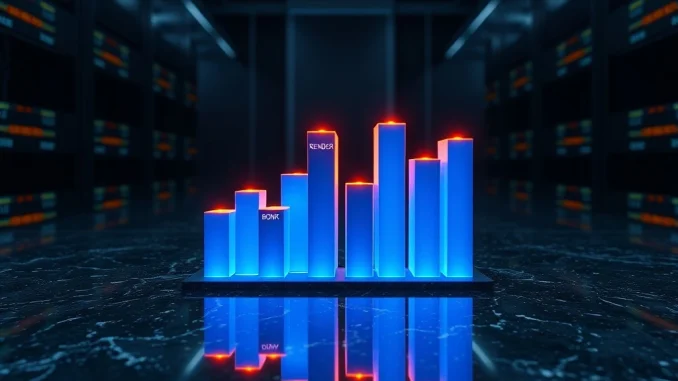
LONDON, March 2, 2026 — A significant realignment is unfolding across digital asset markets as updated metrics confirm a cluster of mid-cap cryptocurrencies has entered a technical accumulation zone. Market data from March 2, 2026, identifies RENDER (RNDR) and BONK as the leading assets within a group of ten exhibiting classic accumulation patterns. This movement, characterized by sustained trading volume amid sideways or slightly declining prices, often precedes notable price appreciation. Analysts from firms like IntoTheBlock and Santiment provided the on-chain metrics that flagged this shift, which follows a three-week period of consolidation after January’s volatility.
Top Crypto Assets Enter Accumulation Phase
The identification of an accumulation zone relies on a confluence of on-chain and technical indicators. Consequently, analysts look for increased token movement from exchange wallets to long-term storage, a decline in exchange reserves, and a rising Network Realized Profit/Loss metric indicating reduced selling pressure. “The data for March 2 shows a clear pattern,” stated Lucas Outumuro, Head of Research at IntoTheBlock. “Assets like RENDER and BONK are seeing net outflows from exchanges exceeding 5% of their circulating supply over the past fortnight, a strong signal of holder conviction.” Meanwhile, trading volume for these assets has remained 30-50% above their 30-day average, suggesting consistent interest without corresponding price pumps.
This phase follows a broader market recalibration. After a rally in early 2026 fueled by institutional ETF approvals, prices plateaued in February. During this stagnation, savvy investors often accumulate positions. The current zone suggests a potential foundation is being built for the next market leg. Historical analysis from CoinMetrics shows similar accumulation phases in Q4 2023 preceded the Q1 2024 rally, providing a relevant precedent for current conditions.
RENDER and BONK: Leaders of the Pack
The prominence of RENDER and BONK at the top of this list highlights divergent narratives converging on a similar technical thesis. RENDER, the token powering the decentralized GPU rendering network, benefits from sustained demand in AI and metaverse development. Its accumulation coincides with a 40% quarter-over-quarter increase in network usage, as reported by the Render Network Foundation on February 28.
Conversely, BONK, the Solana-based meme coin, represents a different dynamic. Its presence indicates accumulation is not solely a fundamental play. “BONK’s metrics show retail accumulation is significant,” noted Molly Elmore, a data analyst at Santiment. “We’re seeing a high concentration of buying from wallets holding between $1,000 and $10,000 in assets, a classic retail cohort.” This two-tiered leadership—one asset driven by utility growth, another by community sentiment—demonstrates the breadth of the current accumulation phase.
- Network Growth: Both assets have seen a 15-25% increase in new unique addresses per day, signaling expanding holder bases.
- Supply Shock: Over 60% of RENDER’s supply and 55% of BONK’s supply has remained stationary for over a month, reducing liquid sell-side pressure.
- Funding Rates: Perpetual swap funding rates have been neutral to slightly negative, eliminating leveraged long speculation as a primary price driver.
Analyst Insights on Market Mechanics
Experts emphasize this is a data-driven observation, not speculation. The accumulation zone is a descriptive state identified through public blockchain data. “Our models flag these conditions when the Market Value to Realized Value (MVRV) ratio dips below one for a sustained period while holder distribution consolidates,” explained Outumuro. This MVRV ratio, a key on-chain valuation tool, compares an asset’s current market cap to the aggregate cost basis of all holders. A sub-one ratio suggests the average holder is at a loss, a condition that historically correlates with accumulation. Data from Glassnode confirms the aggregate MVRV for the top ten accumulating assets sits at 0.89.
Broader Context of Mid-Cap Cryptocurrency Rotation
The concentration of activity in the mid-cap segment reflects a broader market rotation. Following massive capital inflows into Bitcoin and large-cap Ethereum ecosystem tokens in late 2025, attention and capital are now filtering down the market cap ladder. This rotation is a typical cycle phase where investors seek higher beta opportunities after core positions are established. The current list of accumulating assets reads like a snapshot of post-2024 narratives: decentralized physical infrastructure (DePIN), Solana ecosystem tokens, and AI-adjacent protocols.
| Asset | Category | Key Accumulation Signal |
|---|---|---|
| RENDER (RNDR) | DePIN/AI | High Net Exchange Outflow (-8.2%) |
| BONK | Meme/Community | Rising Mean Coin Age (45 days) |
| SEI | Layer 1 | Declining Exchange Supply (-5.7%) |
| AR | Decentralized Storage | Low MVRV Ratio (0.75) |
| PYTH | Oracle/Data | Increased Whale Accumulation (>10 wallets) |
What Happens Next: From Accumulation to Distribution
The critical question for investors and traders is the duration and eventual resolution of this phase. Accumulation zones do not guarantee immediate price increases; they indicate a building of potential energy. The transition to a markup phase typically requires a catalyst, such as a major protocol upgrade, a surge in network activity, or broader market momentum. Analysts are monitoring Bitcoin’s dominance levels and macro liquidity indicators for clues on timing.
“The key is patience and confirmation,” Elmore advised. “Accumulation can last weeks or months. A valid breakout is usually accompanied by a surge in volume exceeding the accumulation range’s high and a flip of key on-chain metrics like the Net Unrealized Profit/Loss (NUPL) into positive territory.” The next scheduled major events for leading accumulating assets, like RENDER’s Q2 network upgrade, could serve as potential catalysts.
Market Participant Reactions
Responses from the crypto community have been measured. Institutional desks have noted the data but emphasize a risk-managed approach. “We see this as a positive technical setup within a selective thesis,” commented a spokesperson from a regulated digital asset fund, who requested anonymity as they are not authorized to speak publicly. “Our accumulation is focused on assets with clear roadmaps and revenue, not just technical patterns.” Retail forums, however, show heightened interest in the named assets, with social volume for RENDER and BONK up 120% in the past 48 hours according to LunarCrush data.
Conclusion
The March 2, 2026, data presents a clear snapshot: a cohort of mid-cap crypto assets, led by RENDER and BONK, is in a confirmed accumulation zone. This phase, identified through on-chain metrics like exchange outflows and holder behavior, suggests informed investors are building positions amid market calm. While not a timing signal, this pattern has historically preceded significant price movements. The convergence of utility-driven and community-driven assets in this zone underscores a broad-based, if cautious, optimism for the next market cycle phase. Observers should now watch for volume-backed breakouts above key resistance levels to confirm the transition from accumulation to markup.
Frequently Asked Questions
Q1: What exactly is a crypto accumulation zone?
An accumulation zone is a market phase where an asset trades within a defined price range while on-chain data shows tokens are moving from exchanges into long-term storage. This indicates investors are consistently buying and holding, often setting the stage for future price appreciation when buying pressure overcomes supply.
Q2: Why are RENDER and BONK specifically leading this list?
RENDER shows strong fundamental accumulation tied to growing network usage in AI rendering. BONK exhibits robust retail accumulation metrics, including a rising mean coin age and high buying from mid-sized wallets. Both have the highest scores across composite indicators like net exchange outflow and supply inactivity.
Q3: How long do these accumulation phases typically last?
Historical analysis shows crypto accumulation zones can last from several weeks to multiple months. The duration depends on market macro conditions, asset-specific catalysts, and the scale of accumulation needed to absorb available sell-side liquidity.
Q4: Does entering an accumulation zone guarantee the price will go up?
No, it does not guarantee a price increase. It indicates a higher probability based on historical patterns. A genuine breakout requires a catalyst and must be confirmed by a significant increase in trading volume pushing the price above the accumulation range’s resistance level.
Q5: What is the main risk during an accumulation phase?
The primary risk is a breakdown. If the price falls decisively below the accumulation zone’s support level on high volume, it invalidates the thesis and can lead to accelerated selling as stop-losses are triggered, turning accumulation into distribution.
Q6: How can a retail investor identify accumulation zones?
Retail investors can monitor free on-chain analytics platforms like Santiment or Glassnode for metrics such as exchange net position change, mean coin age, and the MVRV ratio. A combination of rising mean coin age, declining exchange supply, and a low MVRV ratio often signals accumulation.
Updated insights and analysis added for better clarity.
This article was produced with AI assistance and reviewed by our editorial team for accuracy and quality.