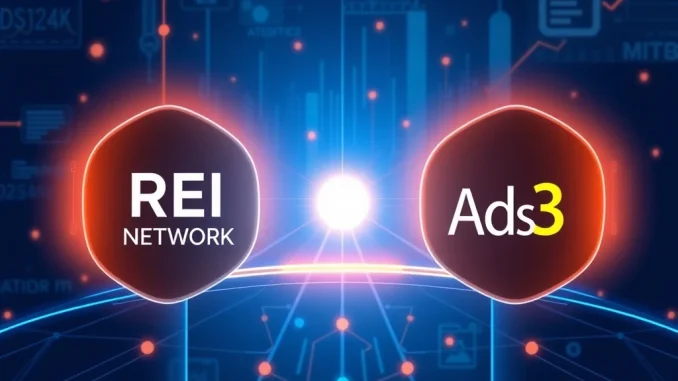
Global, March 2025: The blockchain ecosystem witnesses a significant strategic alignment as REI Network, a lightweight Ethereum-compatible blockchain, announces a formal partnership with Ads3, a specialized Web3 advertising protocol. This collaboration represents a concerted effort to address two persistent challenges in the decentralized space: effective user acquisition and sustainable, organic network expansion. The alliance aims to create a synergistic framework where advertising solutions fuel network activity, and a robust network provides a fertile ground for targeted campaigns.
REI Network and Ads3 Forge Strategic Web3 Advertising Partnership
The partnership between REI Network and Ads3 is not a simple integration but a multi-layered strategic initiative. REI Network, known for its high performance and low transaction costs, provides the underlying infrastructure. Ads3 brings its protocol-layer advertising toolkit, designed to facilitate user acquisition and community building for decentralized applications (dApps). The core proposition is to move beyond traditional, often inefficient, crypto marketing channels. Instead, the collaboration seeks to embed advertising mechanics directly into the user experience of interacting with dApps on the REI Network. This could manifest as reward-based ad engagements, where users opt into viewing relevant promotional content in exchange for network-specific tokens or other incentives, thereby directly contributing to network activity metrics.
Industry analysts view this as a logical step in the maturation of Layer 1 and Layer 2 blockchains. After establishing technical foundations, the focus shifts to adoption and utility. “Network growth is no longer just about transactions per second or low fees; it’s about creating real, sustained economic activity,” explains a blockchain ecosystem strategist who requested anonymity due to corporate policy. “A partnership like this directly ties customer acquisition costs for projects to the health and usage of the underlying chain. It’s a flywheel model: better advertising tools attract more projects, more projects bring more users, and more users increase the network’s value and security.”
Driving Sustainable Network Expansion Through Collaborative Mechanics
Sustainable growth is a key tenet of this alliance. The term “sustainable” here refers to economic and operational longevity, avoiding the “pump-and-dump” cycles associated with purely speculative incentives. The collaboration plans to leverage several mechanics. First, Ads3’s advertising campaigns can be configured to reward users directly on the REI Network, ensuring gas fees and transactions occur natively, boosting fundamental metrics. Second, the data generated from these campaigns—pertaining to user engagement, conversion rates, and demographic trends—can provide invaluable, on-chain verifiable insights for dApp developers on REI Network, helping them iterate and improve their offerings.
Furthermore, the partnership may explore staking mechanisms linked to advertising participation. For instance, users who stake REI tokens could gain access to premium advertising reward pools or have greater influence over the types of ads served within the ecosystem. This creates a vested interest in the network’s long-term health. A comparison with earlier, less successful models highlights the evolution.
- 2017-2020 Model: Airdrops and bounty campaigns with high initial uptake but low retention.
- 2021-2023 Model: Liquidity mining and yield farming, which often attracted mercenary capital without building genuine product users.
- 2025 Model (Exemplified by REI/Ads3): Integrated, value-added advertising that rewards engagement with a specific network’s utility, aiming for retained, active users.
Contextualizing the Move Within Broader Blockchain Trends
This partnership occurs within a specific industry context. The 2024-2025 period has seen increased emphasis on “real-world utility” and “mainstream adoption” across the Web3 sector. Regulatory clarity in several jurisdictions has pushed projects to demonstrate tangible use cases beyond financial speculation. Advertising, a multi-trillion dollar global industry, represents a prime target for blockchain disruption, focusing on transparency, data ownership, and reduced intermediary fees. By combining a scalable network with an advertising protocol, the REI-Ads3 alliance positions itself at the intersection of these two trends.
Historically, blockchain networks have struggled with marketing budgets. Startups building dApps often lack the resources for large-scale user acquisition, while venture funding has become more scrutinizing of growth metrics. A native, chain-level advertising solution lowers this barrier to entry. It allows a nascent dApp on REI Network to tap into a shared, protocol-managed advertising pool, potentially paying for campaigns with their own tokens or a share of future revenue. This aligns the incentives of the network, the advertising protocol, the dApp developer, and the end-user.
Implications for Developers, Advertisers, and the Broader Ecosystem
The implications of this collaboration are multi-faceted. For developers building on REI Network, access to Ads3’s toolkit could become a key differentiator, reducing one of the most significant hurdles to project success: finding and retaining users. For advertisers, particularly those in the crypto-native space, it offers a new, targeted channel to reach engaged audiences who are already comfortable with digital assets and wallets, potentially yielding higher conversion rates than broad social media campaigns.
For the broader Web3 ecosystem, this partnership serves as a case study in vertical integration. If successful, it could inspire similar alliances between infrastructure providers and specialized service protocols, moving towards a more modular and interoperable blockchain landscape. The ultimate test will be in measurable outcomes: an increase in the number of active addresses on REI Network, a rise in transaction volume tied to non-speculative activities, and growth in the total value locked (TVL) within its dApp ecosystem as a result of more effective marketing.
Technical teams from both projects have indicated that the initial integration phase will involve API compatibility and the development of standard templates for ad campaigns redeemable on the REI chain. A pilot program with select dApps is expected to launch in Q2 2025, with results and iterative improvements guiding a full public rollout later in the year.
Conclusion
The strategic collaboration between REI Network and Ads3 marks a pragmatic step toward solving the dual challenges of user acquisition and organic growth in Web3. By integrating sophisticated advertising mechanics directly into its network fabric, REI Network aims to provide more than just infrastructure; it seeks to offer a growth engine for the projects that choose to build upon it. This alliance underscores a maturation in blockchain strategy, where partnerships are formed not for mere publicity, but to create tangible, sustainable value for all participants in the ecosystem. The success of this strategic collaboration will be closely watched as a potential blueprint for how blockchain networks can proactively drive their own expansion in an increasingly competitive landscape.
FAQs
Q1: What is the primary goal of the REI Network and Ads3 partnership?
The primary goal is to create a unified framework that enhances Web3 advertising effectiveness for projects built on REI Network while using those advertising activities to fuel sustainable, organic growth in network usage and economic activity.
Q2: How does this differ from traditional crypto marketing?
It moves beyond generic social media promotions or airdrops by embedding reward-based advertising directly into dApp user experiences on the REI Network. This aims for higher-quality user acquisition with better retention, as incentives are tied to network-specific actions and utility.
Q3: What does “sustainable network expansion” mean in this context?
It refers to growth driven by genuine user engagement and economic transactions, rather than short-term speculative inflows. The model incentivizes users to become active participants in the network’s economy through advertising-related rewards and staking mechanisms.
Q4: What are the potential benefits for a developer building on REI Network?
Developers gain access to a native advertising toolkit (Ads3) that can lower user acquisition costs, provide verifiable on-chain campaign data, and help bootstrap a user base by tapping into a shared network-level advertising ecosystem.
Q5: When will users and developers see the practical effects of this partnership?
The technical integration is underway, with a pilot program involving select dApps planned for the second quarter of 2025. Broader availability and observable ecosystem impacts are expected later in the year based on pilot feedback and iterations.
Updated insights and analysis added for better clarity.
This article was produced with AI assistance and reviewed by our editorial team for accuracy and quality.