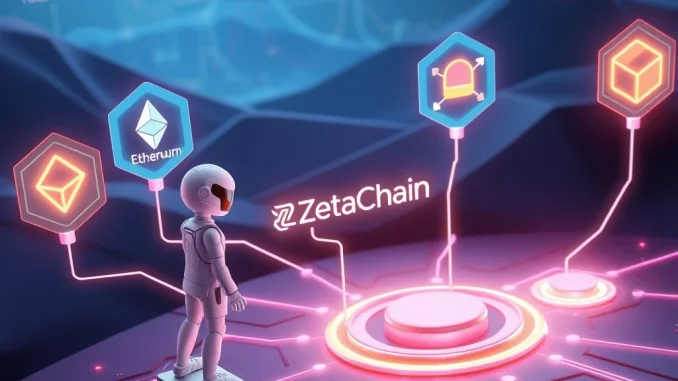
Global, March 2025: The convergence of artificial intelligence and decentralized blockchain networks has reached a pivotal moment. Quack AI, a platform specializing in autonomous AI agents for Web3, has announced a technical integration with ZetaChain, a foundational layer-one blockchain built for omnichain interoperability. This partnership aims to solve a critical bottleneck in decentralized application development: enabling AI agents to execute complex, policy-driven actions seamlessly across any connected blockchain. The move signifies a substantial leap toward a truly interoperable Web3 ecosystem where intelligent automation is not confined to a single network.
Quack AI and ZetaChain Forge a Path for Universal Cross-Chain Execution
The core challenge in today’s multi-chain landscape is fragmentation. Developers building AI-driven decentralized applications (dApps) often face significant complexity when their agents need to interact with assets or logic on a foreign chain. This typically requires wrapping assets, using bridges with varying security models, and managing multiple wallets or contracts—a process that is slow, risky, and inefficient for autonomous agents. Quack AI’s integration with ZetaChain directly addresses this by leveraging ZetaChain’s unique architecture as a universal settlement and logic layer. Essentially, ZetaChain acts as a central nervous system that natively reads and writes state across all connected chains, including non-smart contract chains like Bitcoin and Dogecoin. By tapping into this, Quack AI’s agents can now be programmed with execution policies that trigger actions on any supported network based on on-chain or off-chain events, all from a single point of control on ZetaChain.
Technical Architecture and Policy-Driven Automation
This integration is not a simple API call; it represents a deep technical alignment. Quack AI’s framework for designing and deploying AI agents will now incorporate ZetaChain’s cross-chain messaging and smart contract capabilities as a native primitive. The workflow can be broken down into a clear sequence:
- Event Monitoring: A Quack AI agent, deployed as a smart contract on ZetaChain, monitors specified conditions across multiple chains (e.g., a liquidity pool price on Ethereum, an NFT sale on Polygon, or a transaction on Bitcoin).
- Policy Evaluation: The agent’s pre-defined logic—its “policy”—evaluates the incoming data. These policies can be complex, combining financial rules, risk parameters, and performance goals.
- Universal Execution: Once a policy condition is met, the agent initiates a transaction on ZetaChain. ZetaChain’s validators then securely facilitate the required state change on the target external chain, whether it’s swapping tokens, minting an asset, or voting in a governance proposal.
- Settlement and Verification: The result is settled on ZetaChain, providing a unified audit trail for all cross-chain actions performed by the agent.
This model shifts the paradigm from agents being chain-specific tools to becoming truly network-agnostic orchestrators. For developers, it dramatically reduces the overhead of building and securing cross-chain logic, allowing them to focus on agent behavior and economic design.
The Historical Context of Blockchain Interoperability
The quest for blockchain interoperability is nearly as old as the ecosystem itself. Early solutions like centralized exchanges acted as de facto bridges, but they introduced custodial risk. The rise of token bridges (e.g., Multichain, Wormhole) enabled asset transfer but often created wrapped assets that fragmented liquidity and introduced new attack vectors. More recent approaches include layer-zero protocols and interoperability-focused L1s like ZetaChain, Cosmos with IBC, and Polkadot with its parachains. Each model offers different trade-offs between universality, security, and developer experience. Quack AI’s choice of ZetaChain is significant because its model of a central coordinating chain with native cross-chain capabilities via a threshold signature scheme (TSS) validator set provides a balance of reach—connecting over 30 networks—and a unified programming environment. This history underscores why the Quack AI integration is a natural evolution: it applies a next-generation interoperability solution to the emerging frontier of autonomous AI.
Implications for Web3 Application Development and DeFi
The practical implications of this integration are vast and will likely unfold across several key verticals within Web3. The most immediate impact will be felt in decentralized finance (DeFi). Imagine an AI-powered treasury management agent that can dynamically rebalance a protocol’s reserves across Ethereum, Avalanche, and Solana based on real-time yield opportunities, all while maintaining a single risk policy. In the realm of non-fungible tokens (NFTs) and gaming, AI agents could manage cross-chain asset portfolios, automatically bridging in-game items to the most liquid marketplace for sale. Furthermore, decentralized autonomous organizations (DAOs) could deploy governance agents that execute votes across multiple chain-specific treasuries or subDAOs from a single proposal. The table below outlines potential use case comparisons:
| Use Case | Traditional Multi-Chain Approach | With Quack AI & ZetaChain |
|---|---|---|
| Cross-Chain Arbitrage | Manual or scripted monitoring; requires separate infrastructure and funds on each chain; slow execution. | Fully autonomous agent with a single liquidity pool on ZetaChain; executes arbitrage across all connected chains in one transaction. |
| Multi-Chain NFT Management | User must bridge NFTs manually, pay gas on multiple networks, and interact with different marketplaces. | Agent can mint, list, and sell NFTs on the optimal chain based on fees and demand, controlled by a simple user policy. |
| DAO Treasury Management | Complex multi-sig setups on each chain; rebalancing requires separate, coordinated transactions. | A single policy-driven agent manages the entire cross-chain treasury, executing rebalancing and payments automatically. |
This reduces not only development time but also user friction and systemic risk, potentially accelerating the adoption of more sophisticated Web3 applications.
Conclusion
The integration of Quack AI with ZetaChain represents a meaningful step forward in maturing the Web3 technology stack. By enabling universal cross-chain execution for AI agents, it addresses a fundamental limitation in how automated intelligence can interact with a multi-chain world. This development moves beyond simple asset bridging to programmable, policy-driven action across ecosystems. For builders, it unlocks new design space for dApps. For users, it promises more powerful, seamless, and intelligent applications. While the long-term success will depend on the security and adoption of the underlying platforms, this collaboration clearly points toward a future where blockchain networks operate not as isolated islands, but as a cohesive, intelligently automated domain where AI agents can freely execute complex tasks to create value.
FAQs
Q1: What is Quack AI?
Quack AI is a platform for creating, deploying, and managing autonomous AI agents designed to operate within Web3 environments. These agents can perform tasks like trading, monitoring, and interacting with smart contracts based on predefined rules and goals.
Q2: What is ZetaChain?
ZetaChain is a layer-one blockchain and smart contract platform built with native cross-chain interoperability. Unlike bridges that connect two chains, ZetaChain can read state and initiate transactions across a wide array of connected blockchains (including Bitcoin and Ethereum) from a single, unified network.
Q3: What does “policy-driven, universal cross-chain execution” mean?
It refers to the ability of an AI agent to be programmed with a set of rules (a policy) that, when triggered by on-chain data, can cause the agent to perform an action—like moving assets or calling a contract—on any blockchain connected to ZetaChain, all from a single point of control.
Q4: How does this integration benefit Web3 developers?
It dramatically simplifies development. Instead of building and securing custom cross-chain messaging for each external network, developers can build their agent logic once on ZetaChain and have native access to dozens of chains, reducing complexity, cost, and potential security vulnerabilities.
Q5: Are there risks associated with this kind of cross-chain execution?
Yes, as with any cross-chain technology, security is paramount. The security model relies on ZetaChain’s validator set. Developers and users must understand that agents with broad execution permissions could be exploited if their policy logic is flawed, and the cross-chain messages themselves must be securely relayed and verified.