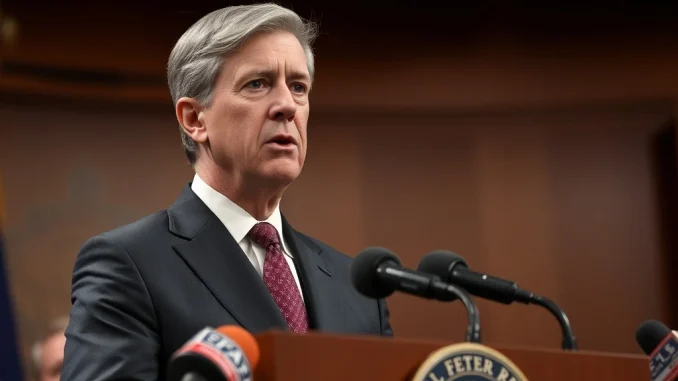
Washington, D.C., March 2025: In a development with significant implications for the stability of U.S. monetary policy, Federal Reserve Chair Jerome Powell stated that no decision has been made regarding whether he will remain on the central bank’s Board of Governors after his term as chair expires. This revelation, made during a recent press conference, immediately shifted focus from short-term interest rate discussions to the longer-term leadership structure of the world’s most influential central bank. Powell’s current term as a board member extends to 2028, creating a complex timeline for potential succession planning and institutional continuity.
Jerome Powell’s Dual Role and the Unanswered Question
Federal Reserve Chair Jerome Powell occupies a unique dual position within the U.S. central banking system. He serves as the Chair of the Federal Reserve Board, a role with a four-year term that is subject to presidential nomination and Senate confirmation. Simultaneously, he holds a separate fourteen-year term as a member of the Board of Governors, which runs until January 31, 2028. This structure, established by the Federal Reserve Act of 1913, is designed to insulate the board from short-term political pressures. Powell’s recent comments highlight the potential for these roles to diverge. A chair could theoretically step down from that leadership position but choose to complete their term as a governor, influencing policy from within the board without holding the gavel. This scenario, while uncommon, is not without precedent in Fed history and adds a layer of strategic ambiguity to current discussions.
Historical Context of Federal Reserve Leadership Transitions
Understanding the weight of Powell’s non-decision requires a look at the historical patterns of Fed leadership. The modern Federal Reserve has seen chairs depart under various circumstances, but the path of a former chair remaining as a governor is less traveled.
- Volcker to Greenspan (1987): Paul Volcker chose not to seek reappointment as chair. He also resigned from the Board of Governors entirely, making a clean break when Alan Greenspan assumed leadership.
- Bernanke’s Departure (2014): Ben Bernanke’s term as chair ended, and he concurrently resigned his seat on the Board of Governors, allowing Janet Yellen to join as both chair and a new governor.
- Yellen’s Unique Path (2018): Janet Yellen’s term as chair was not renewed, but her governor term had years remaining. She chose to resign from the board, paving the way for Jerome Powell to be sworn in as both chair and a governor. This established a recent norm of a complete leadership transition.
Powell’s potential to break this recent norm by staying on as a governor introduces operational and diplomatic complexities for any incoming chair, who would then lead a board containing their immediate predecessor.
The Delicate Balance of Institutional Knowledge and Fresh Perspective
Financial markets and policy analysts are now weighing the pros and cons of Powell potentially remaining as a Fed governor. On one hand, his continued presence would provide invaluable institutional memory and continuity, especially during a period of economic uncertainty. Having a former chair with deep experience in crisis management, inflation targeting, and financial regulation on the board could be seen as a stabilizing asset. On the other hand, a new chair may desire a clean slate and the unambiguous authority that comes with it. Governance dynamics can become strained when a former boss remains in the room, potentially influencing debate and decision-making from a different seat at the table. This balance between experience and renewal sits at the heart of the current speculation.
The Broader Implications for Monetary Policy and Market Stability
The uncertainty surrounding Powell’s future role arrives at a sensitive juncture for the global economy. The Federal Reserve is navigating the final stages of its post-pandemic policy normalization, managing balance sheet runoff, and monitoring persistent inflationary pressures. Clarity in leadership is a key pillar of central bank credibility, which directly influences market expectations and long-term interest rates. A prolonged period of ambiguity about the composition of the Board of Governors could introduce an unnecessary element of uncertainty into financial planning for businesses and investors. Furthermore, the process of nominating and confirming a new Fed chair is inherently political and can be lengthy. Knowing whether a governor seat will also need filling affects the Senate’s confirmation calendar and the administration’s strategic planning.
Powell’s Other Press Conference Declinations: Subpoena and Dollar Policy
During the same press conference, Chair Powell demonstrated the Fed’s strict adherence to protocol in other sensitive areas. When questioned about a subpoena—a topic typically related to congressional oversight or legal proceedings—he declined to comment. This is standard practice for ongoing legal or investigative matters, reflecting the institution’s commitment to allowing formal processes to unfold without external commentary that could be seen as prejudicial. More notably, Powell explicitly deflected a question about the value of the U.S. dollar, stating, “The currency is the responsibility of the Treasury Department and that the Fed does not comment on it.” This reaffirms the long-standing “Fed Put” understanding, where the Treasury manages exchange rate policy and international currency agreements, while the Fed focuses on its dual mandate of maximum employment and price stability. This clear delineation prevents mixed signals to the foreign exchange markets, which are highly sensitive to central bank rhetoric.
Conclusion: A Decision with Far-Reaching Consequences
The question of whether Jerome Powell will remain a Fed governor after his chair term concludes is more than a personnel matter. It is a decision that touches on the core principles of central bank independence, institutional stability, and clear leadership transmission. His choice will signal either a commitment to a clean break for his successor or a belief that his continued service as a governor provides critical value during a complex economic era. As markets and policymakers await his decision, the episode underscores the intricate human and institutional architecture that supports the United States’ monetary policy framework. The focus now shifts to the timeline for an announcement, as clarity will be essential for ensuring a smooth transition and maintaining the unwavering confidence that global markets place in the Federal Reserve.
FAQs
Q1: What is the difference between being Federal Reserve Chair and a Fed Governor?
The Chair is the head of the Federal Reserve System and the Board of Governors, serving a four-year term. A Governor is a member of the seven-person Board, serving a full 14-year term. The Chair is always also a Governor, but a person can be a Governor without being Chair.
Q2: When does Jerome Powell’s term as a Fed Governor end?
Jerome Powell’s term as a member of the Board of Governors is scheduled to end on January 31, 2028.
Q3: Has a former Fed Chair ever stayed on as a Governor?
It is historically rare in the modern era. Typically, outgoing chairs, like Ben Bernanke and Janet Yellen, have resigned from the Board entirely when their leadership term ended, allowing for a complete transition.
Q4: Why did Powell decline to comment on the value of the U.S. dollar?
By long-standing convention and policy, the U.S. Treasury Department is responsible for dollar policy and international exchange rate agreements. The Federal Reserve avoids commenting to prevent sending conflicting signals to currency markets and to maintain its focus on domestic employment and inflation goals.
Q5: Why does this uncertainty about Powell’s future matter to the average person?
Stable and predictable leadership at the Federal Reserve influences interest rates for mortgages, car loans, and credit cards. It also affects overall economic growth and employment. Uncertainty can lead to market volatility, which can impact retirement savings and business investment plans.