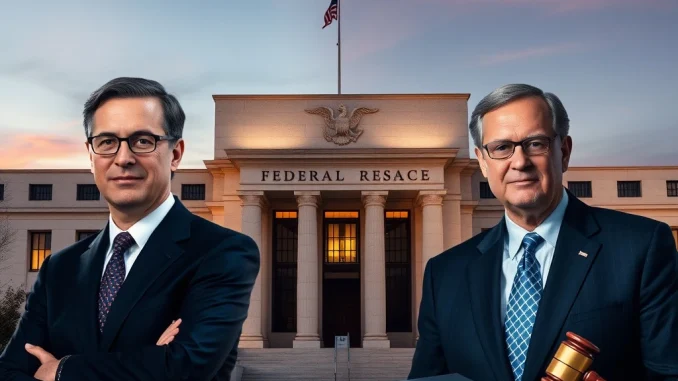
Washington D.C., March 15, 2025: The Federal Reserve faces an extraordinary convergence of legal scrutiny and political transition as Treasury Secretary Scott Bessent publicly urges the Senate to advance confirmation hearings for Fed chair nominee Kevin Warsh. This push occurs while the Department of Justice continues its investigation into current Chair Jerome Powell. This parallel process creates an unprecedented situation for the nation’s central bank, placing its leadership and institutional stability under intense examination during a critical economic period.
Unprecedented Pressure on Federal Reserve Leadership
The Department of Justice’s investigation into Jerome Powell, while details remain confidential, reportedly examines communications and decision-making processes during recent monetary policy shifts. Legal experts note that such probes into a sitting Fed chair are exceptionally rare. Historically, the Federal Reserve maintains operational independence, and direct investigations create immediate concerns about political influence over monetary policy. The investigation’s timing, coinciding with a nomination process, amplifies these concerns significantly. Market analysts observe that uncertainty surrounding central bank leadership can affect investor confidence and economic forecasts, making clarity and stability paramount.
The Push for Kevin Warsh Confirmation Hearings
Treasury Secretary Scott Bessent’s call to proceed with hearings for nominee Kevin Warsh signals a strategic political move. Bessent, in a statement to the Senate Banking Committee, argued that “the continuity of Federal Reserve leadership cannot await the resolution of external inquiries.” Kevin Warsh, a former Fed governor and seasoned financial commentator, brings a known policy perspective favoring tighter monetary controls and greater transparency. His confirmation process would involve rigorous scrutiny of his views on inflation targeting, bank regulation, and digital currency oversight. The Senate must weigh his qualifications against the backdrop of the ongoing probe, a balancing act with significant constitutional and economic implications.
Historical Context and Institutional Precedent
The Federal Reserve Act of 1913 established the central bank’s independence, a principle tested throughout history but seldom amid concurrent legal and confirmation pressures. Analysts draw parallels to past transitions, such as the appointment of Paul Volcker in 1979 during high inflation, but note the legal dimension is new. The situation requires the Senate to navigate its “advice and consent” role carefully, ensuring the nominee’s fitness without prejudging an ongoing investigation. This process tests the resilience of the norms separating monetary policy authority from executive and judicial branch actions.
Potential Consequences for Monetary Policy and Markets
The dual pressures create tangible risks for economic stability. Key areas of impact include:
- Policy Uncertainty: Markets dislike ambiguity. Simultaneous investigation and nomination can lead to hesitation in Fed decision-making, potentially delaying responses to economic data.
- Credibility Erosion: The perceived independence of the Fed is a cornerstone of its effectiveness. Persistent political and legal scrutiny can weaken this perception, affecting how markets interpret policy signals.
- Operational Challenges: Senior Fed staff may face divided attention, managing communications for both the current chair under investigation and preparing for a potential transition.
- International Perception: Global financial institutions watch U.S. central bank stability closely. Unusual domestic pressures could influence foreign investment and currency valuations.
Legal and Political Framework of the DOJ Investigation
While the Justice Department has not disclosed the specific focus of its probe into Chair Powell, legal scholars outline the possible frameworks. Investigations could relate to administrative procedures, compliance with internal governance rules, or communications regarding policy decisions. It is crucial to note that such an investigation does not imply wrongdoing. The process itself, however, consumes institutional resources and places the Chair in a defensive posture. The duration and scope of the investigation will directly influence the political calculus surrounding the Warsh nomination, as senators may be reluctant to confirm a new chair while the previous chair’s tenure is under formal review.
Expert Analysis on Central Bank Governance
Dr. Eleanor Vance, a professor of central banking law at Georgetown University, explains, “The Federal Reserve is designed to be insulated from short-term political pressures. When legal and appointment processes intersect so directly, that insulation is threatened. The key will be for both the DOJ and the Senate to act with deliberate speed and transparency to minimize the period of uncertainty.” This expert perspective underscores the delicate balance between accountability and operational independence that defines modern central banking.
Conclusion
The call to advance Kevin Warsh confirmation hearings amid the ongoing Jerome Powell investigation marks a critical juncture for the Federal Reserve. This situation tests the institutions designed to ensure stable and independent monetary policy. The coming weeks will reveal how political, legal, and economic forces navigate this complex terrain, with outcomes that will shape the central bank’s authority for years to come. The focus remains on maintaining the integrity of the Federal Reserve’s mission to promote maximum employment, stable prices, and moderate long-term interest rates, regardless of its leadership.
FAQs
Q1: What is the Department of Justice investigating regarding Jerome Powell?
The exact scope remains confidential, but such investigations typically examine compliance with internal governance rules, administrative procedures, or communications related to official duties. It is a fact-finding process, not an indication of guilt.
Q2: Who is Kevin Warsh and why is he a nominee for Fed Chair?
Kevin Warsh is a former member of the Federal Reserve Board of Governors (2006-2011) and a former advisor to President George W. Bush. He is a known figure in financial policy with views often associated with a more rules-based and transparent approach to monetary policy.
Q3: Can the Senate confirm a new Fed Chair while the current Chair is under investigation?
Yes, there is no legal barrier. However, it presents a political and procedural challenge, as senators must consider the appropriateness of replacing a chair whose recent tenure is still under formal review.
Q4: How might this situation affect interest rates and the economy?
Prolonged uncertainty can make the Federal Reserve more cautious, potentially delaying policy adjustments. This could lead to increased market volatility as investors seek clarity on the future direction of monetary policy.
Q5: What is the role of the Treasury Secretary in this process?
The Treasury Secretary often serves as a liaison between the administration and the Federal Reserve. Scott Bessent’s public urging of the Senate reflects the executive branch’s interest in shaping the timing and outcome of the leadership transition.
Updated insights and analysis added for better clarity.
This article was produced with AI assistance and reviewed by our editorial team for accuracy and quality.