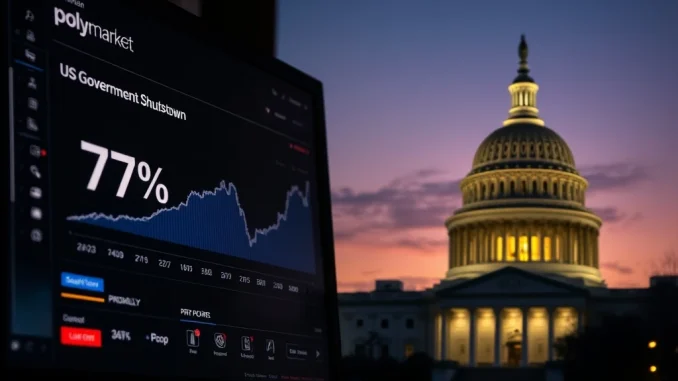
Washington, D.C., January 26, 2025: Decentralized predictive markets are flashing a stark warning about the stability of the United States government. Data from the platform Polymarket indicates traders now assign a 77% probability that the federal government will shut down before the January 31 deadline. This dramatic surge from just 10% a day earlier reflects a profound and growing crisis of confidence in Washington’s ability to resolve a bitter budget impasse, with significant implications for the cryptocurrency industry awaiting crucial regulatory clarity.
Polymarket’s Predictive Surge Signals Deepening Political Crisis
The predictive market platform Polymarket functions as a real-time barometer of collective expectation. Unlike traditional polls, it allows users to stake cryptocurrency on the outcome of future events, creating a financial incentive for accurate forecasting. The contract “Will the US government shut down before Jan 31?” saw its probability for “Yes” skyrocket by 67 percentage points within 24 hours. This volatility is not typical noise; it represents a massive, rapid reassessment of risk by a global pool of informed participants reacting to breaking political developments.
This market movement directly correlates with public statements from Senate leadership. On January 25, Senate Majority Leader Chuck Schumer confirmed that negotiations had reached a stalemate, primarily over funding for the Department of Homeland Security (DHS). This component has become a key sticking point, making the passage of a comprehensive spending bill before the deadline increasingly unlikely. The predictive market digested this news instantly, pricing in a high likelihood of institutional failure.
The Political Deadlock Behind the Probability Spike
The road to this precipice is paved with partisan conflict and strategic maneuvering. The fundamental issue is the failure to pass the twelve annual appropriations bills that fund government operations. A continuing resolution, a temporary funding measure, has kept agencies open, but that authority is set to expire.
- Senate Impasse: Leader Schumer’s announcement highlighted irreconcilable differences within the Senate, particularly around border security funding tied to the DHS budget. This has blocked the unanimous consent needed to move quickly.
- House Complications: Parallel challenges exist in the House of Representatives, where narrow majorities and factional disagreements have historically complicated budget passage.
- Executive Branch Posture: While former President Donald Trump stated he does not “want” a shutdown, his ambiguous comment that “if it is necessary, it is necessary” has been interpreted by markets as a refusal to pressure congressional allies toward a compromise, adding to the uncertainty.
This confluence of factors has created what political analysts describe as a perfect storm for a funding lapse. Polymarket’s probability metric effectively quantifies the collective judgment that these obstacles are insurmountable in the short time remaining.
Implications for Cryptocurrency and Stablecoin Regulation
A government shutdown extends far beyond closed national parks and furloughed federal employees. It freezes the non-essential legislative and regulatory machinery of the state. For the digital asset industry, which has been engaged in a multi-year dialogue with Congress seeking regulatory certainty, a shutdown represents a significant setback.
The most immediate casualty could be the Clarity for Payment Stablecoins Act. This landmark bill aims to establish a federal regulatory framework for payment stablecoins, delineating roles between state and federal regulators and setting requirements for issuers. It is seen as a critical first step toward a comprehensive crypto regulatory structure.
- Legislative Freeze: During a shutdown, congressional committee work and markups on non-critical legislation typically halt. This would delay any progress on the Stablecoin Clarity Act, which is already navigating a complex political landscape.
- Historical Precedent: Past shutdowns have delayed key financial services legislation for months, as the political capital and calendar space are consumed by the crisis and subsequent recovery.
- Industry Uncertainty: Key industry players, including some who had previously supported legislative efforts, have recently expressed reservations about certain bill versions. This regulatory vacuum, prolonged by a shutdown, forces companies to operate in a state of continued ambiguity, potentially stifling innovation and investment in the U.S. market.
How Predictive Markets Differ from Traditional Forecasting
Polymarket’s role in this event highlights the growing influence of decentralized prediction platforms. Unlike expert panels or sentiment analysis, these markets aggregate wisdom by requiring participants to back their beliefs with real money. This is grounded in the concept of the “efficient market hypothesis,” applied to future events. Studies have shown that such prediction markets can often outperform traditional forecasts in accuracy because they incentivize information discovery and penalize inaccurate views financially. The platform’s dramatic probability shift is therefore viewed by many observers not as speculation, but as a credible signal of escalating risk.
The Broader Impact on Financial Innovation and Web3
The potential shutdown occurs at a critical juncture for financial technology. Beyond stablecoins, broader discussions about digital asset market structure, custody rules, and tax treatment are ongoing within various congressional committees and regulatory agencies like the SEC and CFTC.
A protracted funding lapse would:
- Slow Regulatory Guidance: Agencies may operate with skeleton crews, delaying no-action letters, interpretive guidance, and even enforcement actions that shape the market.
- Cool Investor Sentiment: Institutional investors, in particular, seek regulatory clarity before committing significant capital. Continued political dysfunction signals higher regulatory risk.
- Cede Competitive Ground: Other jurisdictions, like the EU with its MiCA framework, are advancing clear rules. U.S. delays could push innovation and talent to more predictable regulatory environments.
The Polymarket data, therefore, is not just a political indicator but a bellwether for the business and innovation climate surrounding Web3 and decentralized finance.
Conclusion
The alarming probability spike on Polymarket is a quantifiable measure of a failing political process. It signals a high likelihood of a U.S. government shutdown with real-world consequences that extend deeply into the economy and the burgeoning cryptocurrency sector. The anticipated delay of pivotal legislation like the Stablecoin Clarity Act underscores how political gridlock in Washington directly threatens to undermine the United States’ position in the global race for financial innovation. As the deadline looms, the predictive markets will continue to offer a stark, real-time gauge of whether lawmakers can bridge their divides or plunge the nation into another period of disruptive uncertainty.
FAQs
Q1: What is Polymarket and how does it predict a government shutdown?
Polymarket is a decentralized prediction market platform where users trade cryptocurrency on the outcomes of future events. The price of a “Yes” share on a specific event contract, like a government shutdown, reflects the market’s collective probability assessment. A price soaring to 77 cents indicates a 77% perceived chance of that event occurring.
Q2: Why would a government shutdown affect cryptocurrency regulation?
During a shutdown, non-essential legislative work in Congress stops. This halts progress on bills like the Clarity for Payment Stablecoins Act. Regulatory agencies also operate minimally, delaying new guidance, rulemaking, and approvals that the crypto industry seeks for legal certainty.
Q3: How accurate are prediction markets like Polymarket?
Academic research suggests well-designed prediction markets, where traders stake real money, can be highly accurate. They aggregate dispersed information and incentivize truthful revelation of beliefs, often outperforming polls or expert panels in forecasting elections and other outcomes.
Q4: What is the Clarity for Payment Stablecoins Act?
It is a proposed U.S. bill that would create a federal regulatory framework for payment stablecoins. It aims to clarify which agencies oversee issuers, establish reserve and disclosure requirements, and preempt some state laws to provide a uniform national standard.
Q5: Has the U.S. government shut down before, and did it affect crypto?
Yes, there have been multiple government shutdowns in U.S. history (e.g., 2013, 2018-2019). While the crypto industry was smaller during past shutdowns, they universally delayed legislative processes. The current situation is unique due to the advanced stage of several crypto-specific bills awaiting action.