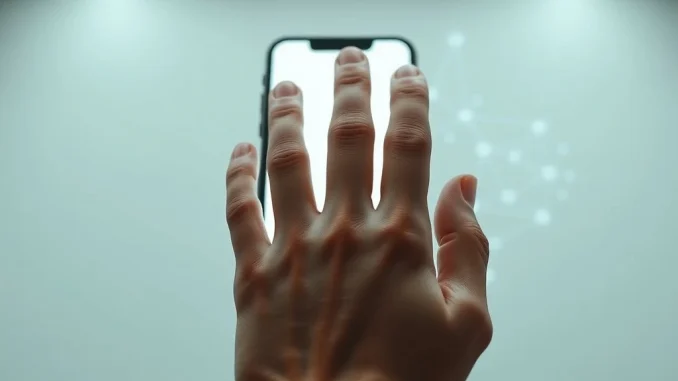
SAN FRANCISCO, March 13, 2026 — In a decisive move to address the escalating threat of AI-powered fraud, Polychain Capital has led a $10 million seed funding round for startup VeryAI. The capital injection, confirmed today, fuels the launch of a novel palm-scan identity verification system built on the Solana blockchain. VeryAI’s technology aims to provide crypto platforms and online services with a critical tool to distinguish real human users from a rising tide of AI-generated accounts, deepfakes, and synthetic identities while preserving user privacy through on-chain zero-knowledge proofs.
VeryAI’s Palm-Scan System: A Technical Deep Dive
The core of VeryAI’s offering is a smartphone-based biometric capture system. A user simply positions their palm in front of their device’s camera. The system then converts the image into an encrypted, irreversible biometric signature. Crucially, this process does not store the original palm image or any personally identifiable data. Instead, it creates a unique feature representation that is recorded as an attestation on the Solana blockchain. This allows other platforms to verify that a specific, unique human has been authenticated without learning who that person is. “Palm biometrics are highly distinctive and far less publicly exposed than facial features,” a VeryAI technical brief explains, highlighting a key privacy advantage over common facial recognition systems.
The urgency for such solutions has skyrocketed throughout 2025. Zach Meltzer, founder and CEO of VeryAI, framed the problem starkly in a statement. “We’re entering a period where the internet can no longer assume that every account, message, or video is created by a real person,” Meltzer said. “AI is powerful, but it also breaks many of the trust assumptions that the internet was built on.” He specifically cited vulnerabilities in crypto, including sybil attacks during exchange onboarding, fake accounts farming token incentives, and sophisticated impersonation scams targeting decentralized communities.
The Escalating Crisis of AI-Generated Identity Fraud
The funding arrives amid what security firms label an “unprecedented surge” in AI-facilitated financial crime. According to blockchain security firm CertiK’s 2025 Annual Report, losses from crypto ATM scams alone jumped 33% in 2025, a spike directly attributed to AI-generated personas and deepfakes used in social engineering. This environment has created intense demand for reliable proof-of-human systems. The challenge is not merely detecting a bot, but providing a reusable, privacy-preserving credential that proves a real person is authentically present across multiple digital interactions.
- Sybil Attack Proliferation: Automated scripts can create thousands of fake accounts to manipulate governance votes, claim airdrops, or distort social sentiment.
- Deepfake Social Engineering: Scammers use AI-generated video and audio to impersonate project leaders or trusted figures in community calls, directing users to malicious sites.
- Synthetic Identity Onboarding: AI can forge consistent but fake identity documents, helping bad actors pass Know-Your-Customer (KYC) checks on exchanges.
Industry and Expert Perspectives on Blockchain Identity
The venture underscores a growing consensus among tech leaders that blockchain-based cryptographic verification may be essential for restoring digital trust. Chris Dixon, a general partner at Andreessen Horowitz, warned last year of an “ocean of AI-powered deepfakes and bots” eroding the foundational trust of the internet. He publicly suggested that decentralized identity systems could be part of the solution. Similarly, Ethereum co-founder Vitalik Buterin has long advocated for privacy-preserving identity models. He promotes systems that use technologies like zero-knowledge proofs to allow users to prove specific attributes—such as uniqueness or citizenship—without revealing their full identity.
VeryAI’s approach directly incorporates this principle. Its use of zero-knowledge proofs allows a user to prove they are a verified human to a platform like an exchange, while the exchange learns nothing else about them. This differentiates it from traditional KYC databases, which centralize sensitive personal information and become high-value targets for hackers.
Competitive Landscape and the Worldcoin Comparison
VeryAI enters a nascent but competitive field of blockchain-based human verification. Its most prominent competitor is Worldcoin, co-founded by Sam Altman, which uses a proprietary hardware “Orb” to scan a person’s iris. Worldcoin has registered millions of users but faces persistent criticism from privacy advocates, including Edward Snowden, who has argued that collecting biometrics creates a dangerous central point of failure. The table below highlights key differences between the two approaches.
| Feature | VeryAI | Worldcoin (WLD) |
|---|---|---|
| Biometric Method | Palm scan via smartphone camera | Iris scan via dedicated Orb hardware |
| Hardware Requirement | Standard smartphone | Proprietary Orb device |
| Data Storage | Irreversible feature hash on-chain | Iris code on a decentralized network |
| Primary Blockchain | Solana | Ethereum sidechain, Polygon |
| Key Privacy Tech | Zero-knowledge proofs | Zero-knowledge proofs |
| Notable Criticism | Untested at scale, phone camera variance | Centralized hardware collection, privacy concerns |
Market interest in proof-of-human concepts is volatile but significant. In January 2026, Worldcoin’s WLD token surged approximately 40% following rumors that OpenAI was exploring a bot-free social media platform requiring human verification. This event demonstrated the market’s sensitivity to developments that tie AI governance to identity solutions.
Integration Roadmap and What Happens Next
VeryAI is not starting from zero. The company has already established working partnerships with several organizations, including crypto exchange MEXC, Solana accelerator Colosseum, and identity oracle projects Clique and Talus. According to Meltzer, other centralized exchanges and wallet providers are in active integration talks. The $10 million in new capital will primarily fund engineering expansion and business development to accelerate these integrations. The involvement of Anatoly Yakovenko, Solana’s co-founder, as an angel investor provides not just capital but also strategic technical guidance for building efficiently on the high-throughput blockchain.
Investor Rationale and Long-Term Vision
For lead investor Polychain Capital, the bet aligns with a broader thesis on foundational crypto infrastructure. “Identity is the missing primitive for the next generation of the web,” a Polychain representative stated, drawing a parallel to the early investments in scalable blockchains and decentralized finance protocols. Other investors in the round included the Berggruen Institute and Anagram, signaling cross-disciplinary interest from both tech venture and philosophical governance circles. The goal for VeryAI extends beyond crypto. The company envisions its system becoming a standard for any online platform needing reliable, private human verification, from social networks to financial services.
Conclusion
The $10 million seed round for VeryAI marks a significant milestone in the escalating arms race between AI-powered fraud and cryptographic identity solutions. By leveraging smartphone-based palm scanning and Solana’s fast, low-cost ledger, VeryAI proposes a more accessible and potentially less invasive alternative to existing biometric systems. Its success will hinge on achieving high accuracy across diverse devices, gaining widespread platform adoption, and maintaining unwavering commitment to its privacy-by-design principles. As AI-generated content continues to blur the lines of digital reality in 2026, tools that can cryptographically attest to “humanness” may become as fundamental to the next internet as the SSL certificate was to the last. The industry will now watch closely as VeryAI moves from funded prototype to live, battle-tested network.
Frequently Asked Questions
Q1: How does VeryAI’s palm scan protect my privacy compared to a traditional KYC document upload?
VeryAI’s system never stores your actual palm image or personal data. It converts your palm scan into an irreversible cryptographic hash, like a unique digital fingerprint. This hash is stored on the blockchain, allowing platforms to verify you are human without knowing who you are, using zero-knowledge proof technology.
Q2: Why did VeryAI choose the Solana blockchain for this identity system?
Solana offers very high transaction throughput and low fees, which is critical for a system that needs to verify millions of identities quickly and cost-effectively. The speed allows for near-instant verification checks, a necessity for user-friendly login or onboarding processes.
Q3: What are the main risks or challenges facing VeryAI’s technology?
Key challenges include ensuring the palm-scan algorithm is equally accurate across all smartphone camera qualities and lighting conditions, preventing sophisticated spoofing attempts using high-resolution models or prints, and driving enough platform adoption to make the “proof-of-human” credential widely useful.
Q4: As a regular crypto user, how might I interact with VeryAI’s system in the future?
You may encounter it during exchange sign-up, wallet creation, or participation in a token launch or governance vote. Instead of uploading a passport, you might be prompted to scan your palm with your phone to generate a private, reusable proof of your unique humanity for that platform.
Q5: How does this development relate to the broader problem of AI and misinformation?
It addresses one foundational layer: authenticating the source. If platforms can reliably verify that an account is held by a verified human, it reduces the scale of anonymous bot networks that spread misinformation, manipulate markets, and coordinate harassment campaigns.
Q6: What should other identity verification startups learn from Worldcoin’s controversies?
VeryAI’s approach seems designed to avoid Worldcoin’s main pitfalls: it uses existing hardware (smartphones) instead of proprietary devices, and it emphasizes that it does not store reconstructable biometric images. The lesson is that privacy and accessibility are non-negotiable for public trust in biometric systems.