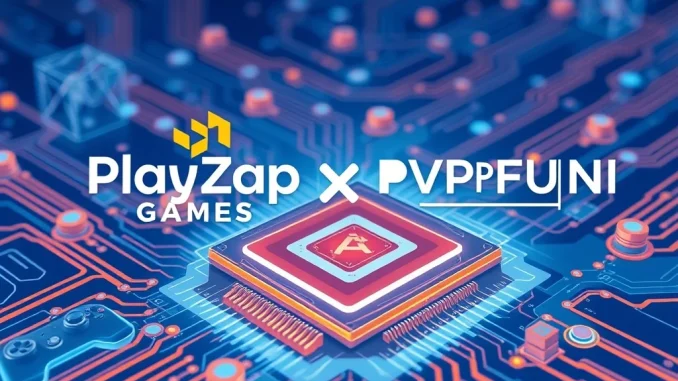
Singapore, April 2025: The blockchain gaming landscape is poised for a significant evolution. PlayZap Games, a prominent developer in the GameFi space, has announced a strategic partnership with artificial intelligence specialist PVPFUN AI. This collaboration aims to fundamentally strengthen the underlying GameFi infrastructure and expand meaningful on-chain utility for a global player base. The move signals a maturation phase for Web3 gaming, where technological integration takes precedence over speculative hype.
Decoding the PlayZap and PVPFUN AI Partnership
This partnership represents a convergence of two specialized domains within the broader Web3 ecosystem. PlayZap Games has established itself by developing engaging play-to-earn titles that emphasize sustainable tokenomics and community governance. Their portfolio includes multiplayer strategy games and virtual world experiences where in-game assets are verifiably owned by players as non-fungible tokens (NFTs). PVPFUN AI, conversely, brings a suite of artificial intelligence tools designed specifically for decentralized applications. Their expertise lies in creating adaptive AI opponents, predictive analytics for in-game economies, and smart contract optimization. The core objective of their alliance is to leverage AI to solve persistent challenges in GameFi, such as economic volatility, player retention, and complex user onboarding.
The Critical Need for Robust GameFi Infrastructure
GameFi, the fusion of gaming and decentralized finance, has experienced explosive growth since its emergence in the early 2020s. However, rapid expansion often exposed infrastructural weaknesses. Early projects frequently suffered from high transaction fees, slow network speeds, and exploitable economic models, leading to player attrition. Infrastructure in this context extends beyond the blockchain layer to include the economic systems, data oracles, and user experience frameworks that support a game. Analysts from firms like DappRadar have consistently highlighted that projects with robust, scalable infrastructure demonstrate higher longevity and user trust. This partnership directly addresses these industry-wide pain points by integrating AI-driven analytics and automation into the foundational layers of PlayZap’s gaming environments.
Technical Integration and On-Chain Utility Enhancements
The integration will manifest in several tangible ways for players and the network. PVPFUN AI’s systems will be deployed to dynamically balance in-game economies, adjusting resource sinks and faucets in real-time based on player behavior data to maintain asset stability. Furthermore, the AI will power more sophisticated and unpredictable non-player characters (NPCs), enhancing gameplay depth. For on-chain utility, the partnership plans to introduce AI-curated decentralized autonomous organization (DAO) proposals, where the AI analyzes community sentiment and game data to suggest protocol upgrades. This moves governance beyond simple token voting. Another key area is the use of AI for fraud detection and the prevention of automated bot farming, which has plagued many play-to-earn models, thereby protecting the economic value for genuine players.
Historical Context and Industry Trajectory
The collaboration follows a clear trend in the technology sector where AI integration becomes a key differentiator. In traditional gaming, companies like Ubisoft and Electronic Arts have used AI for years for content generation and player matchmaking. The Web3 gaming sector is now following suit, but with the added complexity of open, player-owned economies. Previous notable partnerships, such as those between major game engines like Unity and blockchain networks, focused on accessibility. The PlayZap-PVPFUN AI deal represents a deeper, second-wave integration targeting systemic intelligence and resilience. It reflects a shift from merely “putting games on a blockchain” to building intelligent, self-regulating gaming ecosystems that can scale sustainably.
Implications for Developers and the Broader Market
For other developers in the space, this partnership sets a new benchmark. It underscores that future competitiveness in GameFi may depend less on flashy graphics alone and more on the sophistication of a project’s economic and operational backend. Venture capital flowing into the sector has increasingly favored teams with strong technical pedigrees in both game design and systems engineering. This deal could accelerate a consolidation phase where well-funded, technologically integrated projects pull ahead. For the market, successful implementation could lead to more stable in-game asset prices, reducing the notorious volatility that deters mainstream gaming audiences and attracting a more diverse, long-term player base interested in both entertainment and ownership.
Conclusion
The strategic partnership between PlayZap Games and PVPFUN AI marks a pivotal step toward a more mature and sustainable GameFi industry. By focusing on strengthening core infrastructure and enhancing genuine on-chain utility through artificial intelligence, the collaboration addresses fundamental challenges that have hindered mainstream adoption. This move is less about short-term speculation and more about building the intelligent, scalable, and engaging frameworks necessary for the next generation of blockchain gaming. As the industry evolves, such deep technological integrations will likely become the standard, defining which projects succeed in creating lasting value for players in the decentralized future.
FAQs
Q1: What is the main goal of the PlayZap and PVPFUN AI partnership?
The primary goal is to strengthen GameFi infrastructure and enhance on-chain utility for players by integrating PVPFUN AI’s artificial intelligence tools into PlayZap’s gaming ecosystems. This aims to solve issues like economic imbalance, poor player retention, and simplistic gameplay.
Q2: How will AI improve the GameFi experience for players?
Players can expect more dynamic and balanced in-game economies, smarter and more challenging AI opponents, improved fraud and bot detection, and potentially AI-assisted governance tools that make community decision-making more informed and effective.
Q3: What does “on-chain utility” mean in this context?
On-chain utility refers to the practical use and functionality of blockchain-based assets (like NFTs and tokens) within the game. This partnership seeks to expand that utility beyond simple ownership to include roles in advanced governance, AI-driven gameplay features, and verifiable contributions to a stable game economy.
Q4: Is this a common type of partnership in the blockchain gaming industry?
While partnerships are common, a deep integration focusing specifically on AI for backend economic and infrastructural management is a growing but still advanced trend. It represents a maturation of the sector beyond initial proof-of-concepts.
Q5: Could this partnership make PlayZap’s games less decentralized?
The partnership is designed to augment infrastructure, not centralize control. The AI tools will likely operate based on transparent, community-approved parameters and data. The goal is to enhance the user experience and system stability while preserving core Web3 principles of ownership and decentralized governance.