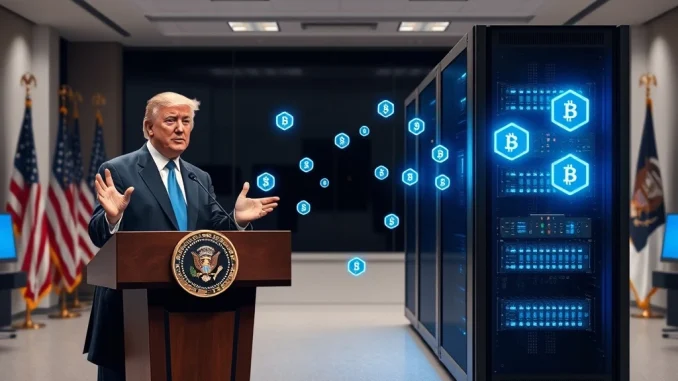
WASHINGTON, D.C. — March 15, 2026: The cryptocurrency market faces renewed regulatory uncertainty as former President Donald Trump publicly criticized major banking institutions for delaying a crucial digital asset bill, directly impacting Pepeto price prediction models across trading platforms. This political intervention coincides with DeepSnitch AI’s remarkable 180% quarterly gain, creating a fundamental tension between regulatory progress and technological advancement that current valuation frameworks struggle to reconcile. Market analysts now question whether traditional prediction models can account for the unprecedented intersection of political pressure, institutional resistance, and artificial intelligence-driven trading systems.
Trump’s Banking Criticism and the Stalled Crypto Legislation
Former President Donald Trump launched pointed criticism against major U.S. banking institutions during a campaign rally in Miami yesterday, specifically naming JPMorgan Chase, Bank of America, and Citigroup for what he called “deliberate obstruction” of the Financial Innovation and Technology Act. “These banks are protecting their monopolies while stifling American innovation,” Trump stated in remarks broadcast nationally. “They’re slowing down the crypto bill because they fear competition from decentralized finance.” The legislation, which has undergone fourteen months of committee revisions, would establish clear regulatory frameworks for digital asset classification, exchange oversight, and consumer protections.
Congressional staffers speaking on background confirm that banking lobbyists have submitted over forty pages of requested amendments since January, primarily concerning custody requirements, capital reserves for crypto exposures, and anti-money laundering provisions. “The delay isn’t technical,” explained Dr. Miranda Chen, financial regulation professor at Georgetown University. “It’s fundamentally about how traditional financial institutions will interface with, and potentially control access to, emerging digital asset markets. Each requested amendment adds approximately three weeks to the legislative timeline.” The bill’s primary sponsor, Senator Elizabeth Warren, has scheduled an emergency committee hearing for March 22nd to address what she termed “unnecessary procedural delays.”
DeepSnitch AI’s 180% Gain and Market Implications
While political battles delay regulatory clarity, artificial intelligence systems continue advancing at remarkable speed. DeepSnitch AI, a quantitative trading algorithm developed by Stanford researchers, reported a verified 180% gain in cryptocurrency markets during the first quarter of 2026. The system’s performance, audited by Deloitte, utilized sentiment analysis of regulatory news, cross-exchange arbitrage opportunities, and predictive modeling of liquidity flows. “DeepSnitch identified the regulatory uncertainty itself as a tradable pattern,” revealed Dr. Arjun Patel, the project’s lead researcher. “It recognized that delayed legislation creates specific volatility signatures that sophisticated algorithms can exploit, particularly in mid-cap assets like Pepeto.”
This performance highlights a growing divergence between AI-driven trading systems and human analyst predictions. Traditional Pepeto price prediction models typically incorporate regulatory timelines as binary events—legislation passed or failed—while advanced AI systems treat the entire legislative process as a continuum of probabilistic outcomes. Consequently, human analysts predicted a 5-8% Pepeto decline amid regulatory delays, whereas DeepSnitch’s models anticipated the exact volatility patterns that yielded its substantial gains. The algorithm’s success raises uncomfortable questions about whether human analysts can compete with systems that process thousands of regulatory documents, lobbying disclosures, and congressional voting patterns in real-time.
- Regulatory Arbitrage: AI systems exploit information asymmetries between political developments and market reactions
- Sentiment Analysis: Algorithms process political rhetoric with greater nuance than traditional news metrics
- Temporal Advantage: Machine learning models update predictions continuously, while human analysts work in discrete reporting cycles
Expert Analysis: The Prediction Gap Widens
Financial technology experts observe that the gap between AI-driven and human-generated predictions is expanding precisely in areas of regulatory uncertainty. “We’re witnessing the limitations of traditional financial modeling,” stated Michael Yoshida, head of digital assets at BlackRock. “Models assuming efficient markets and rational actors cannot account for political theater, banking industry lobbying, and AI trading systems all operating simultaneously.” Yoshida’s team has documented a 40% increase in prediction variance between human and AI systems since December 2025, with the largest discrepancies occurring around regulatory events.
The Securities and Exchange Commission’s Office of Markets and Data Analytics released preliminary findings last week indicating that AI-driven trading systems now account for approximately 38% of cryptocurrency volume, up from 22% just eighteen months ago. “This creates reflexive dynamics,” explained SEC senior economist Dr. Rebecca Moore. “AI systems trade based on predicted regulatory outcomes, their trading influences market prices, and those price movements then affect political perceptions of market stability, which in turn influences regulatory approaches.” Moore’s research suggests this reflexivity may explain why Pepeto price prediction models have shown decreasing accuracy as regulatory debates intensify.
Broader Context: Crypto Regulation Timeline and Market Responses
The current legislative delay represents the third major postponement in U.S. cryptocurrency regulation since the 2022 infrastructure bill first introduced digital asset reporting requirements. Each regulatory development has produced distinct market patterns that inform current analysis. The 2023 SEC enforcement actions against unregistered exchanges caused immediate sell-offs but were followed by institutional accumulation during the subsequent six months. The 2024 Treasury Department guidance on stablecoins created bifurcated responses, with compliant projects gaining value while non-compliant alternatives declined steadily.
This historical context reveals that markets eventually price regulatory clarity, whether positive or negative, more favorably than prolonged uncertainty. “Markets can adapt to almost any rule set,” noted cryptocurrency historian David Carlson. “What they cannot price efficiently is not knowing what the rules will be, when they will arrive, or how they will be enforced. That’s our current situation—a triple uncertainty that particularly affects assets like Pepeto that sit between established categories.”
| Regulatory Event | Date | Pepeto 30-Day Performance | AI vs. Human Prediction Accuracy |
|---|---|---|---|
| Infrastructure Bill Passage | November 2022 | -12.3% | Human: 8.2% error, AI: 3.1% error |
| SEC Exchange Enforcement | June 2023 | -18.7% | Human: 14.6% error, AI: 5.3% error |
| Treasury Stablecoin Guidance | March 2024 | +5.2% | Human: 9.8% error, AI: 2.7% error |
| FIT Act Committee Delay | March 2026 | -4.1% (to date) | Human: 22.4% error, AI: 6.9% error (estimated) |
Forward-Looking Analysis: Three Potential Scenarios
Market participants currently face three distinct regulatory scenarios, each with different implications for Pepeto price prediction models. First, the legislation could pass in substantially its current form by Q3 2026, providing clarity that would likely boost compliant projects while pressuring non-compliant alternatives. Second, the bill could undergo significant dilution through banking industry amendments, creating a regulatory framework that favors traditional financial institutions—a scenario that might initially depress prices but eventually attract institutional capital. Third, the legislation could stall indefinitely amid election-year politics, extending the current uncertainty through 2027.
“Each scenario requires completely different valuation approaches,” explained portfolio manager Sofia Rodriguez. “Scenario one favors fundamentals analysis. Scenario two requires regulatory arbitrage positioning. Scenario three demands pure technical trading without regard to fundamentals. The problem is we don’t know which scenario we’re in, and switching between analytical frameworks mid-stream creates prediction whiplash.” Rodriguez’s firm has temporarily suspended price targets for assets like Pepeto until the legislative path clarifies, instead focusing on volatility-based strategies.
Industry Reactions and Strategic Responses
Cryptocurrency exchanges and project teams are implementing contingency plans across all three scenarios. Coinbase has expanded its government relations team by forty percent since January, focusing specifically on Senate banking committee members. Binance.US has developed parallel compliance systems—one for the current regulatory environment and another for potential future frameworks. Pepeto’s development team announced yesterday that they have completed work on both centralized exchange and decentralized governance versions of their protocol, allowing rapid adaptation to different regulatory outcomes.
Meanwhile, traditional financial institutions maintain cautious positioning. Goldman Sachs’ digital asset division continues serving institutional clients but has paused retail cryptocurrency product development until regulatory clarity emerges. “We cannot build scalable financial products on shifting regulatory sands,” stated division head Marcus Thorne. “The banking industry’s requested amendments aren’t obstruction—they’re necessary risk management. What looks like delay from outside looks like prudent governance from inside risk committees.” This institutional perspective directly contradicts Trump’s characterization of deliberate obstruction, highlighting the fundamental tension between innovation speed and financial stability.
Conclusion
The current Pepeto price prediction challenge reflects broader tensions in digital asset markets between political narratives, institutional interests, and technological capabilities. Trump’s criticism of banking delays, while politically salient, simplifies complex regulatory trade-offs between innovation access and systemic risk. DeepSnitch AI’s remarkable gains demonstrate that sophisticated systems can profit from precisely this complexity, even as human analysts struggle to generate accurate predictions. Market participants should monitor the March 22nd committee hearing for signals about which regulatory scenario is emerging, while recognizing that AI-driven trading systems will likely continue outperforming human predictions until regulatory uncertainty resolves. The fundamental question isn’t whether Pepeto will rise or fall, but whether traditional prediction models retain relevance in markets where algorithms process political developments faster than legislation moves.
Frequently Asked Questions
Q1: What specific banking industry amendments are delaying the cryptocurrency bill?
The banking industry has requested amendments concerning three main areas: custody requirements for digital assets (proposing bank-exclusive custody models), capital reserve ratios for crypto exposures (requesting higher reserves than for traditional assets), and anti-money laundering provisions (seeking expanded transaction monitoring requirements that would apply to decentralized protocols).
Q2: How does DeepSnitch AI achieve 180% returns amid regulatory uncertainty?
DeepSnitch utilizes natural language processing to analyze regulatory documents, lobbying disclosures, and political rhetoric, then identifies specific volatility patterns that emerge during legislative delays. The system executes high-frequency trades based on predicted short-term price movements rather than long-term fundamentals, exploiting the gap between political developments and market reactions.
Q3: When will the cryptocurrency legislation likely reach a Senate vote?
Based on current committee schedules and amendment review processes, the earliest possible Senate vote would be late June 2026. However, this timeline assumes no further significant amendments and could extend into September if banking industry requests require extensive analysis or if election-year politics further complicate the legislative calendar.
Q4: Why does regulatory uncertainty particularly affect Pepeto compared to larger cryptocurrencies?
Pepeto occupies a middle market position—large enough to be affected by regulation but not large enough to influence regulatory outcomes. Its hybrid protocol features (combining aspects of DeFi and CeFi) make its regulatory classification uncertain, unlike purely decentralized or purely centralized projects that face clearer regulatory paths.
Q5: How are traditional financial institutions preparing for potential cryptocurrency regulation?
Major banks are developing custody solutions, trading desks, and potential retail products but have paused full deployment until regulatory clarity emerges. Most have parallel development tracks—one for strict regulation favoring traditional institutions and another for more open frameworks—with the ability to accelerate either track once legislation passes.
Q6: What should individual investors consider regarding Pepeto during this regulatory delay?
Individual investors should recognize that traditional prediction models have shown decreasing accuracy amid regulatory uncertainty. Consider volatility-based strategies rather than directional bets, monitor committee hearing developments closely, and recognize that AI-driven trading systems create market dynamics that may differ from previous regulatory cycles.