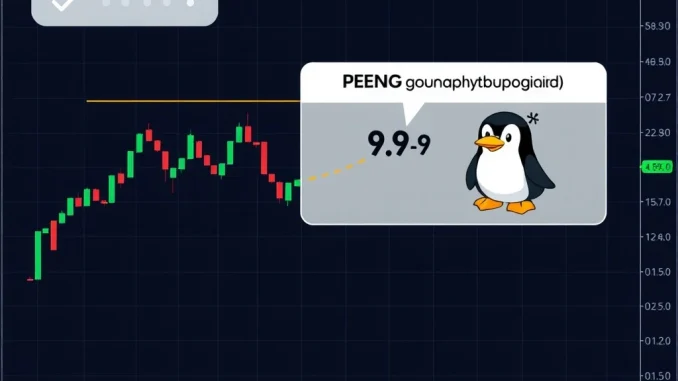
Global Cryptocurrency Markets, April 2025: The PENGU token, the native cryptocurrency of the popular Pudgy Penguins non-fungible token (NFT) ecosystem, has generated notable attention among technical analysts. A specific chart pattern, known as a TD Sequential buy signal, has appeared on its 12-hour price chart. This development occurs as the broader Pudgy Penguins project tests what market observers identify as critical support levels, suggesting the possibility of a significant price movement.
Understanding the PENGU Token and the TD Sequential Signal
The PENGU token serves as the utility and governance asset within the Pudgy Penguins universe. Launched in tandem with the expansion of the NFT brand into physical toys and broader Web3 experiences, the token’s value is often correlated with the project’s adoption and market sentiment. The reported technical signal originates from the TD Sequential indicator, a tool developed by market technician Thomas DeMark. This indicator aims to identify potential exhaustion points in a price trend and pinpoint moments where a reversal may be likely.
On a 12-hour chart, the TD Sequential setup involves a specific count of consecutive closing prices relative to the close from four periods prior. A completed count to nine, followed by a price close above the close four periods earlier, can constitute a buy signal. It is crucial to note that this signal, like all technical indicators, is probabilistic, not deterministic. It suggests a heightened possibility of a bullish reversal based on historical pattern recognition, not a guaranteed outcome.
Analyzing the Current Market Context for Pudgy Penguins
The emergence of this signal does not exist in a vacuum. It coincides with the PENGU token and the underlying Pudgy Penguins NFT collection encountering key price zones that have historically acted as floors during previous market corrections. Several factors contribute to the current market environment:
- Broader Crypto Market Conditions: The entire digital asset sector experiences cyclical volatility. Recent macroeconomic pressures have impacted investor sentiment across blockchain-based assets.
- NFT Market Maturation: The NFT space has evolved from speculative trading towards projects emphasizing intellectual property, community, and real-world utility. Pudgy Penguins has been a frontrunner in this shift.
- Project-Specific Developments: The success of Pudgy Penguins’ retail toy line and ongoing roadmap milestones can influence the perceived long-term value of the associated PENGU token.
Testing support levels means the price has declined to a point where buying interest has historically emerged, preventing further decline. A hold at these levels, coupled with a recognized technical buy signal, forms the basis for analyst observations of a potential rebound.
The Mechanics and Meaning of a 30% Rebound Projection
The reference to a potential 30% rebound is a common analytical projection derived from technical charting. Analysts often measure the distance between recent swing highs and the current support level to establish a potential recovery target. If the TD Sequential buy signal is validated by subsequent price action—meaning the token price begins a sustained upward move—the first major resistance level might represent a gain in that approximate magnitude.
It is a measured move projection, not a prediction. This projection typically aligns with the Fibonacci retracement levels or previous consolidation areas that now act as overhead supply. Traders use these levels to set potential profit targets and manage risk, understanding that market conditions can change rapidly.
Historical Precedents and Technical Analysis Limitations
Technical analysis, including tools like the TD Sequential, operates on the premise that market psychology creates repetitive patterns. Historical data from various asset classes, including cryptocurrencies, shows that these signals can precede significant trend changes. However, authoritative market commentary always stresses the importance of context and confirmation.
A single indicator is rarely used in isolation by professional analysts. They seek confluence—multiple independent signals pointing in the same direction. This could include momentum oscillators like the Relative Strength Index (RSI) showing oversold conditions, volume analysis indicating accumulation, or bullish divergence patterns. Furthermore, fundamental developments within the Pudgy Penguins ecosystem would provide a stronger foundation for any sustained price recovery than a chart pattern alone.
Implications for Investors and the NFT Ecosystem
For observers and participants in the cryptocurrency and NFT markets, signals like this serve as a focal point for market analysis. A validated rebound in a prominent project like Pudgy Penguins could have ripple effects, influencing sentiment across other NFT-linked tokens and the broader “phygital” (physical + digital) asset space. It highlights the increasing sophistication of market participants who apply traditional financial market techniques to emerging digital asset classes.
For investors, the key takeaway is the importance of due diligence. Technical signals are one piece of a much larger puzzle that includes project fundamentals, team execution, roadmap progress, regulatory landscape, and overall crypto market health. Any investment decision should be based on comprehensive research and an understanding of the high-risk, high-volatility nature of cryptocurrency assets.
Conclusion
The appearance of a TD Sequential buy signal on the PENGU token’s 12-hour chart presents a notable technical development for market watchers. It suggests a potential exhaustion of recent selling pressure and the possibility of a bullish reversal, with analysts eyeing a recovery target around 30% based on chart structure. This occurs as the Pudgy Penguins project tests critical support levels, adding contextual weight to the technical setup. While such signals are a standard part of market analysis, they represent probability, not certainty. The future price action of the PENGU token will ultimately depend on a combination of technical confirmation, broader market trends, and the ongoing fundamental progress of the Pudgy Penguins ecosystem itself.
FAQs
Q1: What is the PENGU token?
The PENGU token is the official cryptocurrency of the Pudgy Penguins NFT ecosystem. It is used for governance, community rewards, and accessing various utilities within the project’s expanding universe, which includes digital and physical products.
Q2: What is a TD Sequential buy signal?
The TD Sequential is a technical analysis indicator developed by Thomas DeMark. A buy signal on a price chart, such as the 12-hour chart referenced, suggests that a downtrend may be exhausting itself and a potential bullish reversal could be imminent. It is based on a specific count of price closes.
Q3: Does a TD Sequential signal guarantee a price increase?
No. No technical indicator guarantees future price movement. The TD Sequential signal indicates a higher probability of a trend reversal based on historical patterns, but it requires confirmation from subsequent price action and should be considered alongside other market factors.
Q4: What are “critical support levels”?
In technical analysis, support levels are price zones where an asset has historically found buying interest, halting or reversing declines. “Critical” support refers to a particularly strong or psychologically important level where a breach could lead to further significant downside.
Q5: How is the potential 30% rebound figure calculated?
This is typically a technical projection derived from chart patterns. Analysts measure the distance from the recent swing high down to the current support level. A rebound from support might then be projected to rise towards the next level of significant overhead resistance, which in this context is estimated to be approximately 30% above the signal point.
This article was produced with AI assistance and reviewed by our editorial team for accuracy and quality.