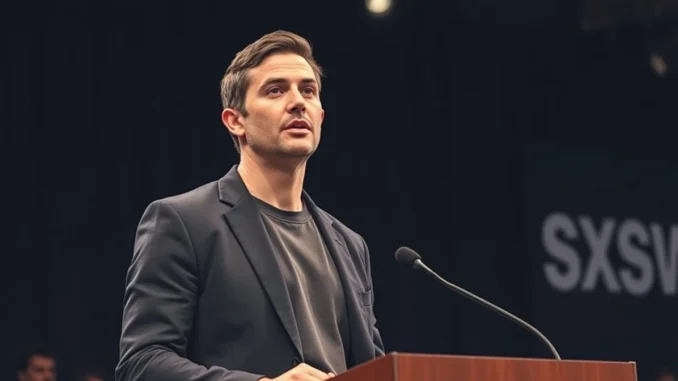
In a forceful address that has reignited a critical debate over intellectual property in the artificial intelligence era, Patreon CEO Jack Conte has publicly challenged the foundational argument used by many AI developers, labeling their ‘fair use’ defense for training models on copyrighted work as ‘bogus’ and demanding systematic compensation for creators.
Patreon CEO Challenges AI Companies’ Fair Use Argument
Speaking at the South by Southwest (SXSW) conference in Austin, Texas, this week, Conte positioned himself not as an opponent of technology but as an advocate for equitable systems. As the founder of a platform supporting hundreds of thousands of creators, Conte argued that the current practice of using vast amounts of creative work—from illustrations and music to writing—to train generative AI models without permission or payment is unsustainable and unjust. His critique centers on a perceived hypocrisy: while AI companies claim a legal right to use publicly available data under fair use doctrines, they simultaneously engage in multi-million dollar licensing agreements with major rights holders like Disney, Condé Nast, and Warner Music Group. “If it’s legal to just use it, why pay?” Conte asked the audience, reading from a prepared manifesto. This contradiction, he asserts, undermines the fairness argument and highlights a system that values corporate content over that of individual artists.
The Legal and Economic Landscape of AI Training Data
The core of the dispute lies in the interpretation of U.S. copyright law’s ‘fair use’ provision, a flexible doctrine allowing limited use of copyrighted material without permission for purposes such as criticism, comment, news reporting, teaching, and research. AI companies have consistently argued that ingesting publicly available data to train models constitutes a ‘transformative’ fair use, as the output does not directly reproduce the training data. However, this stance faces mounting legal challenges. For instance, as of March 2026, numerous lawsuits from authors, visual artists, and media companies are pending in courts, arguing that the scale and commercial nature of the copying exceed fair use boundaries. Conte’s argument leverages the observable market behavior of AI firms themselves. The existence of confidential licensing deals with large publishers, a practice confirmed by multiple financial disclosures throughout 2024 and 2025, suggests the industry acknowledges a need to secure rights for certain high-value data, creating a two-tiered system.
Historical Context of Technological Disruption
Conte framed the rise of generative AI as the latest in a series of internet-age disruptions that have reshaped creative industries. He drew parallels to the shift from digital downloads (iTunes) to streaming subscriptions, which drastically altered musician revenue, and the pivot to vertical video formats demanded by platforms like TikTok. “I learned a very important thing as an artist, which is that change does not mean death,” said Conte, a musician himself. He expressed confidence that creators would adapt and thrive but emphasized that the transition must include mechanisms to ensure they are not stripped of the value their life’s work generates for others. This perspective is supported by economists who note that while new technologies often create new markets, they can also concentrate value extraction away from the original producers if not governed by clear rules.
The Creator Economy’s Stakes in the AI Debate
The financial implications are profound. Patreon, as a central hub for the independent creator economy, has a direct stake in ensuring its community can monetize their skills. Conte’s public stance is also a strategic positioning for his company, potentially advocating for a future where platforms like Patreon could broker collective licensing agreements between creators and AI labs. The scale of Patreon’s community—hundreds of thousands of artists—provides a collective bargaining power most individuals lack. Experts in digital media rights point out that the resolution of this issue will set a precedent for how value is distributed in an economy increasingly driven by synthetic media. Societies that fail to properly incentivize and reward human creativity, Conte warned, risk diminishing a fundamental cultural resource. “When we plan for humanity’s future, we should plan for society’s artists, too,” he concluded.
Defining the Path Forward for AI and Creativity
Looking ahead, several potential models for compensation are being debated in policy and tech circles. These include collective licensing pools, micro-payment systems for data ingestion, and transparent opt-in/opt-out registries for creators. Some AI companies have begun implementing tools allowing website owners to block their content from being crawled by AI bots, a technical step toward greater control. Conte’s speech underscores that the conversation is moving beyond abstract legal arguments into practical discussions about market design. The goal, according to many industry observers, is to establish a framework that supports AI innovation while recognizing the fundamental role of human-created data in that innovation. This balance is seen as crucial for maintaining a vibrant and diverse creative ecosystem alongside technological progress.
Conclusion
Jack Conte’s critique at SXSW has crystallized a central tension in the development of artificial intelligence: the need to reconcile rapid technological advancement with fair compensation for the creators whose work fuels it. By challenging the ‘fair use’ argument as ‘bogus’ and pointing to the industry’s own licensing practices, he has amplified a demand for systemic change. The outcome of this ongoing debate over AI training data and creator compensation will fundamentally shape not only the legal landscape of copyright but also the economic future of the global creative community.
FAQs
Q1: What is the ‘fair use’ argument that AI companies use?
The ‘fair use’ doctrine in U.S. copyright law allows limited use of copyrighted material without permission for purposes like research or commentary. AI companies argue that training models on publicly available data is a transformative, non-infringing fair use because the model learns patterns and does not directly copy or output the original works.
Q2: Why does Jack Conte say this argument is ‘bogus’?
Conte points to a contradiction: AI companies claim they can legally use data for free under fair use, yet they simultaneously pay large sums to license content from major corporations like Disney and Warner Music. He argues that if the fair use defense were legally sound for all content, these payments would be unnecessary, suggesting the practice is selective and unfair to individual creators.
Q3: What does Conte propose as a solution?
While not outlining a specific technical model, Conte’s core demand is that AI companies establish systems to compensate creators for the use of their work as training data. This implies support for licensing frameworks, collective bargaining agreements, or other mechanisms that ensure creators share in the value generated by AI systems.
Q4: Is Patreon against AI technology?
No. Conte explicitly stated he is not anti-AI or anti-tech. He runs a technology company and accepts technological change as inevitable. His argument is specifically about the ethics and economics of how that technology is built, not about stopping its development.
Q5: How does this issue affect everyday creators?
Individual illustrators, musicians, writers, and other creators whose work is widely available online may have had their content ingested into AI training datasets without their knowledge, consent, or compensation. This affects their potential future revenue and control over their intellectual property, especially as AI-generated content becomes more prevalent in their fields.
Updated insights and analysis added for better clarity.
This article was produced with AI assistance and reviewed by our editorial team for accuracy and quality.