
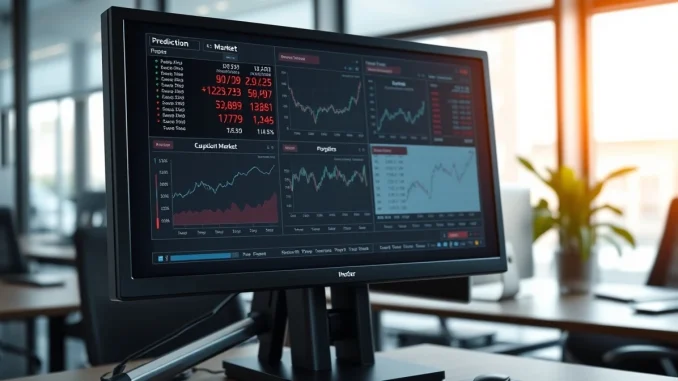
San Francisco, April 2, 2026 – Standard, one of cryptocurrency’s most influential venture capital firms, is constructing a specialized terminal for prediction markets. This project aims to serve professional traders and market makers, signaling a major institutional push into a sector once dominated by retail speculators. According to a Fortune report, the firm began development in late 2025.
Approach’s Prediction Market Ambitions
Led by partner Arjun Balaji, the initiative is more than a simple data feed. Sources told Fortune that Framework is exploring an internal market-making desk dedicated to prediction markets. This desk would provide liquidity by continuously placing buy and sell orders. The firm is also researching the creation of prediction market indexes. These would bundle multiple markets into a single tradable instrument, similar to how the S&P 500 aggregates stocks.
Also read: Bitcoin Plunges, Oil Skyrockets Following Trump's Stark Iran War Address
This suggests Model views prediction markets as a mature asset class worthy of sophisticated financial engineering. The move follows the firm’s significant investments in prediction market platforms. In 2025, Pattern led a $185 million funding round for Kalshi and participated in its later $1 billion round.
The Rush to Serve a Booming Market
Framework is not alone. Major financial institutions are scrambling to access prediction markets. Coinbase and Gemini have launched their own offerings. Traditional exchanges like Nasdaq and Cboe are seeking regulatory approval to list prediction market-style binary options. Monthly trading volume across all platforms has consistently exceeded $10 billion since 2025.
Also read: Huione Money Laundering Boss Extradited in Stunning Blow to Global Crypto Scam Network
Some analysts forecast the sector could reach $1 trillion in annual volume by 2030. This potential explains the rush. “What this means for investors is clear,” said one market analyst who requested anonymity. “Large firms see a convergence between traditional finance and these new, event-driven markets. The first to build solid infrastructure could capture significant fees.”
Existing Platforms and Volume Leaders
Currently, Kalshi and Polymarket dominate trading activity. Data from Model’s own public dashboard shows these platforms lead in volume and open interest across sports, crypto, politics, and financial events. However, newer entrants like OPINION and predict.fun are gaining traction. The competitive field is expanding rapidly.
Regulatory Hurdles Remain
The sector’s explosive growth has attracted intense regulatory scrutiny. Critics argue prediction markets can enable insider trading and manipulation. Contracts based on sporting events also blur the line with sports betting. In the United States, federal and state regulators are still determining jurisdictional authority.
Some regulators abroad have banned specific platforms. The Commodity Futures Trading Commission’s top enforcement official has recently warned about insider trading in these markets. This regulatory uncertainty presents a risk for firms like Approach. Building a terminal for professionals may be an attempt to legitimize the space and encourage clearer rules.
What a Professional Terminal Offers
A terminal for professionals would differ sharply from retail-facing apps. It would likely offer:
- Advanced Data Analytics: Real-time volume, order book depth, and volatility metrics across multiple platforms.
- Direct Market Access: High-speed execution and API connectivity for algorithmic trading.
- Risk Management Tools: Portfolio tracking and exposure management for correlated events.
Pattern has already teased a public data exploration tool. A tweet from a Standard employee on February 4, 2026, showcased a dashboard for discovering prediction markets. The professional terminal is likely a more powerful, private version of this concept.
Implications for the Crypto Industry
Pattern’s project is a significant vote of confidence. The firm has backed foundational crypto projects like Coinbase, Uniswap, and FTX pre-collapse. Its focus on prediction markets could drive more capital and talent into the niche. Furthermore, an internal market-making desk could significantly boost liquidity, making markets more efficient and attractive to larger traders.
The exploration of indexes is particularly notable. Creating a tradable index requires standardization and reliable pricing oracles. Success here could pave the way for derivatives and ETFs based on prediction market outcomes. This would represent a major step toward mainstream financial integration.
Conclusion
Pattern’s development of a prediction market terminal marks a central moment for the sector. It represents a shift from niche, retail-focused platforms to institutional-grade infrastructure. While regulatory challenges persist, the involvement of major venture capital and Wall Street firms suggests prediction markets are being taken seriously as a new financial frontier. The success of this terminal could determine how quickly this frontier is settled.
FAQs
Q1: What is a prediction market?
A prediction market is a platform where participants trade contracts based on the outcome of future events, like elections or sports games. The trading price reflects the market’s collective probability of that outcome occurring.
Q2: Why is Approach, a VC firm, building a trading terminal?
Model invests in crypto infrastructure and sees prediction markets as a high-growth area. Building a terminal for professional traders serves its portfolio companies and positions the firm at the center of a potentially large new market.
Q3: What is an internal market-making desk?
It’s a team within a firm that provides liquidity to a market by constantly quoting both buy and sell prices. This activity tightens bid-ask spreads and makes it easier for other participants to trade.
Q4: Are prediction markets legal?
The legality varies by jurisdiction. In the U.S., they exist in a regulatory gray area. Some platforms operate under specific CFTC no-action letters or are structured as regulated exchanges, while others face legal challenges.
Q5: How big is the prediction market sector?
As of early 2026, monthly trading volume regularly surpasses $10 billion across all platforms. Some industry forecasts project the sector could grow to $1 trillion in annual volume by the end of the decade, though this is not guaranteed.

This article was produced with AI assistance and reviewed by our editorial team for accuracy and quality.




Be the first to comment