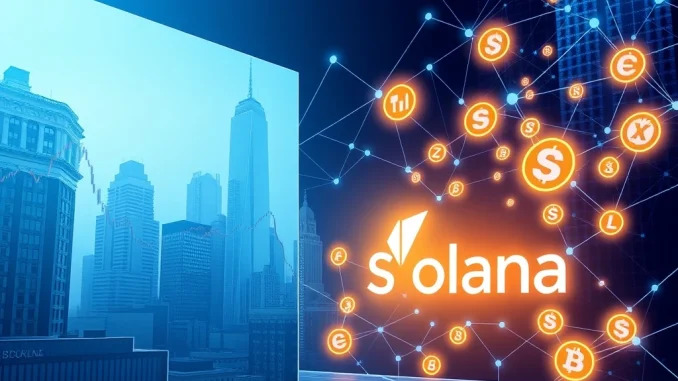
In a landmark move for decentralized finance, Ondo Finance (ONDO) announced on March 15, 2025, its plan to launch over 200 tokenized U.S. stocks and exchange-traded funds (ETFs) on the Solana blockchain. This strategic expansion of Ondo Global Markets directly challenges traditional financial gatekeeping by leveraging blockchain’s inherent efficiency and accessibility. Consequently, the initiative promises to reshape how global investors interact with American capital markets.
Ondo Finance Expands Tokenized Real-World Assets to Solana
Ondo Finance is executing a significant multi-chain strategy. The company initially established its tokenized securities platform on Ethereum and BNB Chain. Now, it is integrating the high-throughput Solana network. This expansion involves creating blockchain-based representations, or tokens, of popular U.S. equities and ETFs. Each token will be fully backed by the corresponding real-world security held in a regulated custodian. Therefore, investors can gain exposure to assets like Apple or an S&P 500 ETF directly through their Solana wallet. This move capitalizes on Solana’s core strengths: high transaction speed and low cost. For instance, Solana can process thousands of transactions per second at a fraction of a cent. This efficiency is critical for creating a seamless user experience that rivals traditional brokerages.
The Technical and Regulatory Framework
Ondo’s model relies on a robust legal and technical structure. The underlying assets are held with a qualified custodian, separate from Ondo’s operations. Smart contracts on Solana mint and manage the tokens, ensuring transparent ownership records. This structure aims to comply with existing securities regulations by providing a clear audit trail. Furthermore, the tokens are designed to be interoperable. They could potentially be used as collateral across various DeFi protocols on Solana, unlocking new financial utility. Industry analysts note this approach mirrors the early stages of the money market fund revolution, which democratized access to wholesale financial instruments.
Impact on the Broader Tokenized Securities Market
The tokenization of real-world assets (RWA) is a rapidly growing sector. Major financial institutions like BlackRock and Franklin Templeton have initiated their own blockchain projects. Ondo Finance’s expansion onto Solana represents a key development for the public, permissionless blockchain approach. It directly competes with private, permissioned networks favored by traditional finance. The choice of Solana is particularly significant. Its ecosystem is known for retail-friendly applications and high-performance decentralized exchanges (DEXs). This integration could funnel significant liquidity and user attention toward Solana’s DeFi landscape. Moreover, it provides a compelling use case for the SOL token beyond speculative trading.
Key benefits of this launch include:
- 24/7 Market Access: Trading tokenized assets is not limited to traditional market hours.
- Reduced Barriers: Potential for fractional ownership lowers the capital required for entry.
- Enhanced Liquidity: Assets can be traded peer-to-peer on DEXs without traditional intermediaries.
- Portfolio Composability: Tokenized stocks can be integrated into complex DeFi yield strategies.
| Blockchain | Key Advantage | Primary User Base | Status |
|---|---|---|---|
| Ethereum | Maximum security & decentralization | Institutional, large holders | Live |
| BNB Chain | Low cost, high adoption in Asia | Retail, global users | Live |
| Solana | Extreme speed & low fees for micro-transactions | Retail, DeFi natives | Launching 2025 |
Expert Analysis on Market Evolution
Financial technology experts point to a clear trend. The convergence of traditional finance (TradFi) and decentralized finance (DeFi) is accelerating. Ondo’s move is not an isolated event but part of a broader institutional adoption curve. A report from Boston Consulting Group projects the tokenized asset market could reach $16 trillion by 2030. Success in this space depends on three pillars: regulatory clarity, technological reliability, and user trust. Ondo’s prior operations on other chains provide a track record that addresses the trust component. The expansion to Solana tackles the technological requirement for scale. Regulatory progress, particularly in jurisdictions like the EU with MiCA, continues to create a more defined operating environment.
Challenges and Considerations for Investors
Despite the promise, several important considerations remain. Regulatory treatment is evolving. The Securities and Exchange Commission (SEC) continues to examine the digital asset space. The legal status of a tokenized stock may involve complex jurisdictional questions. Additionally, smart contract risk exists. While audited, any code can contain vulnerabilities. Investors must also understand the custody model. They own the token, which represents a claim on the underlying asset, not the registered security itself. This introduces a layer of counterparty risk with the issuing entity and custodian. Finally, market liquidity for these new tokens will need time to develop. Initial trading may experience wider spreads than on established stock exchanges.
Conclusion
Ondo Finance’s launch of tokenized stocks and ETFs on Solana marks a pivotal step in the maturation of blockchain-based finance. By combining regulated real-world assets with the efficiency of the Solana network, the project bridges a critical gap. It offers a tangible, practical application of cryptocurrency technology for mainstream investing. This expansion of Ondo Global Markets will likely spur further innovation and competition in the RWA sector. Ultimately, the success of this initiative will be measured by its ability to provide secure, compliant, and user-friendly access to global capital markets. The move solidifies Ondo Finance’s position as a leader in the tokenization of traditional financial instruments.
FAQs
Q1: What are tokenized stocks and ETFs?
Tokenized stocks and ETFs are digital tokens on a blockchain that represent ownership of a real-world stock or exchange-traded fund. Each token is backed 1:1 by the actual security held with a regulated custodian.
Q2: Why is Ondo Finance launching on Solana?
Ondo Finance is expanding to Solana primarily for its high transaction throughput and very low fees. This makes trading tokenized assets more efficient and cost-effective, especially for smaller or more frequent transactions.
Q3: Are tokenized stocks legal and regulated?
The regulatory landscape is still developing. Ondo Finance structures its offerings to comply with applicable securities laws by using regulated custodians and providing transparency. However, regulations vary by jurisdiction, and investors should understand the specific rules in their country.
Q4: How do I buy these tokenized stocks on Solana?
Once launched, users will likely be able to purchase these tokens through supported decentralized exchanges (DEXs) on the Solana network or directly from Ondo’s platform, using a Solana-compatible wallet like Phantom.
Q5: What are the main risks of investing in tokenized securities?
Key risks include smart contract vulnerability, regulatory uncertainty, counterparty risk associated with the issuer and custodian, and potential illiquidity in the early trading stages of the new tokens.
Updated insights and analysis added for better clarity.
This article was produced with AI assistance and reviewed by our editorial team for accuracy and quality.