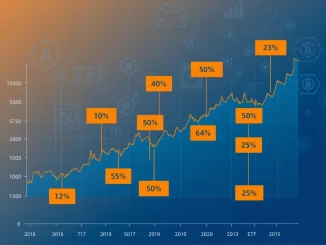
New York, April 2025: The market for on-chain investment vaults, a cornerstone of decentralized finance (DeFi), is on a trajectory to potentially double in size by the end of this year. This stunning forecast comes from a detailed study by asset manager Bitwise, reported by Bloomberg, which points to surging demand for stablecoins and evolving regulatory frameworks as primary catalysts. With the Total Value Locked (TVL) in these automated smart contract platforms already exceeding $6 billion, the sector demonstrates both remarkable momentum and the complex interplay of innovation and risk that defines modern crypto finance.
On-Chain Vault Market Set for Explosive Growth
The Bitwise report provides a data-driven analysis of a financial niche rapidly entering the mainstream. On-chain vaults are not merely digital storage; they are programmable, non-custodial smart contracts that automatically execute complex financial strategies. Users deposit assets like stablecoins, and the vault’s code allocates them across lending protocols, liquidity pools, or yield-farming opportunities to generate returns. This automation removes intermediary steps and, crucially, does not require users to surrender direct custody of their assets to a centralized entity. The current TVL milestone of over $6 billion represents capital actively working within these systems, a figure that has grown steadily despite market volatility. Bitwise’s projection of a doubling by year-end suggests a convergence of technological adoption, capital inflow, and regulatory tailwinds that could push the sector’s TVL toward $12 billion or more.
Understanding the Mechanics and Appeal of DeFi Vaults
To grasp why this market is expanding, one must understand what distinguishes these vaults from traditional finance and even centralized crypto platforms. The core innovation is the non-custodial model. When you use a centralized exchange or lending service, you transfer asset ownership to that company’s wallet, trusting them to manage it. In contrast, an on-chain vault is a piece of code on a blockchain like Ethereum. You interact with it via a Web3 wallet, but the assets never leave your ultimate control; they are simply governed by the immutable rules of the smart contract. This appeals to users seeking transparency and self-sovereignty. Common strategies vaults automate include:
- Yield Optimization: Automatically moving funds between lending protocols like Aave and Compound to chase the highest interest rates for stablecoins.
- Liquidity Provision: Managing assets in decentralized exchange (DEX) pools, earning trading fees, and handling the complex process of impermanent loss mitigation.
- Collateralized Debt Position (CDP) Management: Automating loans against crypto collateral in protocols like MakerDAO to maintain safe health ratios.
The rising demand for stablecoins—digital assets pegged to fiat currencies like the US dollar—is the primary fuel for this growth. Stablecoins offer a less volatile entry point into DeFi, and vaults provide a way to earn yield on these otherwise static holdings.
The Dual Edges of Innovation: Yield and Risk
However, the potential for yield is inextricably linked to risk. The Bitwise report explicitly cautions that the risks behind these yields should not be overlooked. The DeFi ecosystem, while innovative, is not immune to failure. The report references losses on the DeFi platform Stream Finance in 2024 as a stark reminder. Such incidents typically stem from one or more of the following vulnerabilities:
- Smart Contract Risk: Bugs or exploits in the vault’s code can lead to irreversible fund loss.
- Protocol Risk: The underlying lending or trading protocols where the vault deploys capital can themselves be hacked or fail.
- Oracle Risk: Vaults rely on external data feeds (oracles) for pricing. Manipulated or incorrect data can trigger faulty transactions.
- Strategy Risk: The automated financial logic may perform poorly in certain market conditions, leading to losses instead of gains.
This risk-reward calculus is a fundamental part of the on-chain vault market’s narrative. Growth is not just about attracting capital, but also about maturing risk management practices and infrastructure.
The Regulatory Catalyst: The GENIUS Act and Institutional Adoption
A significant factor in Bitwise’s optimistic forecast is the evolving regulatory landscape, particularly in the United States. The passage of the U.S. stablecoin regulation bill, commonly referred to as the GENIUS Act, is expected to be a major catalyst. This legislation aims to create a federal framework for issuing and governing payment stablecoins, bringing clarity and legitimacy to a core building block of DeFi. For asset managers and institutional investors, regulatory uncertainty has been a major barrier to entry. A clear rulebook for stablecoins reduces compliance complexity and legal risk. Consequently, Bitwise anticipates that the GENIUS Act will encourage more traditional asset managers to explore and utilize on-chain vaults as a mechanism for generating yield on client assets in a more structured, compliant manner. This could unlock a wave of institutional capital, significantly scaling the market beyond its current retail and crypto-native base.
A Historical Perspective: From Niche Experiment to Financial Primetime
The journey of on-chain vaults mirrors the broader evolution of DeFi. The concept emerged from the “yield farming” boom of 2020, where users manually moved assets between protocols—a complex and gas-fee-intensive process. Vaults, popularized by platforms like Yearn.finance, automated this toil. Initially a tool for crypto experts, they have gradually become more accessible through improved user interfaces and education. The current TVL of over $6 billion signifies a transition from an experimental phase to a substantive financial sector. This growth has occurred alongside bear and bull markets, suggesting a foundational utility that transcends speculative cycles. The potential doubling forecast by Bitwise represents not a speculative bubble, but an acceleration of this established trend, powered by regulatory tailwinds and product maturation.
Conclusion: A Maturing Market at an Inflection Point
The on-chain vault market stands at a critical inflection point. Bitwise’s analysis, indicating a potential doubling in size by year-end, highlights a sector transitioning from early adoption to accelerated growth. The dual engines of rising stablecoin utility and regulatory clarity through acts like GENIUS are powerful drivers. However, as the report wisely underscores, this growth narrative is balanced by persistent technological and financial risks, as history has shown. The future of this market will likely be defined by its ability to attract sophisticated capital while simultaneously hardening its defenses against the inherent vulnerabilities of decentralized systems. For observers, investors, and the financial industry at large, the expansion of the on-chain vault market is a key indicator of how blockchain technology is concretely reshaping the architecture of modern finance.
FAQs
Q1: What is an on-chain investment vault?
An on-chain investment vault is a non-custodial smart contract that automates complex DeFi strategies, like yield farming or liquidity provision. Users deposit crypto assets, and the vault’s code manages them to generate returns without the user surrendering direct custody to a third party.
Q2: Why does Bitwise think the on-chain vault market could double?
Bitwise cites two main drivers: skyrocketing demand for yield-generating opportunities using stablecoins, and the expected positive impact of clear U.S. stablecoin regulation (the GENIUS Act), which could encourage institutional asset managers to participate.
Q3: What are the biggest risks of using an on-chain vault?
The primary risks are smart contract bugs or exploits, failure or hacking of the underlying DeFi protocols, reliance on faulty external data feeds (oracles), and poor performance of the vault’s automated financial strategy in volatile markets.
Q4: What is Total Value Locked (TVL) and why is it important?
TVL represents the total amount of capital deposited and actively being used within a DeFi protocol or category, like on-chain vaults. It’s a key metric for gauging the size, growth, and user adoption of a decentralized financial service.
Q5: How does the GENIUS Act relate to on-chain vaults?
The GENIUS Act proposes a federal regulatory framework for payment stablecoins in the U.S. Since stablecoins are the primary asset deposited into many vaults, clear regulation reduces legal uncertainty, making it easier for traditional, regulated financial institutions to engage with these DeFi tools.