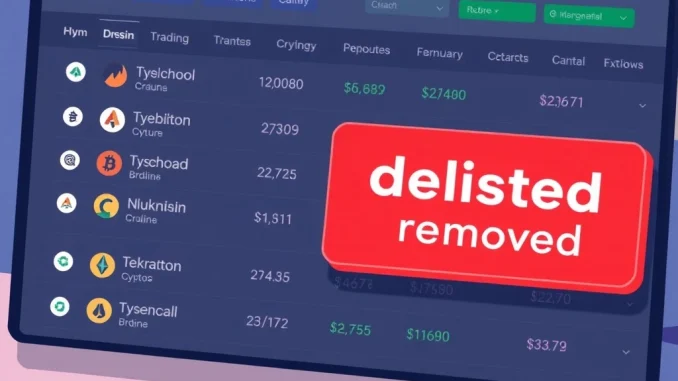
In a significant announcement for its global user base, the prominent cryptocurrency exchange OKX has revealed its decision to delist three specific perpetual futures trading pairs. This move, which impacts LSK/USDT, LOOKS/USDT, and PIPPIN/USDT, is scheduled for July 18 at 08:00 UTC. For many traders, an OKX delisting of this nature can raise questions and prompt immediate action. Let’s delve into what this means for your portfolio and how to navigate these changes effectively.
Understanding the OKX Delisting of Perpetual Futures
OKX, a leading global crypto exchange, communicated this decision via its official website, emphasizing its commitment to maintaining a healthy and robust trading environment. The affected perpetual futures pairs – LSK/USDT, LOOKS/USDT, and PIPPIN/USDT – represent contracts that allow traders to speculate on the future price of an asset without an expiry date. The delisting means that after the specified date and time, users will no longer be able to trade these particular pairs on the OKX platform.
Why do exchanges like OKX undertake such delistings? Typically, these decisions are driven by several factors, including:
- Low Liquidity: Insufficient trading volume can make it difficult for traders to enter or exit positions at desired prices, leading to poor market conditions.
- Lack of Interest: If a specific asset or trading pair sees declining interest from the community, maintaining its listing may not be economically viable for the exchange.
- Project Viability: Concerns over the underlying project’s development, security, or regulatory compliance can also trigger a review.
- Market Conditions: Broader market shifts or specific sector downturns might lead to a reassessment of certain listings.
The Impact on Your Crypto Trading Strategies
For traders currently holding positions in LSK/USDT, LOOKS/USDT, or PIPPIN/USDT perpetual futures, this announcement necessitates immediate attention. The primary concern is to manage existing positions before the delisting deadline. OKX will likely settle all open positions at the time of delisting, but relying on automatic settlement might not always yield the most favorable outcome for traders.
Here’s what you need to consider:
- Close Open Positions: It is highly recommended to manually close any open positions for LSK/USDT, LOOKS/USDT, and PIPPIN/USDT perpetual futures before July 18, 08:00 UTC. This allows you to control your exit price and minimize potential losses from forced liquidation.
- Withdraw Funds: After closing positions, ensure any remaining funds associated with these specific pairs are managed. While the underlying assets (LSK, LOOKS, PIPPIN) might still be tradable on the spot market or other exchanges, their futures contracts on OKX will cease to exist.
- Review Portfolio: Use this opportunity to review your overall crypto trading portfolio and identify other pairs that might be at risk of similar actions across different exchanges. Diversification and staying informed are key.
What This Means for LSK USDT and LOOKS USDT Holders
The delisting of LSK USDT and LOOKS USDT perpetual futures specifically impacts derivatives traders who were leveraging these assets. Lisk (LSK) and LooksRare (LOOKS) are established projects within the blockchain space, focusing on blockchain applications and NFTs respectively. While their perpetual futures contracts are being removed from OKX, this does not necessarily mean the projects themselves are failing. It often points to a strategic decision by the exchange based on the factors mentioned earlier – perhaps lower than desired trading volume for the futures contracts, or a shift in focus.
For those holding the underlying LSK or LOOKS tokens, the delisting of their perpetual futures pairs on OKX primarily affects the derivatives market for these assets on that specific exchange. The spot trading for these tokens might continue, or they might be available on other exchanges. It’s crucial to distinguish between the derivatives market and the spot market.
Navigating Future Trading Opportunities Beyond PIPPIN USDT
While the delisting of PIPPIN USDT perpetual futures might be disappointing for some traders, it also highlights the dynamic nature of the cryptocurrency market. Projects like PIPPIN, though perhaps less widely known than Lisk or LooksRare, contribute to the diverse ecosystem. Exchanges continuously evaluate their offerings to ensure they provide a liquid and efficient trading environment for their users.
For traders, this serves as a reminder to always conduct thorough research (DYOR – Do Your Own Research) before engaging in any form of crypto trading, especially with highly leveraged products like perpetual futures. Staying updated with exchange announcements is paramount to avoid unexpected disruptions to your trading strategies.
Actionable Insights for Traders:
- Set Alerts: Enable notifications for exchange announcements to stay ahead of potential delistings or changes.
- Diversify: Do not put all your eggs in one basket. Diversify your trading pairs and even exchanges to mitigate risks.
- Understand Risks: Perpetual futures carry significant risks due to leverage. Understand these risks thoroughly before trading.
- Monitor Liquidity: Pay attention to the trading volume and liquidity of the pairs you trade. Low liquidity can be a red flag.
The crypto market is known for its rapid evolution, and exchange operations reflect this dynamism. OKX’s decision to delist these perpetual futures pairs is a standard operational adjustment in a volatile market. By being proactive and informed, traders can minimize disruption and continue to navigate the exciting world of cryptocurrency trading effectively.
Summary: Adapting to Exchange Updates
The upcoming OKX delisting of LSK/USDT, LOOKS/USDT, and PIPPIN/USDT perpetual futures on July 18 is a crucial piece of information for all affected traders. This move underscores the importance of staying vigilant and adaptable in the fast-paced world of perpetual futures and broader crypto trading. By taking timely action to close positions and understand the implications for assets like LSK USDT and LOOKS USDT, you can safeguard your investments and prepare for future opportunities. Always prioritize risk management and stay informed about exchange announcements to ensure a smooth and successful trading journey.
Frequently Asked Questions (FAQs)
Q1: What exactly does it mean for a perpetual futures pair to be delisted?
A1: When a perpetual futures pair is delisted, it means that the cryptocurrency exchange (in this case, OKX) will no longer support trading for that specific contract after a certain date and time. All open positions will typically be closed or settled by the exchange at the delisting time, and users will no longer be able to open new positions or manage existing ones for that pair.
Q2: Why did OKX decide to delist LSK/USDT, LOOKS/USDT, and PIPPIN/USDT perpetual futures?
A2: Exchanges delist pairs for various reasons, including low trading volume, insufficient liquidity, declining user interest, concerns about the underlying project’s viability, or changes in regulatory landscape. While OKX didn’t provide specific reasons for each pair, these are common industry practices to maintain a healthy and efficient trading environment.
Q3: What should I do if I have open positions in LSK/USDT, LOOKS/USDT, or PIPPIN/USDT perpetual futures?
A3: It is highly recommended that you manually close all your open positions for these pairs before the delisting time (July 18, 08:00 UTC). This allows you to control your exit price and avoid potential forced liquidations by the exchange, which might occur at less favorable rates.
Q4: Will I still be able to trade LSK, LOOKS, or PIPPIN on the spot market on OKX after the delisting?
A4: The delisting specifically applies to the perpetual futures trading pairs. It does not automatically mean the underlying spot tokens (LSK, LOOKS, PIPPIN) will also be delisted from OKX’s spot market. You should check OKX’s official announcements for any separate news regarding spot trading for these assets.
Q5: What are the risks of not closing my positions before the delisting time?
A5: If you do not close your positions manually, OKX will automatically settle them at the time of delisting. This automatic settlement might occur at a price that is not optimal for you, potentially leading to greater losses than if you had closed the position yourself. It’s always best to be proactive.
This article was produced with AI assistance and reviewed by our editorial team for accuracy and quality.