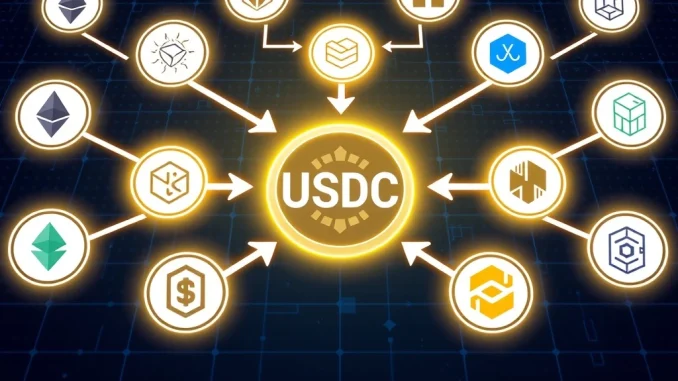
Global, May 2025: The decentralized finance (DeFi) landscape is witnessing a pivotal infrastructure upgrade. Oku, a prominent decentralized trading platform, has completed its integration of Circle’s Cross-Chain Transfer Protocol (CCTP). This technical implementation allows for zero-slippage transfers of native USDC between 14 distinct blockchain networks. The move directly addresses long-standing challenges in cross-chain liquidity fragmentation and introduces a new standard for asset security and efficiency in multi-chain ecosystems.
Oku and Circle CCTP: A Technical Breakdown of Native Transfers
The core innovation lies in the use of native USDC. Prior to protocols like CCTP, moving USDC between chains often involved wrapping assets or using bridges that minted derivative tokens on the destination chain. These “bridged” or “wrapped” assets, while functional, introduced counterparty risk, liquidity silos, and redeemability complexities. Circle’s CCTP operates as a permissionless on-chain utility that burns USDC on the source chain and mints an equivalent amount of native USDC on the destination chain. This process is fully attested by Circle, ensuring the canonical version of the stablecoin moves seamlessly. Oku’s integration acts as a user-facing portal and liquidity router for this protocol, abstracting the technical complexity for traders and liquidity providers.
The Critical Impact on Cross-Chain Liquidity and DeFi Security
This integration fundamentally reconfigures how value moves across blockchains. The promise of zero-slippage transfers is not merely a cost-saving measure; it is a liquidity unifier. By eliminating the price impact typically associated with cross-chain swaps through decentralized exchanges (DEXs), Oku enables large-volume transfers to occur without destabilizing pool balances on either chain. This creates a more efficient and unified liquidity landscape where USDC on Ethereum, Solana, Avalanche, and the other 11 supported chains behaves as a single, fungible asset pool. From a security perspective, reducing reliance on third-party bridge contracts significantly shrinks the attack surface that has led to several high-profile exploits in recent years, as users interact directly with the canonical mint-and-burn mechanism governed by Circle.
Historical Context and the Evolution of Cross-Chain Solutions
The development of cross-chain communication has evolved through distinct phases. Early solutions relied on centralized custodians, which reintroduced trust assumptions. The rise of multi-signature bridges and later more complex cryptographic models improved decentralization but often at the cost of speed, cost, or security audits. The 2022-2024 period, marked by several bridge exploits totaling billions in losses, underscored the systemic risk. Circle’s introduction of CCTP in 2023 represented a shift toward issuer-guaranteed interoperability for stablecoins, a model now being operationalized by platforms like Oku. This progression mirrors the broader industry trend of moving from speculative infrastructure to robust, financial-grade plumbing.
Supported Blockchain Networks and Functional Implications
The selection of 14 blockchains is strategic, covering a majority of Total Value Locked (TVL) in DeFi and key ecosystems for both institutional and retail activity. The supported networks typically include:
- Ethereum
- Solana
- Avalanche
- Polygon
- Arbitrum
- Optimism
- Base
- Stellar
- Noble (Cosmos)
- Polkadot (via specific parachains)
- Flow
- Hedera
- Celo
- BNB Chain
This breadth means a liquidity provider on Arbitrum can seamlessly fund a trading position on Solana through Oku’s interface without worrying about asset provenance or bridge delays. It enables sophisticated, chain-agnostic trading strategies and improves capital efficiency for market makers operating across multiple venues.
Broader Consequences for the DeFi and Institutional Landscape
The long-term implications extend beyond retail trading. For institutional participants, the ability to move large sums of native USDC predictably and with minimized execution cost reduces operational friction and hedging complexity. It also paves the way for more sophisticated cross-chain monetary markets and lending protocols that can treat USDC as a universal base asset. Furthermore, by standardizing on native USDC, Oku and similar integrations enhance regulatory clarity, as the asset remains the direct liability of a regulated issuer throughout its cross-chain journey, unlike opaque wrapped variants. This could accelerate the onboarding of traditional finance entities into DeFi applications.
Conclusion
The integration of Circle’s CCTP by Oku marks a definitive step toward a mature, interoperable blockchain ecosystem. By enabling zero-slippage native USDC transfers across 14 major networks, the upgrade tackles the dual challenges of fragmented liquidity and bridge security head-on. This development is less about a single platform’s feature and more about the hardening of critical financial infrastructure, setting a new benchmark for how stablecoins will move in a multi-chain world. Its success will be measured by the gradual erosion of liquidity barriers between chains and a measurable decrease in cross-chain-related security incidents.
FAQs
Q1: What is native USDC, and why is it important?
A1: Native USDC is the original version of the stablecoin minted directly by Circle on a specific blockchain. It is important because it is the canonical, fully-backed asset, unlike “wrapped” versions created by third-party bridges, which carry additional smart contract and counterparty risk.
Q2: How does Circle’s CCTP achieve zero-slippage transfers?
A2: CCTP uses a burn-and-mint mechanism. It burns (destroys) USDC on the sending chain and, after verifying the transaction, mints (creates) the same amount of native USDC on the receiving chain. This is a direct 1:1 issuance by Circle, not a market swap, so there is no price impact or slippage.
Q3: Does using Oku with CCTP require KYC verification?
A3: Interacting with the CCTP protocol itself does not require KYC. However, users must comply with the terms of the platforms (like Oku) they use to access it and the regulations of their jurisdiction. On-ramping fiat to USDC through Circle may involve KYC.
Q4: What are the main security benefits of this model?
A4: The primary benefit is the reduction of bridge risk. Users are not locking assets in a third-party bridge contract, which has been a major attack vector. The security model relies on Circle’s attestation and the integrity of the USDC minting controls on each chain.
Q5: Can this technology be applied to other stablecoins or assets?
A5: The burn-and-mint model is specific to the issuer of an asset. While other stablecoin issuers could develop similar protocols, CCTP is currently for USDC. The concept, however, sets a precedent for how token issuers can provide native cross-chain functionality for their assets.
This article was produced with AI assistance and reviewed by our editorial team for accuracy and quality.