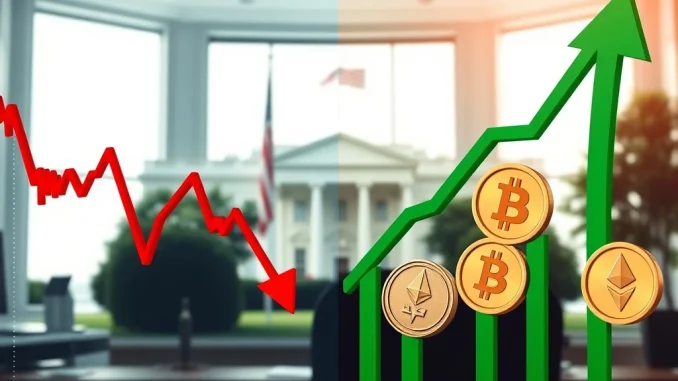
WASHINGTON, D.C., March 18, 2026 — Global financial markets experienced dramatic divergence Monday as oil prices plunged 28% from four-year highs while cryptocurrencies posted significant gains, all triggered by conflicting signals from President Donald Trump regarding the ongoing conflict with Iran. The sudden market movements followed Trump’s contradictory statements within a 24-hour period, first suggesting the war was “very complete” before threatening Iran with “Death, Fire, and Fury” on social media. This geopolitical whiplash sent Brent crude tumbling from $118 to approximately $85 per barrel while Bitcoin reclaimed the $70,000 level and Ethereum stabilized above $2,000, highlighting how digital assets increasingly respond to traditional geopolitical risk factors.
Trump’s Contradictory Statements Create Market Chaos
President Trump’s Monday morning interview with CBS News initially calmed markets when he declared the Iran conflict nearly resolved. “I think the war is very complete, pretty much,” Trump told reporters. “If you look, they have nothing left. There’s nothing left in a military sense.” The U.S. military confirmed striking over 3,000 Iranian targets during the first week of operations. Consequently, oil markets reacted immediately, with the 28% price drop representing the largest single-day decline since the 2020 pandemic crash. However, the relief proved short-lived. On Tuesday morning, Trump posted on Truth Social: “If Iran does anything that stops the flow of oil within the Strait of Hormuz, they will be hit by the United States of America TWENTY TIMES HARDER than they have been hit thus far.” He added, “Additionally, we will take out easily destroyable targets that will make it virtually impossible for Iran to ever be built back, as a Nation, again.”
The conflicting messages continued during a Republican congressional fundraising event in Florida Monday evening. “We’ve already won in many ways, but we haven’t won enough,” Trump told supporters. “We go forward more determined than ever to achieve ultimate victory that will end this long-running danger once and for all.” This pattern of de-escalation followed by escalation rhetoric created what market analysts term “geopolitical whiplash” — rapid shifts between risk-on and risk-off sentiment that particularly affect commodities and alternative assets.
Oil Market Volatility and Cryptocurrency Correlation
The oil price collapse represents more than a simple correction; it signals how geopolitical narratives directly influence global energy markets. According to data from OilPrice.com, the $33 drop from peak to trough occurred within hours of Trump’s initial comments. Meanwhile, cryptocurrency markets demonstrated unexpected resilience, with the total crypto market cap increasing 3.1% over 24 hours. This inverse relationship between oil and crypto during geopolitical uncertainty marks a significant evolution in digital asset behavior. Traditionally, cryptocurrencies followed risk assets downward during Middle East tensions. Now, they appear to function as potential hedges against specific types of geopolitical risk, particularly those affecting traditional energy markets.
- Energy Market Impact: The 28% oil price drop immediately reduced inflationary pressures but threatened energy sector stability
- Crypto Response: Bitcoin’s recovery to $70,000 suggests investors view digital assets as alternatives during commodity volatility
- Market Psychology: Conflicting signals create uncertainty that benefits decentralized assets perceived as outside traditional geopolitical systems
Expert Analysis: Mixed Signals Create Trading Opportunities
Augustine Fan, partner and head of insights at crypto trading software provider SignalPlus, told Cointelegraph that markets struggle to interpret Trump’s contradictory statements. “It’s generally hard to take these headline comments at face value, especially with other members of his cabinet stating that things are still in the beginning phase, and U.S. military assets still deployed in the region,” Fan explained. “Crypto prices will continue to follow other risk assets without a fundamental narrative of their own in the near term, and macro leadership will still be driven by oil, which has seen a +$30 turnaround over just 24 hours.” Fan added that SignalPlus doesn’t “expect the conflict to be resolved any time soon” but anticipates “tradable bounces and BTC to do relatively better as a potential store of value during these times.”
Historical Context and Market Comparison
This episode represents the third major instance since 2024 where presidential communications directly triggered simultaneous commodity and cryptocurrency movements. The pattern demonstrates how digital assets have matured from speculative tech investments to macroeconomic instruments responsive to geopolitical developments. The table below compares recent geopolitical events and their market impacts:
| Event Date | Geopolitical Trigger | Oil Price Change | Bitcoin Price Change |
|---|---|---|---|
| March 2026 | Trump’s mixed Iran signals | -28% | +4.2% |
| November 2025 | Taiwan Strait tensions | +12% | -8.5% |
| July 2024 | Russia-Ukraine ceasefire collapse | +18% | -12.3% |
The divergent response in March 2026 suggests cryptocurrency markets may be developing more sophisticated reaction patterns to geopolitical events rather than simply mirroring traditional risk assets. This evolution coincides with increasing institutional cryptocurrency adoption and the development of more complex trading strategies that account for geopolitical risk factors.
Forward Outlook: Prolonged Uncertainty Expected
Market analysts anticipate continued volatility as the Iran situation develops. Andri Fauzan Adziima, research lead at cryptocurrency exchange Bitrue, provided Cointelegraph with a nuanced perspective. “If Trump’s claim that the Iran war is almost over proves accurate, I’m expecting a strong relief rally in crypto, driven by plunging oil prices, eased inflation/geopolitical fears, and renewed risk appetite,” Adziima stated. However, he cautioned that “doubts persist amid mixed signals from Iran and potential for prolonged uncertainty.” Indeed, Iran’s Revolutionary Guard responded to Trump’s statements by calling them “nonsense” and asserting “we are the ones that will determine the end of the war.” This diplomatic stalemate suggests markets face extended periods of uncertainty regardless of presidential rhetoric.
Industry and Political Reactions
The energy sector expressed immediate concern about price stability. Major oil companies began revising quarterly forecasts within hours of the price drop. Meanwhile, cryptocurrency communities debated whether the positive price action represented a fundamental shift or temporary anomaly. On Capitol Hill, lawmakers from both parties questioned the administration’s communication strategy. Senator Elizabeth Warren (D-MA) stated, “Wild swings in energy prices caused by contradictory statements hurt American consumers and businesses.” Representative Patrick McHenry (R-NC), chair of the House Financial Services Committee, noted that “cryptocurrency market responses to geopolitical events demonstrate these assets’ growing integration into global finance.”
Conclusion
The dramatic market movements following President Trump’s contradictory Iran statements reveal several critical developments in global finance. First, cryptocurrency markets now respond to geopolitical events with increasing sophistication, sometimes diverging from traditional risk assets. Second, presidential communications directly impact commodity prices with unprecedented speed and magnitude in the digital information age. Third, the inverse relationship between oil and crypto during this episode suggests investors may be reevaluating digital assets as potential hedges against specific geopolitical risks. As the Iran situation continues to evolve, markets will likely remain volatile, responding to both military developments and diplomatic communications. Investors should monitor not only battlefield reports but also official statements and social media posts from key political figures, as these increasingly drive financial market movements in interconnected global markets.
Frequently Asked Questions
Q1: Why did oil prices drop 28% after Trump’s statements?
Oil prices plummeted because Trump initially suggested the Iran conflict was nearly resolved, reducing fears of supply disruptions. Markets anticipated decreased geopolitical risk premium, which had pushed prices to four-year highs. The 28% drop represents the removal of that risk premium plus normal market correction.
Q2: How did cryptocurrency markets react differently this time compared to past geopolitical events?
Unlike previous Middle East tensions that caused crypto selloffs, this event saw Bitcoin gain 4.2% while oil collapsed. This suggests investors may view cryptocurrencies as potential hedges against specific geopolitical risks affecting traditional energy markets, representing an evolution in digital asset market behavior.
Q3: What happens next with Iran and market impacts?
Analysts expect prolonged uncertainty as Iran rejects Trump’s characterization of the conflict. Markets will likely remain volatile, responding to both military developments and diplomatic communications. The key watch points are Strait of Hormuz shipping activity, further U.S. military actions, and Iran’s responses to Trump’s threats.
Q4: Should ordinary investors worry about these market movements?
Retail investors should maintain diversified portfolios rather than reacting to daily geopolitical news. While dramatic, these movements primarily affect short-term traders. Long-term investors should focus on fundamental factors rather than geopolitical headlines that often produce temporary volatility.
Q5: How does this affect global inflation and interest rates?
The oil price drop reduces immediate inflationary pressures, potentially allowing central banks more flexibility with interest rate policies. However, if the conflict escalates and oil prices rebound, inflation concerns could return quickly. Central bankers will monitor the situation closely before making policy decisions.
Q6: What does this mean for cryptocurrency adoption by traditional institutions?
The divergent crypto response demonstrates sophisticated market behavior that institutional investors monitor. If cryptocurrencies continue showing unique correlation patterns during geopolitical events, more institutions may allocate to digital assets as portfolio diversifiers, potentially accelerating mainstream adoption.