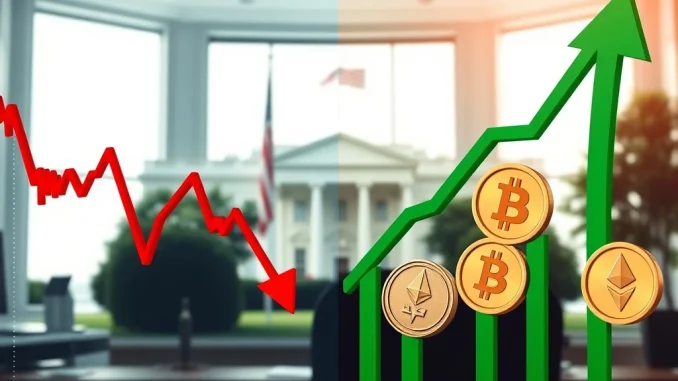
WASHINGTON, D.C. — March 25, 2026: Global markets experienced dramatic volatility Monday as conflicting statements from President Donald Trump about the Iran conflict sent oil prices tumbling 28% while cryptocurrencies posted significant gains. The sudden shift followed Trump’s morning declaration that the war was “very complete, pretty much” during a CBS News interview, only to be contradicted hours later by aggressive social media posts threatening “Death, Fire, and Fury” against Iran. This geopolitical whiplash triggered immediate reactions across financial markets, with Brent crude oil falling from a four-year high of $118 to approximately $85 within hours, while Bitcoin reclaimed the $70,000 level for the first time in weeks.
Trump’s Contradictory Statements Create Market Chaos
President Trump’s Monday morning interview with CBS News created immediate market optimism about de-escalation in the Persian Gulf. “I think the war is very complete, pretty much,” Trump told reporters. “If you look, they have nothing left. There’s nothing left in a military sense.” The U.S. military had reported striking over 3,000 Iranian targets during the first week of operations, according to Pentagon briefings. Market analysts at OilPrice.com documented the rapid 28% decline in oil prices following these comments, representing one of the most significant single-day drops since the 2020 pandemic collapse.
However, the relief proved short-lived. By Tuesday morning, Trump posted on his Truth Social platform with dramatically different rhetoric: “If Iran does anything that stops the flow of oil within the Strait of Hormuz, they will be hit by the United States of America TWENTY TIMES HARDER than they have been hit thus far.” He added, “Additionally, we will take out easily destroyable targets that will make it virtually impossible for Iran to ever be built back, as a Nation, again.” This escalation followed comments at a Florida fundraising event where Trump stated, “We’ve already won in many ways, but we haven’t won enough. We go forward more determined than ever to achieve ultimate victory.”
Dual Market Impact: Oil Collapse Meets Crypto Resilience
The conflicting signals created a bifurcated market response that experts say reveals deeper structural shifts in how different asset classes respond to geopolitical risk. Oil markets reacted with extreme sensitivity to any suggestion of de-escalation, given the Strait of Hormuz handles approximately 20% of global oil consumption. Meanwhile, cryptocurrency markets demonstrated what analysts call “asymmetric resilience”—responding positively to risk-off sentiment in traditional markets while maintaining stability during uncertainty.
- Oil Market Shock: The $33 price swing represented the largest single-day percentage decline since April 2020, wiping billions from energy company valuations and triggering margin calls across commodities exchanges.
- Crypto Recovery: Bitcoin gained 3.1% over 24 hours to reclaim $70,000, while Ethereum stabilized above $2,000. The broader crypto market cap increased by approximately $45 billion during the same period.
- Traditional Safe Havens: Gold showed muted response, gaining only 0.8%, while the U.S. dollar index remained flat—suggesting investors viewed the situation as contained rather than systemic.
Expert Analysis: Mixed Signals Reflect Strategic Ambiguity
Augustine Fan, partner and head of insights at crypto trading software provider SignalPlus, told Cointelegraph that market participants struggle to interpret the administration’s messaging. “It’s generally hard to take these headline statements at face value,” Fan explained. “Other members of his cabinet have stated that things are still in the beginning phase, and U.S. military assets remain deployed in the region.” Fan emphasized that cryptocurrency prices continue to follow other risk assets without establishing a fundamental narrative of their own in the near term.
Energy analyst Karim Kobeissi, whose Kobeissi Letter first documented the oil price collapse, noted the unprecedented speed of the decline. “We haven’t seen this magnitude of move in such a compressed timeframe since the COVID crash,” Kobeissi stated. “The market is pricing in both the potential for resolution and the risk of further escalation simultaneously, creating extraordinary volatility.”
Historical Context: Geopolitical Risk and Digital Assets
This event represents the latest chapter in cryptocurrency’s evolving relationship with geopolitical instability. Unlike previous crises where digital assets correlated strongly with traditional risk-off movements, the current response suggests maturing market dynamics. The table below compares market responses to three major geopolitical events since 2022:
| Event | Oil Price Change | Bitcoin Change | Gold Change |
|---|---|---|---|
| Russia-Ukraine Invasion (2022) | +42% (1 week) | -12% (1 week) | +8% (1 week) |
| Israel-Hamas Conflict (2023) | +18% (3 days) | +5% (3 days) | +3% (3 days) |
| Trump Iran Statements (2026) | -28% (1 day) | +3.1% (1 day) | +0.8% (1 day) |
Andri Fauzan Adziima, research lead at cryptocurrency exchange Bitrue, provided additional perspective: “If Trump’s claim that the Iran war is almost over proves accurate, I’m expecting a strong relief rally in crypto, driven by plunging oil prices, eased inflation fears, and renewed risk appetite.” However, Adziima cautioned that “doubts persist amid mixed signals from Iran and potential for prolonged uncertainty.” Iranian Revolutionary Guard officials reportedly dismissed Trump’s statements as “nonsense,” asserting that “we are the ones that will determine the end of the war.”
Forward Outlook: Volatility as the New Normal
Market participants now brace for continued volatility as the situation develops. The White House has scheduled a press briefing for Wednesday morning, where officials are expected to provide clarification on U.S. policy toward Iran. Meanwhile, OPEC+ has called an emergency meeting to discuss production adjustments in response to the price collapse. Energy analysts predict that unless clear resolution emerges, oil prices could experience continued whipsaw action between $80 and $100 per barrel in coming weeks.
Cryptocurrency Market Positioning for Uncertainty
Crypto traders appear positioned for multiple scenarios. Options market data shows increased demand for both upside calls and downside puts on Bitcoin, suggesting expectations for significant movement in either direction. “We don’t expect the conflict to be resolved any time soon,” SignalPlus’s Fan noted. “We would expect tradable bounces and BTC to do relatively better as a potential store of value during these times.” This sentiment reflects growing perception of Bitcoin as a geopolitical hedge, particularly among investors in regions directly affected by the conflict.
Conclusion
The dramatic market movements following President Trump’s contradictory statements highlight the fragile equilibrium in global energy markets and cryptocurrency’s evolving role during geopolitical crises. Oil’s 28% collapse demonstrates the extreme sensitivity of traditional commodities to Middle Eastern stability, while Bitcoin’s recovery above $70,000 suggests digital assets may be developing differentiated response patterns to geopolitical risk. As conflicting signals continue from Washington and Tehran, investors face a landscape where rapid position adjustments become necessary. The coming days will test whether cryptocurrency markets can maintain their relative stability or succumb to the volatility engulfing traditional assets. Market participants should monitor White House communications, Iranian responses, and technical support levels across all asset classes for clues about the next phase of this unfolding situation.
Frequently Asked Questions
Q1: Why did oil prices drop so dramatically after Trump’s statements?
Oil prices fell 28% because markets interpreted Trump’s initial comments as signaling potential de-escalation in Iran. Since the Strait of Hormuz handles 20% of global oil shipments, any reduction in conflict risk immediately affects pricing. The speed of the decline also reflected algorithmic trading and margin call cascades.
Q2: How are cryptocurrency markets responding differently than in past geopolitical crises?
Unlike during the 2022 Russia-Ukraine invasion when Bitcoin fell 12%, current movements show positive correlation with de-escalation signals. This suggests maturing market dynamics where crypto acts as both risk asset and potential hedge, depending on the specific nature of the geopolitical event.
Q3: What happens next with U.S.-Iran relations according to experts?
Analysts expect continued volatility as conflicting signals persist. The White House has scheduled a Wednesday briefing for clarification, while Iran’s Revolutionary Guard maintains they control conflict timelines. Most experts predict prolonged uncertainty rather than immediate resolution.
Q4: Should retail investors adjust their portfolios based on these developments?
Financial advisors recommend against reactive trading to geopolitical headlines. Instead, they suggest maintaining diversified portfolios with appropriate risk allocations. Those with concentrated energy or crypto positions might consider rebalancing to manage volatility exposure.
Q5: How does this situation compare to previous Middle East conflicts affecting markets?
The current volatility exceeds most recent conflicts in speed though not necessarily magnitude. The 1990 Gulf War saw oil spike 130% then collapse; the 2019 Saudi refinery attacks caused 20% single-day jumps. This event’s unique aspect is cryptocurrency’s simultaneous positive response.
Q6: What specific indicators should traders watch in coming days?
Key indicators include: U.S. military deployment changes, Iranian statements about Strait of Hormuz transit, OPEC+ production decisions, Bitcoin’s ability to hold $70,000, and oil’s technical support around $80. Also monitor Treasury yields and dollar strength for broader risk sentiment.